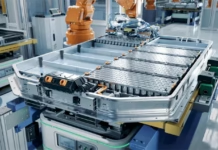

Donut Lab releases impressive independent test results for its solid state Donut Battery. The Technology Research Centre VTT conducted these evaluations, focusing sharply on charging speed and thermal performance under tough conditions. Instead of relying on active cooling systems, testers allowed the cell’s temperature to rise freely during high-power charges, which closely mirrors demanding real-world electric vehicle scenarios. These findings validate the company’s bold claim of a 5-minute full charge, even when pushing the battery to extreme limits. Manufacturers now anticipate simpler, lighter battery packs, while drivers look forward to refueling times that rival gas stations. This breakthrough positions solid state technology as a game-changer in the EV race.
Test Setup Reveals Practical Strength
Researchers designed the experiment with two passive cooling configurations to test real-world viability. In one setup, they positioned the cell between two lightly compressed aluminum plates; in the other, they attached it to just a single bottom plate for minimal thermal support. They measured charging speed using C-rates, where 1C fully charges the battery in one hour, 5C takes about 12 minutes, and 11C achieves it in roughly 5-6 minutes. Traditional lithium-ion batteries typically operate at 1C to 3C and require complex liquid cooling to avoid overheating. Donut Battery, however, handled much higher rates without such aids, starting with a standard 1C discharge test before escalating to rapid 5C and 11C charges. This rigorous approach demonstrates the cell’s robustness for everyday automotive use.
5C Charging Delivers Reliable Performance
At the 5C rate, the battery cell sustained charging for more than nine minutes, reaching 80% capacity in approximately 9.5 minutes and a full 100% in just over 12 minutes. When testers discharged it afterward, the cell delivered 100% of the charged capacity, showing no immediate losses from the fast charge. Heat levels rose moderately but stayed within safe bounds thanks to the passive cooling plates. This performance far outpaces conventional rivals, which often struggle with heat buildup at lower speeds. For EV drivers, such results mean significantly shorter stops at chargers, making electric mobility feel more convenient and practical.
11C Rate Sets Ultra-Fast Benchmarks
Pushing further, the team charged at an extreme 11C rate, achieving 0-80% state of charge in a stunning 4.5 minutes and full capacity in just over seven minutes. Post-charge discharge tests recovered 98.4% to 99.6% of the energy, proving excellent short-term stability under brutal conditions. Unlike many solid state competitors that swell 15-20% during cycles and demand heavy compression, the Donut Battery maintains its structure with minimal volume change. This stability simplifies integration into vehicle packs. Engineers can now design more compact systems that deliver higher power without added mechanical complexity.
Simplified Packs Drive Cost Efficiency
The Donut Battery’s design eliminates the need for high-pressure clamping or elaborate cooling, which cuts weight, cost, and manufacturing hurdles. CTO Ville Piippo emphasizes that this approach yields packs with superior energy and power density compared to traditional lithium-ion setups burdened by pumps and hoses. Passive cooling proves sufficient even at peak rates, freeing designers to prioritize performance over thermal infrastructure. As a result, automakers like Tesla or BYD could scale production faster while offering vehicles with longer ranges and quicker acceleration. These advantages make the technology attractive for both consumer cars and commercial fleets.
Lithium-Ion Lags in Speed and Simplicity
Current lithium-ion EVs often take 20-30 minutes for a 10-80% charge, relying on sophisticated liquid systems to manage heat and prevent degradation. Donut Battery slashes that to 4.5 minutes for 0-80% with far less oversight, retaining nearly full capacity right after. This edge reduces range anxiety and aligns EV charging with the speed of gas pumps. Moreover, by avoiding common solid state pitfalls like dendrite growth or thermal runaway, it enhances safety for passengers and insurers alike. As infrastructure expands with mega-chargers along highways, adoption accelerates dramatically.
Thermal Stability Boosts Versatility
Passive cooling handled heat spikes effectively, ensuring the cell operated reliably without fans or fluids, which suits diverse climates from scorching deserts to freezing winters. This reliability extends to high-use scenarios like delivery trucks or ride-sharing fleets that charge multiple times daily. Energy grids benefit too, as stable batteries support peak loads without strain. Consequently, Donut Lab’s results build strong confidence among stakeholders pushing for widespread electrification.
Future Tests Pave Adoption Path
While these initial findings thrill, upcoming evaluations will scrutinize long-term cycle life, aging effects, and pack-level behavior under real driving patterns. Abuse tests and wide-temperature performance data will further solidify its credentials. VTT’s independent stamp adds vital credibility, drawing interest from global manufacturers. With markets hungry for faster, safer storage, Donut Battery stands poised to reshape electric transport.