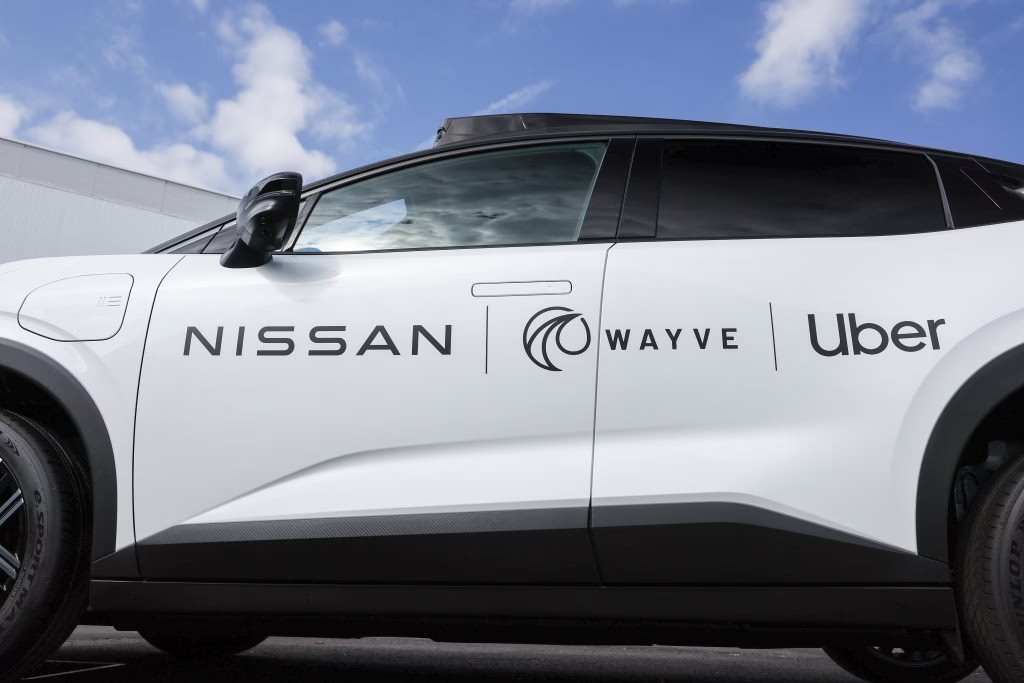

This collaboration marks a major step toward scalable urban robotaxis. Wayve, Uber, and Nissan signed a memorandum of understanding to co‑develop self‑driving robotaxi services in Tokyo. The pilot will run on Uber’s app and use Nissan LEAFs equipped with Wayve’s AI Driver software. Riders will access robotaxis through the existing Uber network, starting with a safety‑operator‑assisted phase. This approach aligns with global pushes to commercialize Level 4 autonomy in complex cities.
Strategic Partnership and Timeline
Uber’s deal with Wayve and Nissan is its first autonomous‑vehicle partnership in Japan. The trio plan a Tokyo robotaxi pilot deployment by late 2026, subject to regulatory approval. Nissan will integrate Wayve’s AI Driver into the LEAF platform, which then connects to Uber’s marketplace. Uber will use a licensed taxi operator to run the service and comply with local rules. This structure mirrors Uber’s earlier announcement to launch robotaxis in London during 2026, signaling a broader global rollout.
Wayve’s AI Driver is designed to scale across markets without high‑definition HD maps. Instead, the system learns from real‑world driving data and generalizes across new roads. The company has tested this technology in Japan since early 2025, gaining experience in dense, narrow‑street environments. Those tests help build a safety‑first foundation for Tokyo’s unusually complex traffic patterns. Later this year, these validated models will underpin the first commercial robotaxi rides on Uber’s network.
Technology Behind the Robotaxi Service
Wayve’s AI Driver uses an end‑to‑end neural‑network architecture trained on vast real‑world datasets. The software processes camera and sensor data to make decisions at the driving level, rather than relying on pre‑built high‑definition maps. This design allows faster deployment in new cities and more flexible adaptation to changing road layouts. In Tokyo, that adaptability is crucial for handling narrow lanes, tight intersections, and dense pedestrian flows.
The Nissan LEAF serves as the base vehicle, combining proven electric performance with new autonomous hardware. Wayve’s stack integrates with the car’s control systems to enable hands‑off driving under defined conditions. Uber’s platform then matches these robotaxis with riders, handing trip assignment, payment, and customer support. The combination of Wayve’s AI, Nissan’s EV platform, and Uber’s network creates a vertically integrated mobility solution.
During the initial phase, each LEAF will carry a trained safety operator behind the wheel. This operator monitors the AI system and can intervene if needed, which helps build trust and gather real‑world data. Yet riders can still experience fully automated driving on approved routes, giving them a preview of driverless mobility. Feedback from this pilot will feed back into Wayve’s models, accelerating learning and improving safety over time.
Tokyo’s Unique Urban and Regulatory Context
Tokyo presents one of the most challenging environments for autonomous driving. The city features dense traffic, narrow streets, frequent lane‑weaving, and complex multi‑lane intersections. At the same time, Japanese authorities enforce high safety and reliability standards for any commercial autonomous service. Deploying robotaxis here therefore acts as a stress test for the Wayve AI Driver’s generalization capabilities. Success in Tokyo can accelerate expansion into other tightly packed Asian cities.
Uber has emphasized that this initiative supports Japan’s long‑term mobility needs. Driver shortages in the taxi and delivery sectors are already a concern, and robotaxis could help offset those gaps. Moreover, electrified autonomous fleets can reduce congestion and emissions in packed urban centers. By working with local taxi operators and regulators, Uber aims to align the robotaxi rollout with Japan’s own safety and social‑policy goals. This collaborative model may become a template for future AV deployments in regulated markets.
Wayve and Nissan also highlight “mobility intelligence” as a core theme. Their vision is to embed AI into everyday vehicles, not just robotaxis. Lessons from the Tokyo pilot will feed back into Nissan’s broader consumer‑car lineup, improving advanced driver‑assistance features. In parallel, Wayve continues to scale its AI Driver across Europe and North America, using data from multiple cities. Tokyo thus becomes both a showcase for cutting‑edge autonomy and a learning hub for global AV systems.
Global Robotaxi Strategy
The Tokyo pilot is part of a wider plan to launch Wayve‑powered robotaxis across more than ten cities worldwide. London remains a key early market, with Uber already confirming 2026 trials using L4‑capable vehicles. Wayve will deploy its AI Driver into these fleets, while Uber owns and operates the cars. The same basic architecture—Wayve’s software, OEM hardware, and Uber’s platform—will underpin services in Tokyo, London, and later cities. This standardized stack lowers integration costs and speeds up geographic scaling.
Recent funding rounds, such as Wayve’s recent $1.5 billion raise, are helping to scale this global autonomy platform. That capital supports software development, safety validation, and regulatory engagement in multiple regions. Uber, for its part, is expanding beyond ridesharing into autonomous mobility and delivery. Partnerships with firms like Wayve and Baidu position it as a central orchestrator of robotaxi ecosystems, rather than just a marketplace. Such alliances could eventually lower per‑ride costs and improve fleet utilization.
Looking ahead, the Tokyo pilot may help define how robotaxis coexist with human‑driven taxis and private cars. Policy questions around safety‑case validation, data‑sharing, and liability will remain central. However, the combination of Wayve’s map‑free AI, Nissan’s electric vehicles, and Uber’s global platform offers a practical path toward safer, more efficient urban transport. If Tokyo’s late‑2026 trial succeeds, it could accelerate similar deployments in other megacities and reshape the future of ride‑hailing.