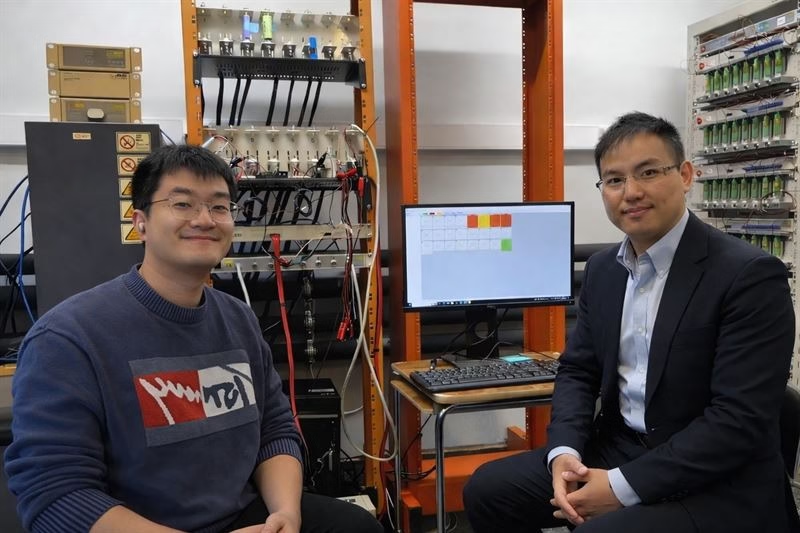

Researchers at Chalmers University created a new smart charging method. This AI breakthrough technology extends electric vehicle battery life by twenty-three percent. The system works without increasing the time spent at charging stations.
Engineers currently face many challenges with rapid energy transfer for cars. Fast charging often causes significant wear on internal lithium-ion components. This new AI system solves the problem of long-term battery life degradation.
It monitors the state of health during every single charging session. Modern vehicles usually lose capacity after several hundred full charge cycles. The Chalmers team managed to push these limits using advanced algorithms.
Their method focuses on reducing the stress placed on battery cells. Charging remains fast while the internal structure stays safe and cool. Drivers will benefit from vehicles that last much longer than before.
Furthermore, this solution relies on smart software rather than new hardware. The research demonstrates a major shift in how we manage electricity. Automakers can now improve performance through simple digital system updates.
This innovation helps maintain high capacity for more than seven hundred cycles. The team proved their results through extensive testing and simulation environments. Additionally, the new strategy reduces the environmental impact of electric transport.
This approach ensures that batteries remain efficient for a longer duration.
The Role of Reinforcement Learning in Battery Health
The core of this technology is a method called reinforcement learning. This type of machine learning interacts with the battery environment directly. The algorithm learns the best ways to deliver power to the cells.
It receives rewards for maintaining health and keeping charging times short. Standard methods use a rigid profile for every single charging event. In contrast, this AI system adapts to the unique health status.
The researchers link the cut-off voltage to the current health level. Therefore, the charging profile changes as the battery becomes much older. This flexibility supported by AI prevents the harmful mechanisms that usually destroy battery life.
Specifically, the AI avoids the lithium plating that occurs during charging. The algorithm finds a perfect balance between speed and long-term durability. Most systems today follow a simple constant current and voltage path.
However, these standard paths do not account for individual cell aging. The AI understands the physics of the battery through continuous data monitoring. It adjusts the current flow to protect the delicate internal chemistry.
Consequently, the system provides a customized experience for every vehicle unit. This intelligent approach represents a massive leap for the automotive industry. Future batteries will use these smart profiles to maximize their total output.
Thus, machine learning transforms basic hardware into a highly dynamic system.
Key Benefits
- Boosts cycle life 23 percent without charge delays.
- Prevents lithium plating in aged and cold batteries.
- Adapts currents to state of health precisely always.
- Enables software updates, no hardware changes needed.
- Lowers warranty costs and material usage rates.
- Supports fast charging for taxis and daily drivers.
Structural Cooling and the Integration of Smart Software
CATL recently introduced the Qilin battery with advanced structural integration features. This third-generation technology achieves a record volume utilization of seventy-two percent. The Qilin system uses a multifunctional interlayer for cooling and expansion.
This layer acts as a buffer as cells expand during use. Smart AI charging systems must account for these complex physical changes. The Chalmers research provides a way to map health to voltage.
This data helps systems like the Qilin battery operate more safely. The CATL design increases the cooling surface area by four times. Effective cooling allows for faster charging without immediate damage to cells.
However, thermal management alone cannot stop all forms of chemical wear. Combining high-tech cooling with AI logic offers the best possible protection. The Qilin battery supports a range of over one thousand kilometers.
Maintaining this range over many years requires very sophisticated management software. AI helps predict how the elastic interlayer responds to various currents. This cooperation between physical design and digital intelligence is essential now.
Moreover, CATL continues to explore new materials like sodium-ion for batteries. Every new chemistry will require a tailored AI charging strategy anyway. Engineers aim to optimize every component within the large battery pack.
These structural improvements pave the way for faster and safer energy storage.
Global Trends in Automotive Software and Digital Management
LG Energy Solution focuses on building a total energy software ecosystem. They recently joined the SDVerse marketplace for advanced automotive software tools. LG aims to provide optimized batteries through global technology leadership programs.
Their management systems track data points from active materials to products. Similarly, Northvolt uses a massive data network to improve battery quality. These companies recognize that software is the key to battery longevity.
Northvolt collects data from their factories to minimize waste and errors. They also monitor batteries in use to refine their future designs. The AI method from Chalmers fits perfectly into these digital frameworks.
Software updates can implement these new algorithms without changing car parts. This capability allows manufacturers to improve older cars on the road. Legacy vehicles could receive a twenty percent boost in battery life.
Furthermore, these updates reduce the need for mining raw battery materials. Efficient use of existing resources is a core goal for Northvolt. LG Energy Solution also promotes sustainable practices through smart power management.
The industry is moving toward a future defined by intelligent systems. Digital twins and AI models will soon manage every battery cell. Therefore, software engineering has become just as important as chemical research.
The connected battery ecosystem will support a much cleaner global environment.
Long-Term Benefits of AI for Sustainable Electric Mobility
Samsung SDI uses deep learning to test the quality of batteries. Their PRiMX brand stands for prime battery for the maximum experience. Samsung focuses on absolute quality and high performance for all users. Their super-fast charging technology minimizes the transport distance of ions. The Chalmers AI study supports these goals by refining the charging path.
Increased longevity means fewer batteries end up in the waste stream. Lower costs for consumers make electric vehicles more accessible to everyone. Researchers identify several key advantages of these new AI charging strategies.
Firstly, they provide extended lifespan for standard lithium-ion cell types. Secondly, car owners spend no additional time waiting at charging stations. Thirdly, vehicle manufacturers face a reduced risk of expensive warranty claims.
Fourthly, the systems improve sustainability through efficient use of raw materials. Lastly, software-based implementation works effectively with existing hardware units. These points highlight why the Chalmers discovery is so very important.
Researchers will next test these controllers on physical battery units directly. The transition to full electrification depends on such smart technical advances. Global researchers continue to innovate to make sustainable travel a reality.
Soon, every electric car might use AI to protect its valuable battery.
Sources: Chalmers University of Technology