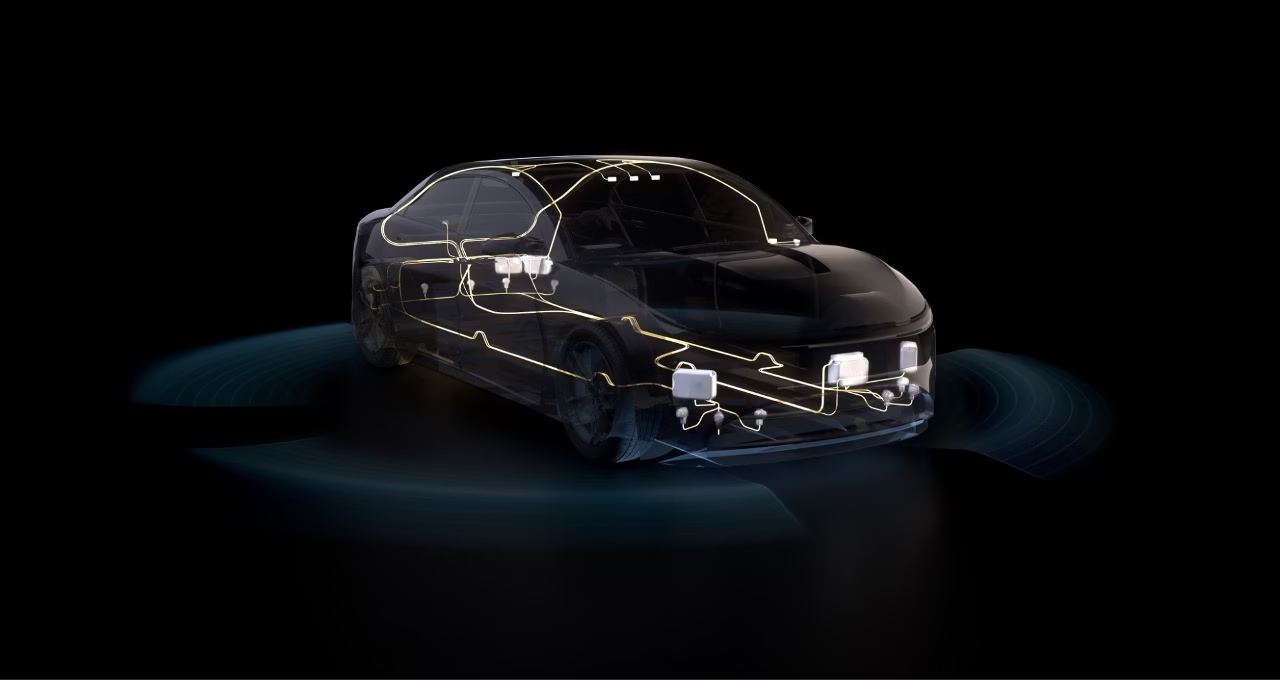

Nvidia announced major partnerships at GTC 2026. They team up with BYD, Geely, Hyundai, Isuzu, Nissan, and Uber. This move boosts Level 4 autonomous driving tech. Nvidia The Drive Hyperion platform powers these efforts. Companies now develop advanced driver assistance systems together. Moreover, Nvidia’s CEO Jensen Huang calls it the “ChatGPT moment” for self-driving cars. These deals speed up robotaxi and AV deployment.
Drive Hyperion: Core Technology Explained
Drive Hyperion serves as Nvidia ‘s flagship platform. It integrates chips, sensors, and software for AVs. Specifically, it uses dual DRIVE AGX Thor SoCs. These deliver over 2,000 FP4 TFLOPS for real-time sensor fusion. Thus, vehicles handle 360-degree views safely. The platform supports Level 4 autonomy in defined areas. No human intervention needed there. Additionally, it ensures ISO 26262 ASIL-D safety certification.
Key Automaker Partnerships and Strategies
BYD adopts Hyperion for upcoming Level 4 models. They already use Nvidia chips in current EVs. Geely integrates Thor chips into Zeekr vehicles. Interestingly, Geely supplies Zeekr to Waymo for US robotaxis. Hyundai builds on its Motional robotaxi work with Nvidia GPUs. Nissan and Isuzu target L4 systems too. For example, Isuzu collaborates with TIER IV for autonomous buses. These partnerships create a robust ecosystem.
Uber’s Role in Robotaxi Scaling
Uber joins to scale global Level 4 fleets. They plan 100,000 vehicles starting 2027. Deployments begin in Los Angeles and San Francisco. Nvidia’s Cosmos platform builds their AI data factory. This supports ride-hailing networks with robot drivers. Furthermore, Uber partners with OEMs for Hyperion-ready cars. Such moves accelerate commercial AV services worldwide.
These alliances push autonomous EV adoption faster. Chinese firms like BYD and Geely gain edge in L4 tech. Meanwhile, Japanese and Korean players strengthen portfolios. Uber’s expansion challenges rivals like Waymo. Overall, Nvidia dominates AV compute market. Experts predict wider robotaxi use by 2028. However, regulatory hurdles remain key. Still, GTC 2026 signals rapid progress ahead.
Nvidia’s strategy enriches the EV landscape deeply. Drive Hyperion now equips diverse fleets from buses to robotaxis. Partners leverage Nvidia’s AI prowess effectively. This fosters innovation across continents. Consequently, consumers expect safer, smarter drives soon. The ecosystem grows with more sensor and software integrations. In addition, safety programs like Halos build trust. These steps transform mobility fundamentally.