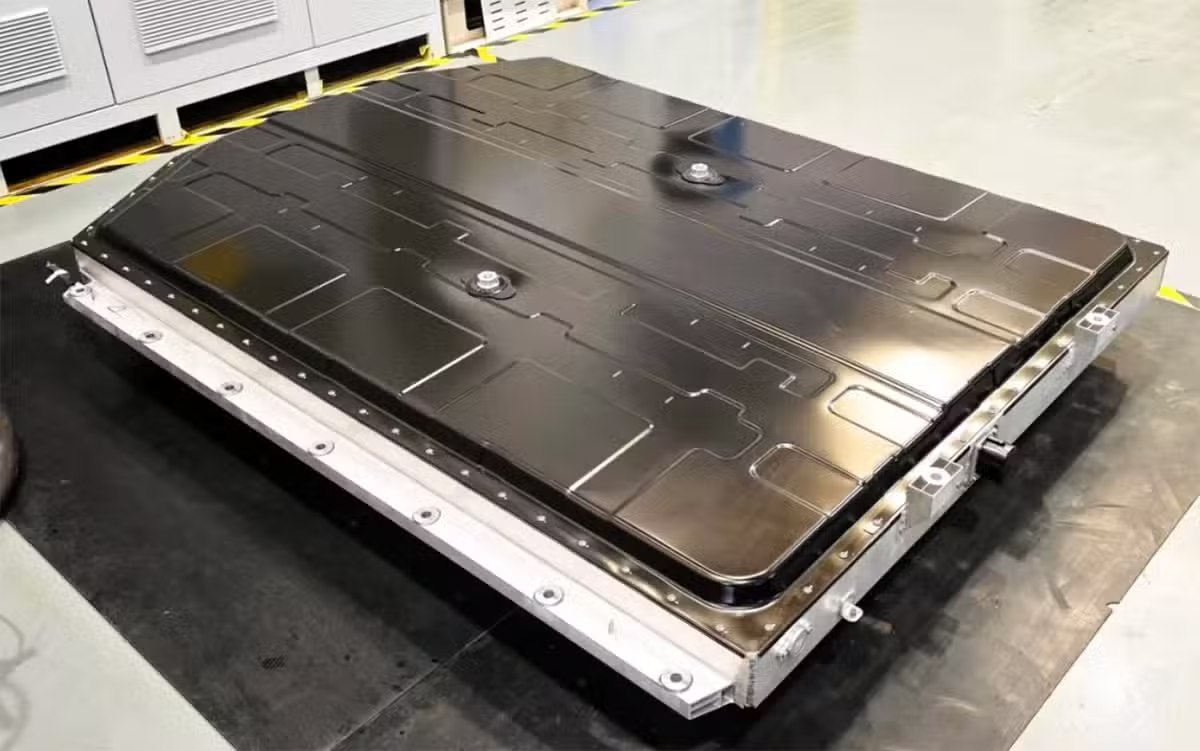

BAIC Group unveiled its sodium-ion battery prototype recently. This marks a key step in next-generation power tech. Now, its Aurora Battery platform covers lithium-ion, solid-state, and sodium-ion routes. Engineers designed it for diverse EV scenarios. Moreover, the prismatic cell hits over 170 Wh/kg energy density. This level places it among industry leaders. For instance, it supports 4C fast charging. Thus, users recharge fully in about 11 minutes. Additionally, it thrives in harsh conditions. The battery operates steadily from -40°C to 60°C. Even at -20°C, it retains over 92% energy output. These features address common EV pain points effectively.
Superior Safety and Performance in Extreme Tests
Safety stands out in BAIC’s sodium-ion battery. It passed rigorous tests without fire or explosion. Tests included overcharging, heating, and mechanical impacts. Indeed, results exceed China’s national standards. Furthermore, the team finalized prototype design. They also set up mass production for prismatic cells. BAIC applied for about 20 patents too. These cover materials, electrolytes, and integration. Consequently, this strengthens their tech edge. Compared to lithium-ion batteries, sodium-ion offers better stability. It reduces overheating risks significantly. For example, sodium chemistry handles full discharge safely. This boosts usable capacity overall.
Sodium-ion batteries excel in cold weather too. Lithium cells often falter there. However, sodium versions maintain performance. Transitioning to commercialization accelerates now. BAIC joins China’s fierce battery race actively.
China’s Sodium-Ion Race Heats Up with CATL and BYD
CATL leads the pack in sodium-ion commercialization. Last month, they unveiled a passenger EV with partner Changan. This model uses CATL Naxtra battery. It achieves 175 Wh/kg density, matching LFP levels. Production starts mid-2026. The Naxtra passed strict GB 38031-2025 safety tests. These cover thermal diffusion and fast-charging cycles. Notably, it works at -40°C with 90% capacity. Plus, it offers 5C peak charging for 500 km range. Lifespan exceeds 10,000 cycles too. Therefore, costs drop to half of lithium-ion.
BYD advances rapidly as well. Last month, they entered third-generation sodium-ion development. It reaches 10,000 cycle life maximum. This suits energy storage perfectly. Meanwhile, market forecasts predict growth. The global sodium-ion battery market hits $914 million by 2030. It grows at 16.3% CAGR from 2024. Abundant sodium drives lower costs. Thus, EVs become more accessible worldwide.
Advantages of Sodium-Ion Over Lithium-Ion Batteries
Sodium-ion batteries bring clear edges. First, they charge faster than lithium-ion. Second, they perform better in extreme cold and heat. For example, energy density ranges 160-200 Wh/kg now. Safety improves with less fire risk. Cycle life improves steadily too. However, lithium-ion holds higher density at 250+ Wh/kg. Still, sodium costs less per kWh. Sodium resources abound everywhere. This cuts supply chain worries. Cobalt and lithium shortages fade away. As a result, manufacturers scale production easier.
In EVs, these traits matter most. Cold climates challenge lithium packs. Sodium-ion delivers reliable power there. Fast charging suits daily use. Moreover, stability prevents thermal runaway. Industry shifts to dual chemistry. Sodium complements lithium for varied needs.
Path to Mass Production and Broader Applications
BAIC readies for mass production next. Their patents secure key innovations. Similarly, CATL deploys Naxtra in swap models. Changan’s EV launches soon. BYD targets long-life sectors. Analysts call 2026 a turning point. Large-scale use begins in vehicles and storage. Renewables like solar need affordable storage. Sodium-ion fits perfectly. Costs drop further with scale. Thus, EV adoption speeds up globally.
Extreme performance opens new doors. Trucks and buses benefit from cold tolerance. Energy grids gain reliable backups too.
Sodium-Ion Future in Electric Vehicles
China dominates sodium-ion battery progress. BAIC, CATL, and BYD push boundaries. Commercial models arrive mid-2026. Energy density nears LFP standards. Fast charging and safety lead advantages. However, cycle life needs more gains. Market expands rapidly for clean energy. EVs get cheaper and tougher. Therefore, global shift accelerates. Users enjoy longer range in any weather. Battery tech evolves fast. Sodium-ion reshapes the EV industry for good.