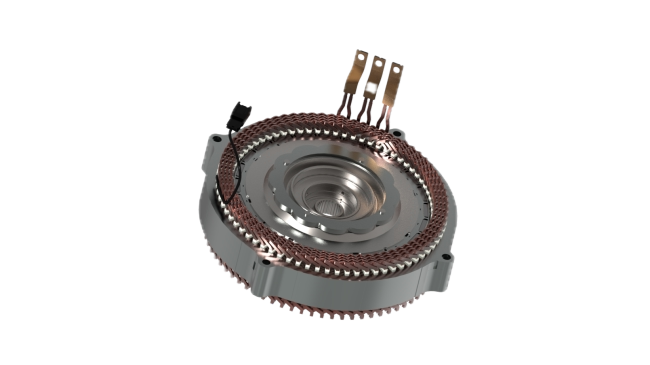

BorgWarner has secured several new eMotor business awards in China. The announcements cover battery-electric, hybrid, and range-extended vehicle programs. They also mark the first market introduction of BorgWarner’s aluminum-wire eMotor technology.
The company will supply motor components to Chinese OEMs and an electric drive system supplier. Production is expected to begin between 2027 and 2028 for most awarded programs. However, the aluminum-wire program is scheduled to enter production in the fourth quarter of 2026.
Products Covered by the Awards
BorgWarner’s latest contracts focus on stator and rotor assemblies rather than complete packaged motors. This approach gives vehicle makers flexibility to integrate the technology into their own electric drive systems.
The new business includes three major technology areas:
- High-voltage hairpin P1 eMotor assemblies for a range-extended vehicle platform.
- High-voltage hairpin main-drive eMotor assemblies for next-generation electric SUVs.
- S-winding stator and rotor assemblies for a 130 kW P2 hybrid eMotor.
- Aluminum-wire hairpin eMotor technology for hybrid generator and auxiliary-drive applications.
Together, these programs show BorgWarner’s strategy in China. The company is not relying on one motor design. Instead, it is matching different winding technologies, voltage levels, and power outputs to specific vehicle needs.
Aluminum-Wire eMotor Technology
The most notable technical announcement is BorgWarner’s first business award for its aluminum-wire eMotor. A major Chinese OEM will use the technology in hybrid vehicles. Production is expected to start in the fourth quarter of 2026.
The motor combines aluminum conductors with BorgWarner’s hairpin winding expertise. It is intended for generator motors in hybrid systems and traction motors in auxiliary-drive applications.
Aluminum’s Role in eMotor Design
Copper has traditionally dominated electric motor windings because it conducts electricity very well. Aluminum has lower electrical conductivity than copper. Therefore, an aluminum conductor generally needs a larger cross-section to carry the same current.
BorgWarner says it has optimized the motor design, manufacturing process, and connection technology to address these challenges. The result is an aluminum-wire solution that maintains peak torque and peak power compared with a copper-wire motor of similar specifications.
The claimed benefits are substantial:
- Wire weight falls by more than 60 percent.
- Wire cost falls by more than 80 percent.
- Peak torque and peak power remain comparable to a conventional copper-wire motor.
- The design supports both generator and auxiliary traction applications.
These figures refer to the wire itself, not necessarily the complete motor. Even so, the potential impact is important. Conductors represent a meaningful share of motor material cost, especially in high-volume vehicle production.
Hairpin Winding With Aluminum
Hairpin windings use preformed, rectangular conductor segments. These segments are inserted into the stator slots and then joined at their ends. This construction can create a denser winding arrangement than conventional round-wire designs.
BorgWarner has extensive experience with high-voltage hairpin technology. Its HVH220 motor, for example, uses patented high-voltage hairpin winding, a permanent-magnet rotor, and proprietary stator insulation enhancements. The company says that motor can deliver up to 300 kW, operate at up to 18,000 rpm, and reach peak efficiency above 97 percent.
Applying hairpin architecture to aluminum conductors is therefore the central innovation. BorgWarner is combining a proven winding structure with a lower-cost, lighter conductor material. The company says local engineering and manufacturing capabilities helped it adapt the design for hybrid generator and auxiliary-drive use.
High-Voltage Hairpin Motors for EVs and Range Extenders
BorgWarner also won business for high-voltage hairpin eMotor stator and rotor assemblies. These programs cover both a range-extended vehicle platform and next-generation electric SUV platforms.
P1 Motor for Range-Extended Vehicles
In the range-extended vehicle program, BorgWarner will supply a high-voltage hairpin P1 eMotor. The motor delivers 115 kW of peak power, an increase from 100 kW in the previous generation.
A P1 motor is positioned in the driveline close to the engine. In a range-extended vehicle, it can support rapid acceleration and also generate electricity during range-extending operation. This dual role makes efficiency and thermal management especially important.
BorgWarner says the new motor uses an optimized cooling structure. It also delivers higher efficiency across a wider operating range. These features are intended to improve vehicle efficiency and reliability.
Main-Drive Motor for Electric SUVs
The second hairpin program supports a leading Chinese new-energy-vehicle OEM. BorgWarner will continue to supply main-drive eMotor stator and rotor assemblies for the customer’s next-generation SUV platforms.
This motor is designed for a 715 V high-voltage architecture. It produces 300 kW of peak power and 495 Nm of peak torque.
The system uses a customized stator and a permanent-magnet rotor. BorgWarner says this combination provides the power density and torque density required for demanding traction applications.
High-voltage architectures can reduce current for a given power level. Lower current can help limit resistive losses in cables and motor windings. BorgWarner’s broader HVH portfolio has previously supported 800 V systems, including oil-cooled motors with peak efficiency above 96 percent.
S-Winding Technology for Hybrid Systems
BorgWarner will also supply stator and rotor assemblies for a 130 kW P2 eMotor. The customer is an electric drive system supplier. The motor will be used in hybrid propulsion systems for several global vehicle programs.
This motor uses BorgWarner’s proprietary S-winding technology. It applies a continuous-wave winding configuration. According to BorgWarner, this design supports compact packaging, low alternating-current losses, and high power density.
How S-Winding Differs
S-winding is different from conventional hairpin winding. BorgWarner describes it as a continuous, rectangular formed-winding design. Instead of relying on many individual hairpin segments, it uses radial wire insertion and a compressed winding structure.
The company says this approach makes better use of materials and reduces welding points by more than 90 percent. Fewer welds can simplify manufacturing and improve design scalability.
BorgWarner’s SW130 motor provides a useful reference point. It has a 130 mm stator diameter and a 65 mm stack length. The company says this layout optimizes peak torque while improving noise, vibration, and harshness performance.
The new 130 kW P2 motor extends this concept into hybrid propulsion. A P2 motor typically sits between the engine and transmission. It can drive the wheels, assist the engine, and recover energy through regenerative braking.
Efficiency, Cooling, and Power Density
Across the new programs, BorgWarner emphasizes three technical priorities: power output, power density, and energy efficiency. These priorities shape both the electromagnetic design and the thermal design of its motors.
Optimized electromagnetic designs can improve how magnetic energy is used inside the motor. Better cooling structures can remove heat more effectively. Together, they allow the motor to sustain high output without excessive thermal stress.
BorgWarner says its next-generation motors increase peak efficiency and extend the high-efficiency operating range. This matters because vehicles do not operate at one fixed point. They accelerate, cruise, climb, regenerate energy, and operate in different temperatures.
A wider efficient operating range can reduce energy consumption across more real-world conditions. For battery-electric vehicles, that can support greater driving range. For hybrids and range-extended vehicles, it can improve fuel economy and electric operating efficiency.
Local Engineering and Manufacturing in China
BorgWarner links these wins to its established engineering and production footprint in China. The company says local design and manufacturing enable faster market entry, consistent quality, and dependable delivery.
This local capability is particularly relevant for China’s fast-moving new-energy-vehicle market. Automakers often require rapid development cycles, customized motor specifications, and high-volume production.
BorgWarner has previously announced investment in a Wuhu manufacturing base for electric drive systems. That facility is intended to use intelligent production lines capable of building multiple motor platforms on shared lines. Shared lines can increase capacity and support scaled delivery.
The company’s broader China portfolio also includes ultra-short high-voltage hairpin technology, known as S-HVH. This design shortens end turns, reduces axial volume, increases power density, and lowers copper usage. It is compatible with existing production lines and supports both 400 V and 800 V platforms.
Strategic Importance of the New Contracts
The announcements show that BorgWarner is positioning itself across several electrified propulsion segments. It is supplying technology for battery-electric SUVs, range-extended vehicles, and multiple hybrid architectures.
The company is also diversifying its materials and winding strategies. Copper-based hairpin motors remain central to high-power traction applications. Meanwhile, aluminum-wire technology targets cost-sensitive hybrid generator and auxiliary-drive uses.
This layered approach has several advantages:
- Serves different vehicle architectures, from BEV to hybrid and range-extended platforms.
- Offers multiple voltage options, including 715 V and broader high-voltage systems.
- Balances performance, efficiency, packaging, cost, and manufacturing scalability.
- Uses localized engineering and production to meet Chinese OEM requirements.
- Expands BorgWarner’s customer base through new and existing OEM relationships.
Technology at a Glance
| Technology | Main application | Key technical feature | Reported benefit |
|---|---|---|---|
| Aluminum-wire hairpin eMotor | Hybrid generator and auxiliary traction | Aluminum conductors with hairpin winding | More than 60% lower wire weight and more than 80% lower wire cost |
| High-voltage hairpin P1 eMotor | Range-extended vehicles | 115 kW peak power and optimized cooling | More power and wider efficient operation |
| High-voltage hairpin main-drive eMotor | Battery-electric SUVs | 715 V architecture, 300 kW, 495 Nm | High traction power and torque density |
| S-winding P2 eMotor | Hybrid propulsion | Continuous-wave winding | Compact packaging, lower AC losses, high power density |
Key Takeaways
- BorgWarner has won multiple eMotor awards from Chinese OEMs and a drive-system supplier.
- The programs span battery-electric, hybrid, and range-extended vehicle applications.
- The aluminum-wire eMotor is the company’s first market introduction of this technology.
- Aluminum conductors can reduce wire weight by more than 60 percent and wire cost by more than 80 percent.
- Hairpin, S-winding, optimized cooling, and permanent-magnet rotor designs remain central to BorgWarner’s motor strategy.
- Most new programs are expected to begin production between 2027 and 2028. The aluminum-wire program is expected to start in late 2026.
Sources: BorgWarner