
New Vehicle-in-the-Loop Environment at IAAPS
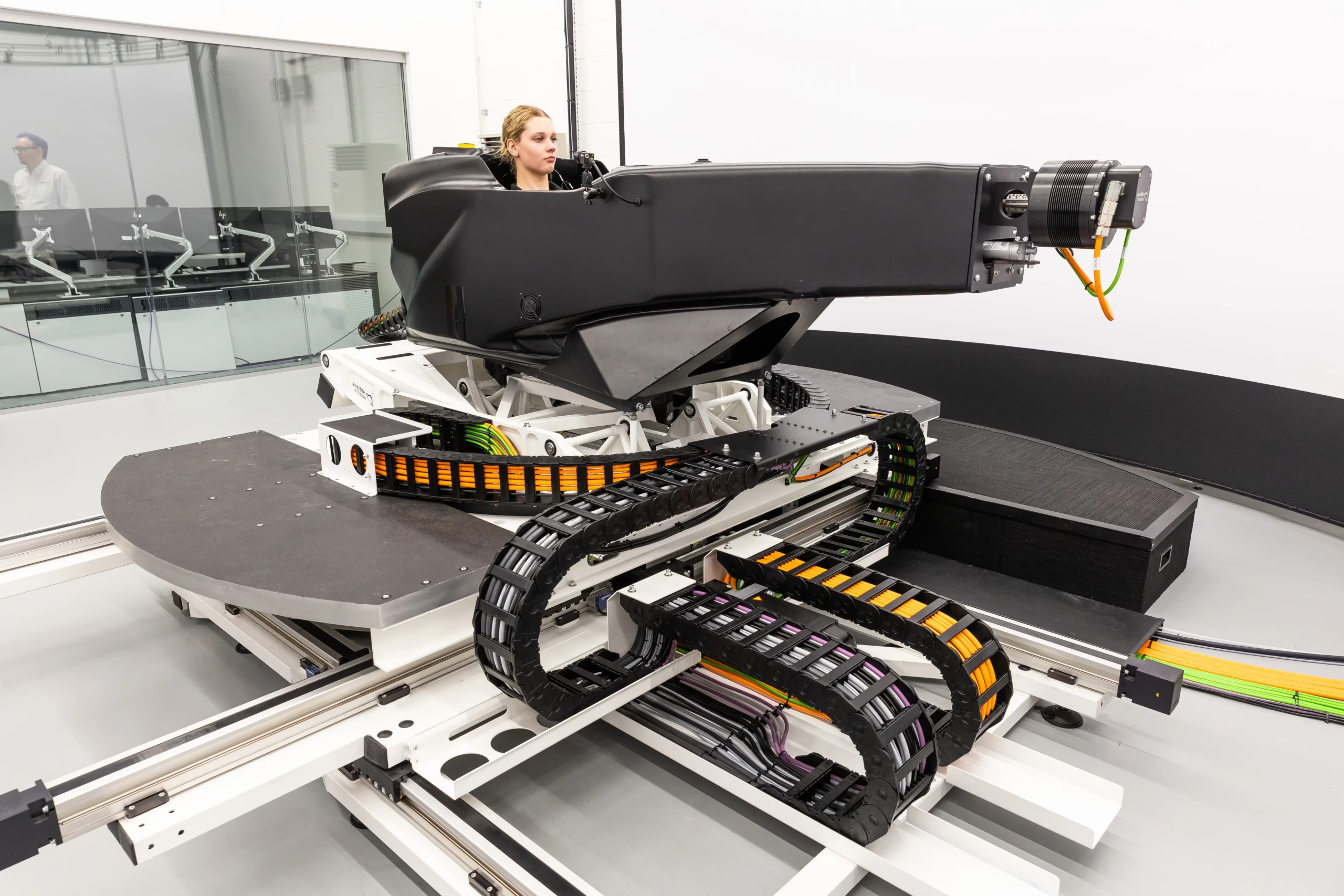
IAAPS has linked its 1,800 kW four-wheel-drive powertrain testbed to an Ansible Motion Delta S2 simulator. This creates a unified Vehicle-in-the-Loop and Driver-in-the-Loop environment for real-time development work. The setup joins a human driver, virtual vehicle dynamics, and physical propulsion hardware in one loop. Validation can therefore begin before a complete prototype vehicle exists.
The system sits within IAAPS’ Bristol and Bath Science Park site in the UK. It targets motorsport teams, OEMs, and Tier One suppliers seeking earlier calibration data. The approach pulls key validation tasks forward from costly physical prototypes and track sessions.
Simulator Hardware and Integration Details
IAAPS selected the Delta S2 for its compact footprint and high-fidelity motion cues. The simulator uses a patented six-degrees-of-freedom Stratiform motion base. A projection-based vision system supports fully integrated rFpro world-space simulations. An interchangeable cockpit environment allows rapid configuration changes between test programs.
The Delta S2 connects directly to one of IAAPS’ existing AVL 1,800 kW full four-wheel-drive powertrain dynamometers. This link enables seamless, real-time interaction between driver inputs and actual powertrain systems. The dynamometer precisely controls and monitors powertrain inputs and outputs in a lab setting. Ansible Motion also provides support and maintenance for IAAPS’ advanced research needs.
Key Capabilities of the IAAPS–Ansible Motion Setup
- The Delta S2 simulator links directly to an AVL 1,800 kW 4WD powertrain dynamometer.
- Human drivers interact with virtual vehicle dynamics and real propulsion hardware in real time.
- The rig supports combustion, hybrid, and battery electric powertrain architectures.
- Motorsport teams can optimize setup and strategy without booking track time.
- OEMs and suppliers can validate ADAS transitions and driver handover scenarios early.
- Smaller organizations gain ad hoc access to advanced simulation without owning hardware.
- IAAPS engineers support test design, execution, and data interpretation for customers.
- The system reduces prototype mileage, tyre use, and overall development costs.
Applications for Motorsport Teams
Racing teams can use the rig for vehicle setup optimization and calibration work. Strategy development and scenario testing become possible without booking track time. Drivers gain a platform for track familiarization and race procedure practice. Coaching and consistency training also fit within this environment.
The DiL rig has already supported race preparation for F1 Academy driver Rachel Robertson. Teams can cut track time, tyre use, and mileage while refining car behavior. Smaller competitors gain access to professional simulation tools without owning a simulator. Engineering support from IAAPS complements the hardware for deeper setup work.
Powertrain Validation for OEMs and Suppliers
OEMs and suppliers can assess driver behavior and propulsion response across multiple architectures. The facility supports combustion, hybrid, and battery electric powertrains before road testing. Engineers can evaluate Advanced Driver Assistance Systems and autonomous driving transitions early. Edge-case scenarios become testable in a repeatable and resource-conscious manner.
This configuration captures human-in-the-loop behavior during active powertrain operation. It avoids exposing personnel or hardware to undue risk in hazardous driving scenarios. Driveline calibration and validation accelerate across ICE, hybrid, and electric platforms. Full vehicle availability is no longer a prerequisite for meaningful system-level testing.
IAAPS Facility Capabilities and Context
IAAPS operates an 11,300 m² site at Bristol & Bath Science Park. The center hosts powertrain cells, chassis dynamometers, and hardware-in-the-loop integration across facilities. Its 4WD chassis dynamometer reaches 200 kph with a 250 kW power rating. Inertia ranges from 454 kg to 5,448 kg for diverse vehicle classes.
The site includes two 4WD 5E hybrid powertrain and transmission cells. A 2WD 3E hybrid cell supports additional electrified powertrain research. Seven propulsion cells test electric machines, inverters, batteries, fuel cells, and engines. Battery emulation up to 750 kW is available in all cells for flexible testing.
Climatic rolling roads deliver environmental control from −10 °C to +45 °C. Robot drivers ensure maximum repeatability during emissions and efficiency studies. Electrical power analysis and full emissions measurement suites support regulated testing. Green hydrogen production and storage infrastructure underpins net zero research goals.
Partnership Background with Ansible Motion
IAAPS and Ansible Motion first announced a technical cooperation agreement in 2024. That phase included installation of a Theta Seat Driver-in-the-Loop simulator at IAAPS. The initial work focused on integrating DIL and mechanical Hardware-in-the-Loop systems. IAAPS became Ansible Motion’s first UK service partner under that arrangement.
The new agreement extends the collaboration with a long-term Delta S2 installation. It targets operational readiness from February 2026 for the combined VIL-DIL environment. Both parties plan a joint launch event once the system is fully operational. The partnership aligns IAAPS’ propulsion expertise with Ansible Motion’s simulator technology.
Development Benefits and Industry Impact
Shorter development cycles emerge from earlier virtual validation of complex systems. Reduced reliance on physical prototypes lowers cost and resource consumption. High-fidelity data informs calibration decisions before on-road testing begins. Better understanding of driver behavior in real-world situations supports UX and ADAS tuning.
The approach also enables earlier development of ADAS and driver handover strategies. Sustainable development processes gain ground as track mileage and tyre use drop. Smaller OEMs and academic institutions gain ad hoc access to advanced simulation tools. Tier One suppliers can validate brake-by-wire, steer-by-wire, and adaptive suspension virtually.
Access Model and Target Users
IAAPS will offer access to the simulator for Tier One suppliers and smaller OEMs. Academic institutions and motorsport teams can also book time on the rig. The facility serves as a second reference location alongside Ansible Motion’s Hethel site. Customers benefit from ad hoc access without owning or operating their own simulator.
Engineering teams at IAAPS support test design, execution, and data interpretation. The model suits organizations seeking flexible capacity for peak development periods. Race teams can prepare for specific events without long-term simulator commitments. Automotive programs can frontload validation before committing to prototype builds.
Sources: IAAPS