
IAA 2026 showcase sets commercial vehicle energy agenda
FORVIA HELLA will display its full energy management portfolio at IAA Transportation 2026 in Hanover. The event runs from mid-September and gathers global commercial vehicle manufacturers and suppliers. The supplier will present established series products alongside new concept innovations. These solutions target electrification and scalable electrical and electronic architectures. The company aims to support zonal designs and software-defined vehicle strategies.
FORVIA HELLA will share Hall 12, Stand 36 with parent group FORVIA during the show. The group will present a unified commercial vehicle strategy across five business groups. This integrated approach covers seating, electronics, interiors, lighting and zero-emission systems. The energy management lineup forms a core pillar of that commercial vehicle push.
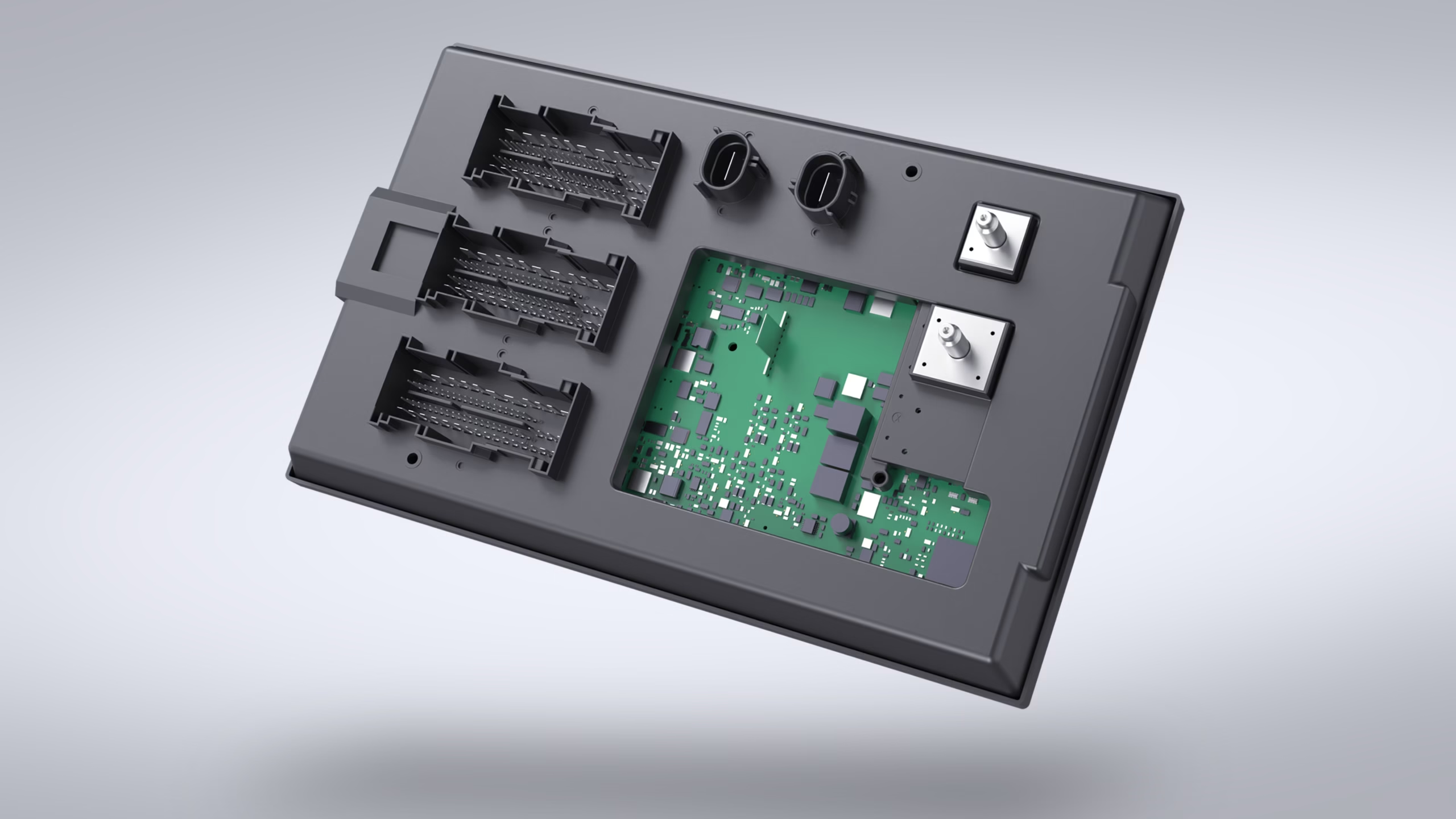
Intelligent Power Distribution Module enables fail-operational supply
The intelligent Power Distribution Module, or iPDM, delivers fail-operational power distribution in vehicles. It uses electronic fuses, known as eFuses, to monitor and control power flows in real time. The system already entered series production for passenger cars in mid-2025. FORVIA HELLA now adapts this technology for commercial vehicle applications.
The iPDM detects which electrical consumers need power at each moment during operation. It identifies risks such as low onboard voltage before faults become critical. Safety-critical functions like braking, steering and driver assistance keep working during faults. This capability reduces unplanned downtime and improves fleet availability for operators.
Electronic fuses measure power roughly ten thousand times faster than a human blink. They react reversibly, so no physical replacement is needed after a fault event. This design removes the need for easy physical access inside the vehicle cabin. Engineers can route wiring more flexibly and use shorter, lighter cable runs. Wiring harness weight can drop by up to twenty-five percent in some applications.
The iPDM also supports predictive maintenance through continuous data collection. Digital twin models can simulate stress and aging across the power network. This approach helps plan service intervals and avoid unexpected failures in fleets. The module aligns with service-oriented vehicle architectures that FORVIA promotes.
EnergyCore packs X-in-1 energy management into one concept
EnergyCore presents a compact, integrated X-in-1 energy management concept for next-generation vehicles. It combines multiple power and battery electronics components into one configurable system. The modular architecture allows adaptation to different vehicle platforms and duties. This flexibility supports both low-voltage and high-voltage applications across portfolios.
The concept builds on FORVIA HELLA expertise in power and battery electronics. It includes battery management and safety-related electronics up to ASIL D levels. Such integration reduces part count and simplifies assembly in electric commercial vehicles. It also supports efficient thermal management and space optimization under the chassis.
EnergyCore illustrates how integrated approaches improve electric vehicle architectures overall. Manufacturers can scale the design from vans to trucks with minimal redesign effort. This scalability lowers development costs and shortens time to market for new models. The concept complements the iPDM within a broader zonal electrical strategy.
Intelligent Battery Sensors monitor 12-volt and 24-volt systems
FORVIA HELLA offers Intelligent Battery Sensors for both 12-volt and 24-volt onboard systems. The sensors measure voltage, current and temperature with high accuracy during operation. They calculate state of charge, state of health and state of function in real time. These parameters help prevent unexpected battery failures in commercial fleets.
The company has more than twenty-five years of experience in this product area. It delivered more than twenty million battery sensors during the previous year alone. The sensors support numerous battery chemistries and vehicle types across segments. They integrate directly into vehicle electrical systems using the LIN communication protocol.
Technical data shows wide operating ranges for harsh commercial vehicle environments. The 12-volt generation II sensor operates from six to eighteen volts and up to 1,500 amperes. It functions from minus forty to plus one hundred twenty-five degrees Celsius. The 24-volt variant covers 7.5 to 32 volts and up to 2,000 amperes briefly. Protection class IP6K9K ensures resistance to dust, water and high-pressure cleaning.
Accurate battery monitoring reduces breakdowns caused by weak or failing batteries. Fleet managers can plan replacements before critical capacity loss occurs on routes. This proactive approach improves vehicle availability and lowers total cost of ownership. The sensors also support functional safety requirements for advanced driver assistance systems.
High-voltage DC/DC converters stabilize low-voltage networks
The high-voltage DC/DC converter ensures a stable 12-volt supply in electrified vehicles. It achieves peak efficiency above ninety-six percent during normal operation. FORVIA HELLA launched its first high-voltage voltage converter into series production in 2025. This product now supports commercial vehicle electrification programs as well.
The converter steps down high-voltage battery energy to power low-voltage loads reliably. It supports safety-critical electronics that require uninterrupted 12-volt power at all times. High efficiency reduces thermal load and improves overall vehicle energy consumption. This benefit matters especially for long-haul trucks with large electrical loads.
The converter design leverages decades of power electronics experience within the group. It aligns with FORVIA HELLA goals to double commercial vehicle revenues by 2030. The product fits into zonal architectures alongside iPDM and EnergyCore concepts. Together, these components form a scalable foundation for future vehicle generations.
Key product features and fleet benefits at a glance
- iPDM provides fail-operational power for braking, steering and driver assistance systems.
- eFuses measure power ten thousand times faster than a human blink cycle.
- Wiring harness weight can drop by up to twenty-five percent with eFuse technology.
- EnergyCore combines multiple power electronics into one configurable X-in-1 system.
- EnergyCore supports battery management and safety electronics up to ASIL D levels.
- Intelligent Battery Sensors cover 12-volt and 24-volt commercial vehicle systems.
- IBS devices measure voltage, current and temperature for SoC, SoH and SoF.
- 12-volt IBS operates from 6 to 18 volts and up to 1,500 amperes continuously.
- 24-volt IBS handles 7.5 to 32 volts and brief peaks up to 2,000 amperes.
- High-voltage DC/DC converters reach peak efficiency above ninety-six percent.
- Series production of HV DC/DC converters began in 2025 for electrified vehicles.
- The portfolio supports zonal, software-defined vehicle architectures for fleets.
Sources: FORVIA HELLA