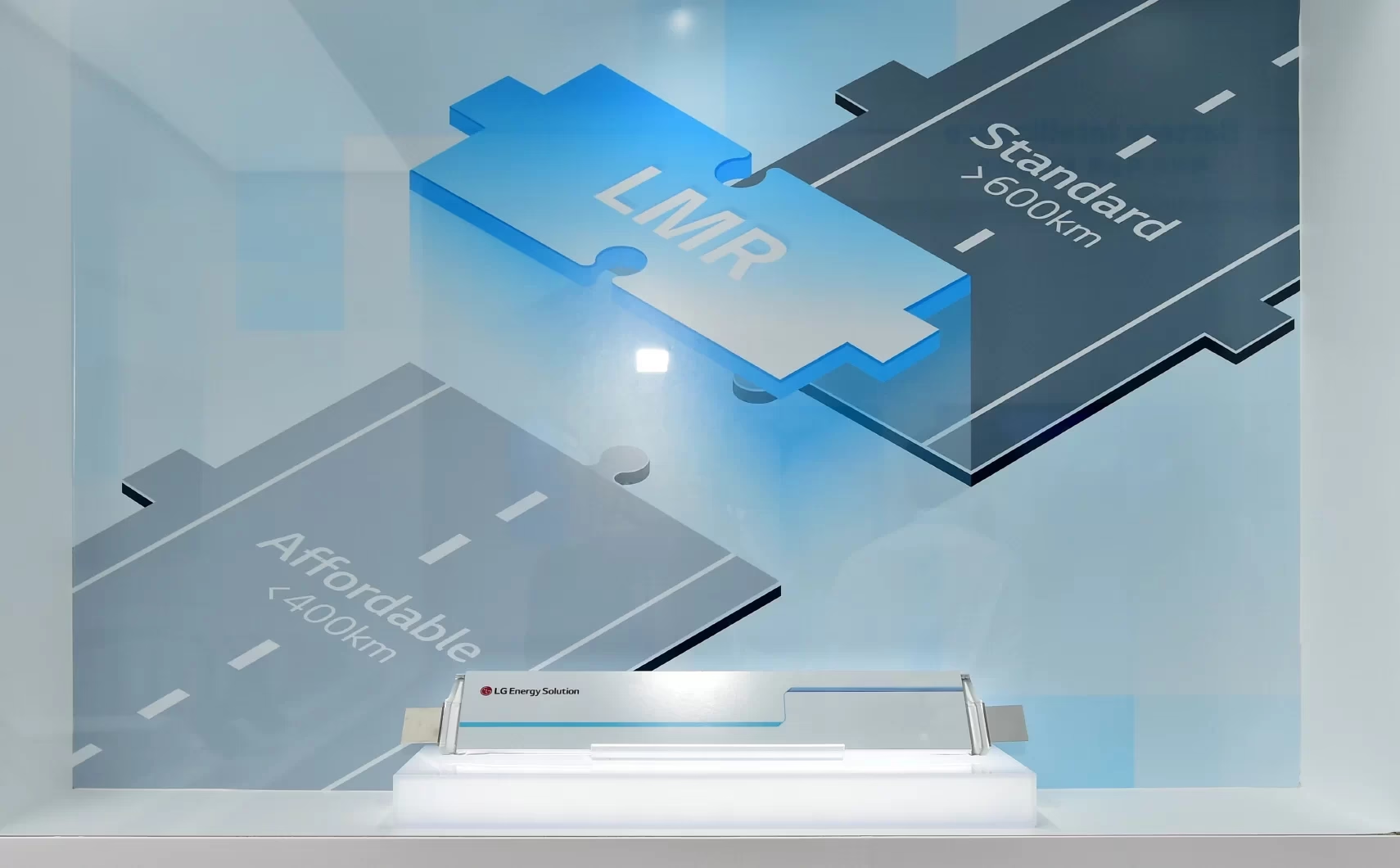

Breakthrough in LMR Battery Commercialization
LG Energy Solution and Seoul National University achieved a major step toward commercializing lithium manganese-rich (LMR) batteries. Their joint research team suppressed gas evolution, a critical barrier to large-format cell deployment. The optimized 40 Ah-class cells retained 92.2 percent of initial energy after 883 cycles.
Why LMR Cathodes Matter for EVs
LMR cathodes rely heavily on manganese, a lower-cost material compared with nickel or cobalt. They also enable cobalt-free designs, which reduce supply-chain risk and material expenses. Energy density improves because oxygen in the cathode participates in energy storage alongside transition metals. This dual mechanism supports longer driving ranges without increasing cell weight.
However, oxygen redox introduces structural challenges during repeated cycling. Incomplete oxygen reduction damages the cathode and releases gas inside the cell. Large-format EV cells have limited internal space, so gas buildup raises pressure and accelerates degradation. This issue previously confined LMR use to small-format applications.
Root Cause: Oxygen Redox Reversibility
The research team traced gas generation to oxygen redox reversibility during charge and discharge. Oxidized oxygen must return to its original state during discharge to avoid structural damage. If oxygen remains partially oxidized, it forms molecular oxygen gas within the cell. This process undermines cycle life and safety in large prismatic cells.
Scientists analyzed oxygen behavior across different voltage windows. They found oxygen recovery depends on both upper charging voltage and lower discharge cutoff. Prior work often focused only on the charging ceiling. This study showed discharge conditions are equally important for long-term stability.
Voltage Protocol Changes Drive Stability
Lowering the upper charging voltage from 4.6 V to 4.3 V improved oxygen reduction from 86 percent to 97 percent. Reducing the discharge cutoff from 3.0 V to 2.0 V enabled near-complete oxygen recovery. These adjustments closed the gap left by charging-only optimization. The dual-cutoff approach restored oxygen to its initial state more reliably.
LG Energy Solution redesigned the operating voltage range for 40 Ah-class LMR cells. Engineers also modified the formation process to match the new protocol. A lower-temperature formation step suppressed gas generation during initial activation. This combination addressed gas evolution specific to large-format cells.
Cycle-Life Performance in Large-Format Cells
The optimized 40 Ah-class LMR cells retained 92.2 percent of initial energy after 883 cycles. This retention exceeds the roughly 80 percent threshold used for EV-grade acceptance. Stable cycle life in large prismatic cells supports mass production readiness. The results expand LMR potential beyond small pouch or coin cells.
Electrochemical protocol design alone delivered this durability without material changes. The approach reduces reliance on complex cathode modifications or additives. Manufacturers can apply these voltage windows across existing production lines. This pathway lowers development time and cost for next-generation cells.
Key Technical Adjustments
The team implemented several targeted changes to stabilize LMR chemistry:
- Reduced upper charging voltage from 4.6 V to 4.3 V to improve oxygen reduction.
- Lowered discharge cutoff voltage from 3.0 V to 2.0 V to enable full oxygen recovery.
- Redesigned the operating voltage range for 40 Ah-class large-format LMR cells.
- Applied a lower-temperature formation process to suppress gas during activation.
- Validated performance over 883 charge-discharge cycles with 92.2 percent energy retention.
Path to EV Deployment and Production
LG Energy Solution views this work as a foundation for LMR growth in the EV battery market. The company has not disclosed a specific series-production timeline yet. Industry reports indicate GM and LG Energy Solution target LMR prismatic cells by 2028 via Ultium Cells. Preproduction may begin by late 2027 for full-size truck and SUV platforms.
Cobalt-free LMR adoption could reduce demand for high-nickel ternary cathodes over time. Manganese-based cathodes may gain share as voltage protocols mature. Lower material costs and improved stability support competitiveness against conventional chemistries. These advances align with broader efforts to diversify EV battery supply chains.
Research Leadership and Publication
Professor Jongwoo Lim led the Seoul National University chemistry team in this collaboration. He emphasized that discharge conditions must complement charging parameters for LMR stability. LG Energy Solution researchers handled cell design, voltage optimization, and formation tuning. Their joint effort produced peer-reviewed evidence in Nature Communications.
The publication details how oxygen redox reversibility governs longevity in layered oxide cathodes. It provides a protocol framework other manufacturers can adapt for LMR development. Academic and industrial partners can use these findings to accelerate cobalt-free battery programs. The work also informs thermal and safety modeling for large-format LMR packs.
Broader Industry Context
High-manganese, low-nickel, and cobalt-free cathodes address resource constraints in the EV sector. LMR chemistry offers a route to cut nickel use while maintaining energy density. Voltage protocol optimization reduces the need for exotic material substitutions. This strategy supports cost reduction without compromising cycle life.
Automakers seek battery chemistries that balance range, cost, and durability. LMR cells with suppressed gas evolution meet these criteria more effectively now. The technology strengthens the business case for next-generation EV platforms. It also supports energy storage systems that require long cycle life.
Sources: LG Energy Solution