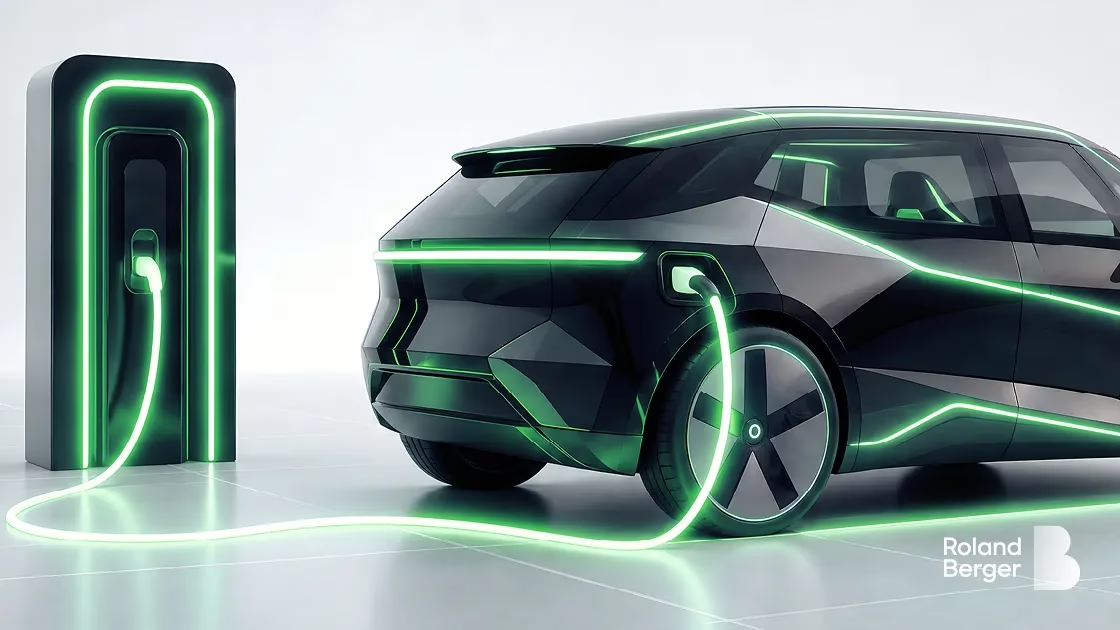

Roland Berger’s 2026 EV Charging Index shows a global EV market that has clearly moved into scale mode. One in four new cars sold worldwide was electric in 2025, but the bigger story now sits in charging speed, network efficiency, and regional execution.
A market that keeps expanding
The report covers 34 countries and shows that electric mobility kept advancing across major markets in 2025. Global EV sales surpassed 20 million units, and electric cars reached about 25% of all new-car sales worldwide.
This is not a small milestone. It confirms that EVs are no longer a niche product in the world’s biggest automotive markets. Instead, they now shape fleet planning, infrastructure investment, and policy decisions across continents.
China again sat at the center of the shift. Its EV penetration crossed 50%, and it continued to anchor global demand, supply chains, and pricing pressure.
Charging is changing
Roland Berger says public charging expanded further in 2025, but the pace changed. Around 1.1 million new public charge points were added worldwide, which was slightly fewer than in earlier years.
That slowdown does not signal weakness. It shows that the market is moving away from pure buildout and toward better utilization, stronger economics, and more targeted charging deployment.
The most important trend is the rise of fast and ultra-fast charging. In Europe, more than half of all fast charge points are now ultra-fast capable, compared with roughly one-quarter five years ago.
Why speed matters more
This shift matters because EV adoption creates new expectations. Drivers want shorter charging stops, operators want higher throughput, and policymakers want infrastructure that supports long-term growth.
Roland Berger’s report suggests that the next phase of competition will be defined by performance, not count. Charging quality, site location, grid readiness, and uptime will matter more than simple network size.
The company also notes a widening gap in Western Europe. The region averages around 45 BEVs per fast charge point today, while a sustainable long-term ratio will likely need to exceed 100.
Regional performance
Europe delivered one of the strongest rebounds in 2025. EV sales rose sharply, and the charging market kept shifting toward higher-power stations and better network economics.
North America faced a more uneven year. Policy uncertainty and softer demand weakened EV momentum compared with the previous year, even as charging operators continued to build out sites.
Asia-Pacific remained the strongest growth engine overall. China led the market, while Southeast Asian countries continued to post faster growth from a smaller base.
Key country signals
- Norway remained the global leader with about 89% EV sales penetration.
- Sweden saw around three in five new cars and vans sold as electric.
- The Netherlands passed 10% EV parc penetration.
- Germany recovered after earlier policy disruption and returned to stronger growth.
- Turkey emerged as a fast-growing market, supported by Togg, Tesla, and BYD.
- India still trails on passenger-car EV penetration, but two-wheelers remain a major entry point.
Charging and business models
Roland Berger’s broader EV charging work points to a market that is becoming more commercial and less experimental. The firm says its global charging team combines automotive, energy, retail, and infrastructure insight because the business now depends on all four.
That matters for investors and operators. Fast-charging hubs need the right traffic, the right power levels, and the right economics to stay viable over time.
The same direction appears in the IEA’s latest outlook. The agency says electric car sales topped 20 million globally in 2025, and one in four new cars sold worldwide was electric.
The IEA also highlights continued expansion in the global EV fleet and charging infrastructure. That supports Roland Berger’s conclusion that the market is mature enough to shift from volume growth to quality growth.
What happens next
Roland Berger’s longer-term automotive outlook suggests electrification will keep advancing through 2040. The firm expects battery-electric vehicles to take a much larger share of global new-car sales over time.
That makes charging strategy more important, not less. Automakers, charge-point operators, utilities, and policymakers now need to focus on speed, reliability, and geographic fit rather than simple expansion.
For the industry, the message is clear. The EV race is still about adoption, but the charging race is now about execution.
Sources: Roland Berger