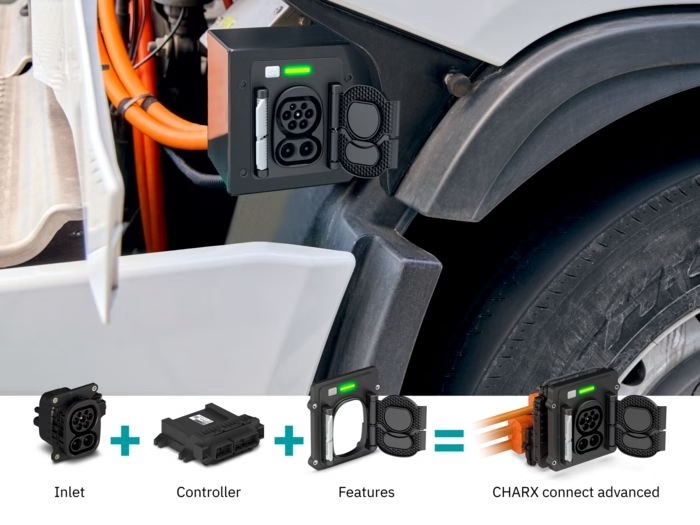

Phoenix Contact unveils CHARX connect advanced, a groundbreaking CCS vehicle charging inlet for commercial electric vehicles. This innovation integrates the charging controller directly into the inlet. Moreover, it targets electric buses, trucks, and off-road machines. Thus, it simplifies vehicle design and speeds up charging. Series production starts in Q3 2026, with samples available now.
Integrated Charging Controller Transforms EV Design
Phoenix Contact engineers mount the controller mechanically and electrically right on the inlet. This setup eliminates external units and extra interfaces. As a result, vehicles save installation space—down to 128.5 mm depth. Communication flows seamlessly via PLC to CAN, following DIN 70121 and ISO 15118 standards.
Key Communication and Control Features
The system handles DC and AC charging talks. It controls CP, PP, PE signals, locking actuators, and temperature sensors. Additionally, built-in LEDs, a cancel button, and search light enhance usability. Preconditioning for buses aligns with VDV 261. Cybersecurity prep meets UNECE R155/R156, and safety reaches ISO 26262 ASIL B.
Furthermore, real-time responses hit 100-200 ms. Operators can buy the inlet without the controller if needed. This flexibility suits diverse fleets. Meanwhile, E1 approval ensures road-ready performance.
Modular Connections Boost Flexibility and Maintenance
CHARX connect advanced offers plug-in cables for tool-free swaps. Mechanics replace inlets or high-voltage lines quickly. Cable outlets come in 90° left, right, or straight directions. AC cross-sections hit 6-16 mm²; DC ranges 70-120 mm².
High-Power Charging Specs Shine
It supports up to 1000V DC, continuous currents of 200-400A, and 800A peaks in boost mode. IP67 sealing protects fully; contacts reach IP6K9K. CCS Type 1 or 2 variants fit global needs. Thus, it powers demanding commercial routes efficiently.
In comparison, market peers like MCS aim for 3.75 MW in heavy-duty apps, but CHARX excels in integrated control. High-power stations already hit 800kW totals with 300kW per gun.
Market Trends Fuel Demand for Smart Charging Inlets
The EV charging inlets market grows at 5-9.6% CAGR through 2033. Passenger EVs drive volume, but commercial segments surge with fleet electrification. Governments push sustainability, boosting infrastructure needs.
Integrated controllers cut costs and wiring. They optimize renewable energy ties and grid loads. Charger software prevents overloads and speeds charging. For buses, CCS plugs deliver 80kW mobile options, but CHARX scales higher for depots.
Phoenix Contact, a leader in e-mobility, builds on CHARX series for IATF 16949 quality. Samples let integrators test now. Thus, it positions firms ahead in the race to electrify trucks and buses.
Future Implications for Commercial EV Fleets
CHARX connect advanced eases adoption barriers. Fleets gain faster uptime and lower maintenance. Moreover, high 800A charging rivals refueling times. As e-trucks boom, such inlets become essential.
However, challenges like grid capacity remain. Yet, smart integration helps. Overall, this inlet sets a new benchmark. It drives efficiency in sustainable transport. Commercial operators benefit most from its modularity and power.
In Europe, CCS dominates trucks; MCS follows for megawatt needs. Phoenix Contact’s move aligns perfectly. Thus, expect wider use by 2027 as production ramps.