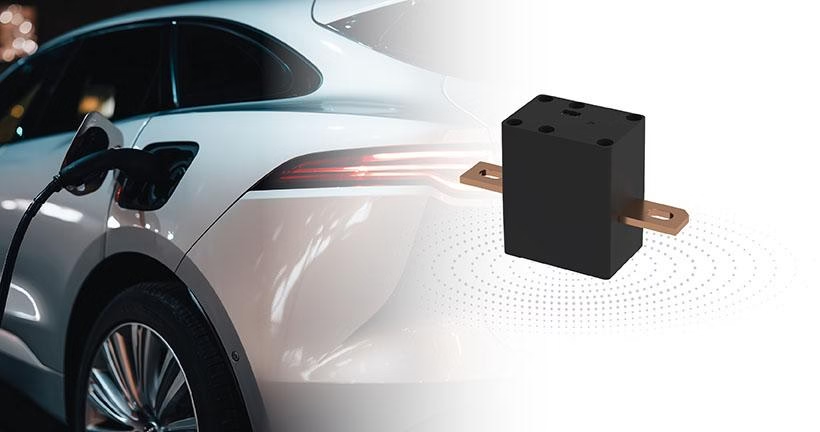

Sensata Technologies has introduced its Active + Passive PyroFuse, a high-voltage protection device designed for electrified systems. The new STPS500P Series combines system-triggered and current-driven interruption in one package, aiming to improve fault response, redundancy, and system-level simplification.
High-voltage protection challenge
As electrified systems grow more powerful, protection becomes harder to design. OEMs must balance response speed, reliability, and component count while managing rising voltage and current demands. Traditional approaches often force a choice between active protection that depends on system signals and passive protection that reacts to electrical or thermal conditions.
That tradeoff can create weak points in complex architectures. If upstream sensors or control signals fail, active-only strategies may lose effectiveness. If the protection relies too heavily on thermal behavior, response time may suffer.
What the PyroFuse does
Sensata’s new PyroFuse combines both interruption methods in a single device. One mechanism is system-triggered, while the other is mechanically driven and current-based. This dual approach adds redundancy at the device level, so interruption can still occur even when upstream electronics are unavailable.
The company says the design supports faster fault interruption and stronger resilience in high-voltage architectures. It is aimed at electric vehicles, commercial transportation, charging infrastructure, and industrial electrification systems.
How the design works
The device does not rely only on thermal melting like some passive solutions. Instead, it uses a current-driven mechanism that responds directly to electrical conditions. That approach supports millisecond-level interruption, regardless of current level.
This faster reaction can help protect contactors, busbars, and downstream components before damage spreads. It also reduces dependence on upstream sensing and control logic, which can improve overall fault tolerance. In practice, that means the device can add protection without increasing design complexity.
Benefits for OEMs
The main value proposition is system simplification. Faster interruption can lower peak energy exposure and reduce short-circuit demands on contactors. That can let OEMs size parts differently and streamline protection strategies.
Sensata says the device can help reduce component requirements, lower cost, and cut system complexity. Those benefits matter in high-voltage platforms, where every added part can affect packaging, performance, and budget.
Key benefits at a glance
- Dual active and passive protection in one device.
- Millisecond-level passive response independent of current level.
- Less reliance on upstream sensors and control signals.
- Better protection for contactors, busbars, and downstream components.
- Potentially lower cost, size, and architecture complexity.
Application areas
The A+P PyroFuse targets several electrified markets. Sensata names electric vehicles, commercial transportation, charging infrastructure, and industrial electrification systems. These segments all face rising demand for compact, reliable protection devices.
The product also fits broader high-voltage system trends. As architectures become more integrated, OEMs need protection solutions that support safety without creating extra design burden. A single redundant device can be easier to manage than multiple separate layers of protection.
Sensata’s portfolio fit
Sensata positions the A+P PyroFuse as part of a wider high-voltage platform. The company says it complements its contactors, sensing products, and electrical protection technologies. That gives OEMs the option to source more of the safety stack from one supplier.
This approach may appeal to manufacturers looking for integrated system support. It can also help align protection, sensing, and switching functions across the same architecture. In a market where packaging and reliability matter, that kind of portfolio fit can be a practical advantage.
Executive perspective
Markus Schwabe, Executive Vice President of Automotive at Sensata Technologies, said EV manufacturers have long had to work around the limits of active-only or passive-only protection. He added that the new product removes that tradeoff and supports safer, more resilient systems with less complexity.
That message reflects a familiar industry shift. As electrification advances, suppliers are moving toward integrated safety components rather than standalone parts. Sensata’s launch follows that direction closely.
Why it matters
The launch highlights a broader move toward smarter high-voltage protection. OEMs increasingly need devices that react quickly, tolerate failure conditions, and simplify the overall architecture. A combined active and passive design addresses all three needs at once.
It may also influence how engineers think about fault protection. Instead of choosing between redundancy and simplicity, they can potentially get both in one component. That can improve both design flexibility and system robustness.
Sources: Sensata