
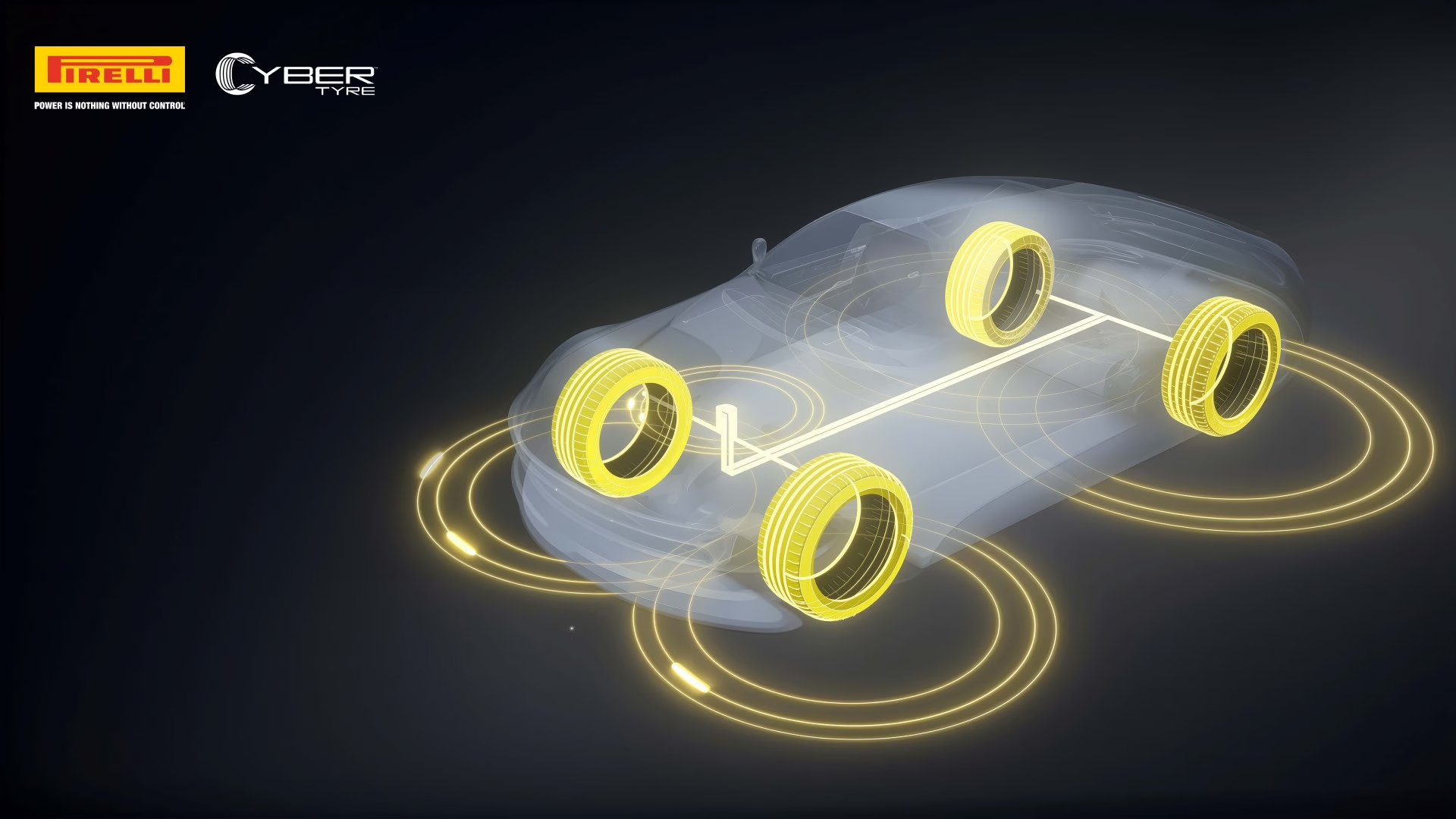

Pirelli’s agreement with RIDEsense is less about ownership and more about technology. The real story is the expansion of tyre intelligence through virtual sensing, physics-based modeling, and real-time vehicle data interpretation.
RIDEsense brings a software-driven layer that helps Pirelli’s Cyber Tyre system understand tyre behavior in more detail. That means the car can move from simple measurement toward predictive analysis.
This is important because tyres influence safety more than many drivers realize. Grip, wear, load, temperature, and road water all affect performance at once.
What RIDEsense actually does
RIDEsense describes its platform as a virtual sensor solution for vehicles. The company says it can create “an infinite number of sensors” without extra weight, volume, or physical failure points.
In practice, that means software replaces some of the sensing burden normally handled by added hardware. The system uses real-time algorithms to infer tyre and vehicle conditions from signals already present in the vehicle.
Its core strength is physics-based modeling. Rather than guessing, the software calculates tyre behavior from mathematical models that reflect how tyres and vehicles behave on the road.
How the technology works
The RIDEsense approach starts with inputs from the vehicle and ends with tyre insight. Between those two points, the software estimates hidden variables such as grip potential, wear trends, road friction, and aquaplaning risk.
That hidden-layer analysis matters because not every important tyre state can be measured directly. Some conditions only become clear when data is processed through a dynamic model.
This is why virtual sensing is so valuable for connected mobility. It can provide more useful information than a raw sensor reading alone, especially when conditions change quickly.
Why virtual sensing matters
Virtual sensing helps reduce hardware complexity. It can also improve the speed and flexibility of vehicle intelligence because software updates can refine the model over time.
It also scales well across different use cases. The same software logic can support road vehicles, testing environments, and performance applications such as motorsport.
That flexibility is a major advantage in modern mobility. Manufacturers want more insight, but they do not want unnecessary weight, cost, or packaging complexity.
Cyber Tyre as a platform
Pirelli’s Cyber Tyre is already an intelligent tyre system built to communicate with the car in real time. Pirelli says it gathers vital data from sensorized tyres and sends that information to the vehicle.
The company presents Cyber Tyre as a system that can support ABS, ESP, traction control, and other vehicle functions. That makes the tyre a live input to safety and stability systems.
RIDEsense adds another layer to that architecture. Instead of relying only on physical sensing, Pirelli can now use software to interpret the data more deeply and more adaptively.
What improves with RIDEsense
The clearest gain is better aquaplaning detection. Pirelli says the integration strengthens this function and broadens the system’s safety potential.
That matters because aquaplaning is a fast-moving problem. When water cuts contact between the tyre and the road, the vehicle must respond immediately.
The combined platform also aims to improve tyre diagnostics and vehicle diagnostics. In other words, the tyre can help explain not only its own condition, but also how the whole vehicle is behaving.
Safety and control functions
Pirelli’s Cyber Tyre is not just a data collector. It is designed to communicate meaningful tyre information to the car’s control systems in real time.
That data can support braking and stability systems during critical driving situations. It can also help the driver understand what the car is sensing before the situation becomes obvious.
With RIDEsense, those messages can become more precise. The software can identify patterns, not just signals, which improves decision quality for the vehicle’s control stack.
A better view of road grip
Road grip is one of the most important variables in tyre performance. It changes with road surface, moisture, temperature, and load.
RIDEsense helps translate those changing conditions into usable information. That can improve control response, warning logic, and long-term performance analysis.
For fleets and premium vehicles, that is especially valuable. They need both safety insight and operational data, often in the same system.
Software-defined tyre value
The shift here is part of a larger trend. Vehicle systems are becoming more software-defined, and tyres are now part of that transformation.
Instead of treating the tyre as a passive component, the new model treats it as a sensing and computing interface. That changes how the vehicle understands the road.
It also creates room for new applications. Diagnostics, condition monitoring, road hazard detection, and advanced driver-assistance support all become easier when tyre data is smarter.
RIDEsense hardware and software
RIDEsense is not limited to one deployment format. The company says its technology can be delivered as software for ECUs or through the Kymes platform for testing and motorsport use.
That modular approach is useful because different customers need different integration paths. A carmaker may want embedded software, while a test engineer may want a more flexible hardware setup.
The company also highlights CAN bus compatibility and external sensor support. Those features make it easier to plug RIDEsense into existing vehicle and testing ecosystems.
From research to industry
RIDEsense emerged from the University of Naples Federico II and the MegaRide ecosystem. That academic origin matters because tyre modeling depends on deep engineering knowledge, not just software coding.
Pirelli positions the collaboration as a way to bring that research into broader industrial use. The company clearly sees value in pairing its own tyre expertise with RIDEsense’s modeling approach.
This kind of transfer from lab to road is common in advanced mobility. But it only works when research can survive the complexity of real-world driving conditions.
Why the deal stands out
The acquisition headline is straightforward, but the technological implications are more interesting. Pirelli is investing in software that can make tyres more predictive, more connected, and more useful to the entire vehicle.
That makes the move relevant beyond a single corporate transaction. It reflects the growing importance of virtual sensing in automotive electronics and tire intelligence.
It also shows that tyre innovation no longer ends with rubber compounds and tread design. The next layer of value now sits in data, modeling, and real-time computation.
Key technical points
- RIDEsense uses physics-based virtual sensors to model tyre behavior.
- The software estimates grip, wear, friction, and aquaplaning risk.
- Pirelli Cyber Tyre sends tyre data to vehicle electronics in real time.
- The combined system aims to strengthen safety and diagnostics.
- The technology supports ECU software and modular testing applications.
Sources: Pirelli