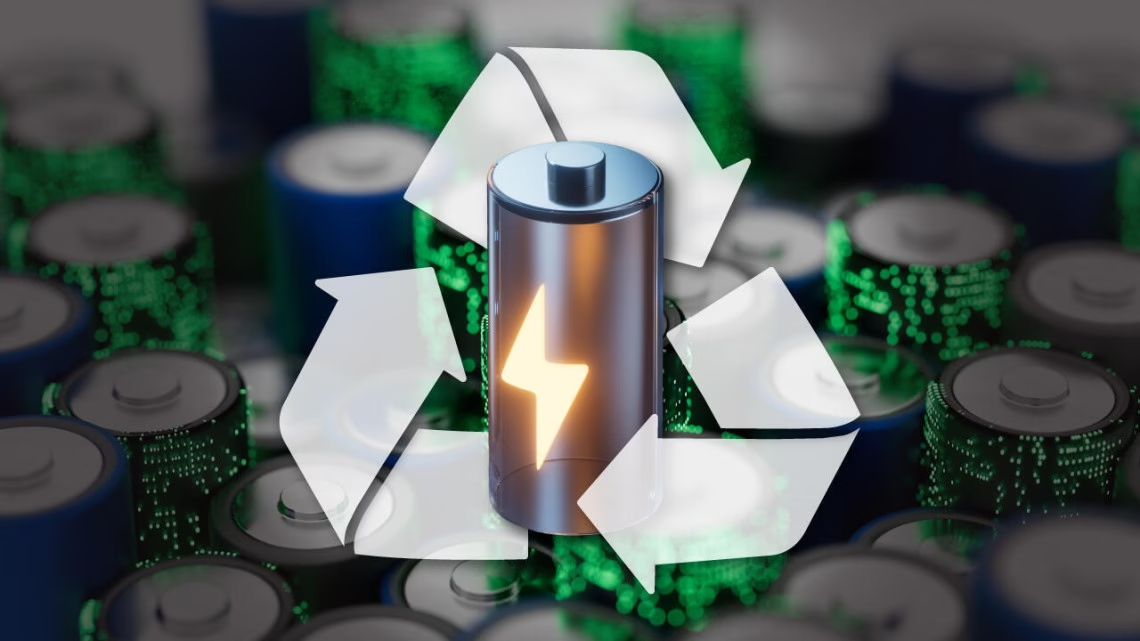

Cornell’s main breakthrough is simple and important. The team can restore spent lithium-ion battery electrodes without shredding them first. That lets the battery recover up to 95% of its original power.
The process also reduces recycled cell manufacturing cost by 56%. At the same time, it lowers air pollution and water use versus current recycling routes.
Why this matters
The U.S. needs battery minerals such as nickel and cobalt, but supply remains tight. Cornell says the country also lacks enough domestic infrastructure to handle every step of traditional recycling. That creates a long and expensive recycling loop.
This makes battery reuse and mineral recovery more urgent. A method that preserves the electrodes can keep more value inside the battery system. It also reduces dependence on brute-force recycling steps.
What DEER changes
DEER stands for direct electrode-to-electrode regeneration. The process removes intact electrodes from a spent cell and places them in a separate electrochemical solution. That solution dissolves the solid electrolyte interphase, which is the insulating layer that builds up during cycling.
Cornell’s team says the electrodes are repaired “as is,” then reused in a new battery. This is different from pyrometallurgy, which smelts batteries at high heat, and hydrometallurgy, which crushes them and uses harsh acids.
Process steps
- Remove the spent battery’s electrodes while they remain intact.
- Place them in a cell with 1,3-dimethyl-2-imidazolidinone.
- Dissolve the thick interphase layer that blocks performance.
- Reuse the preserved electrodes in a new battery.
Performance gains
The article says the spent batteries in the study had 70% to 80% state of health. That range is typical for electric vehicle applications when packs are retired. Cornell says the method can extend that usable window if it addresses more degradation modes.
The regenerated batteries not only regained capacity but also lasted longer when reused. That makes DEER attractive for applications where cost and lifecycle matter. It also points to a faster path from waste stream back to supply chain.
Environmental benefit
Traditional recycling can be energy-intensive and chemically harsh. Cornell says DEER offers a cleaner route because it avoids shredding, powdering, and re-synthesizing the battery materials. That reduces the burden on both waste handling and industrial processing.
The study’s analysis found lower air pollution and less water use than pyrometallurgical and hydrometallurgical methods. In sustainability terms, that gives the process a broader advantage than cost alone.
Research background
The study was published June 9 in Energy and Environmental Science. Postdoctoral researcher Kiwon Kim led the work, and Vibha Kalra headed the project.
Kalra worked with Shuwen Yue to better understand the solvation dynamics during interphase removal. The team also used open-source tools developed with Argonne National Laboratory’s ReCell Center to measure techno-economic and environmental impact.
Next steps
The researchers now want to test DEER on industrial batteries. They also want to target other degradation issues, including lithium loss.
That matters because real-world batteries fail in more than one way. If DEER can handle a wider range of aging modes, it could become more useful in commercial recycling systems.
Sources: Cornell