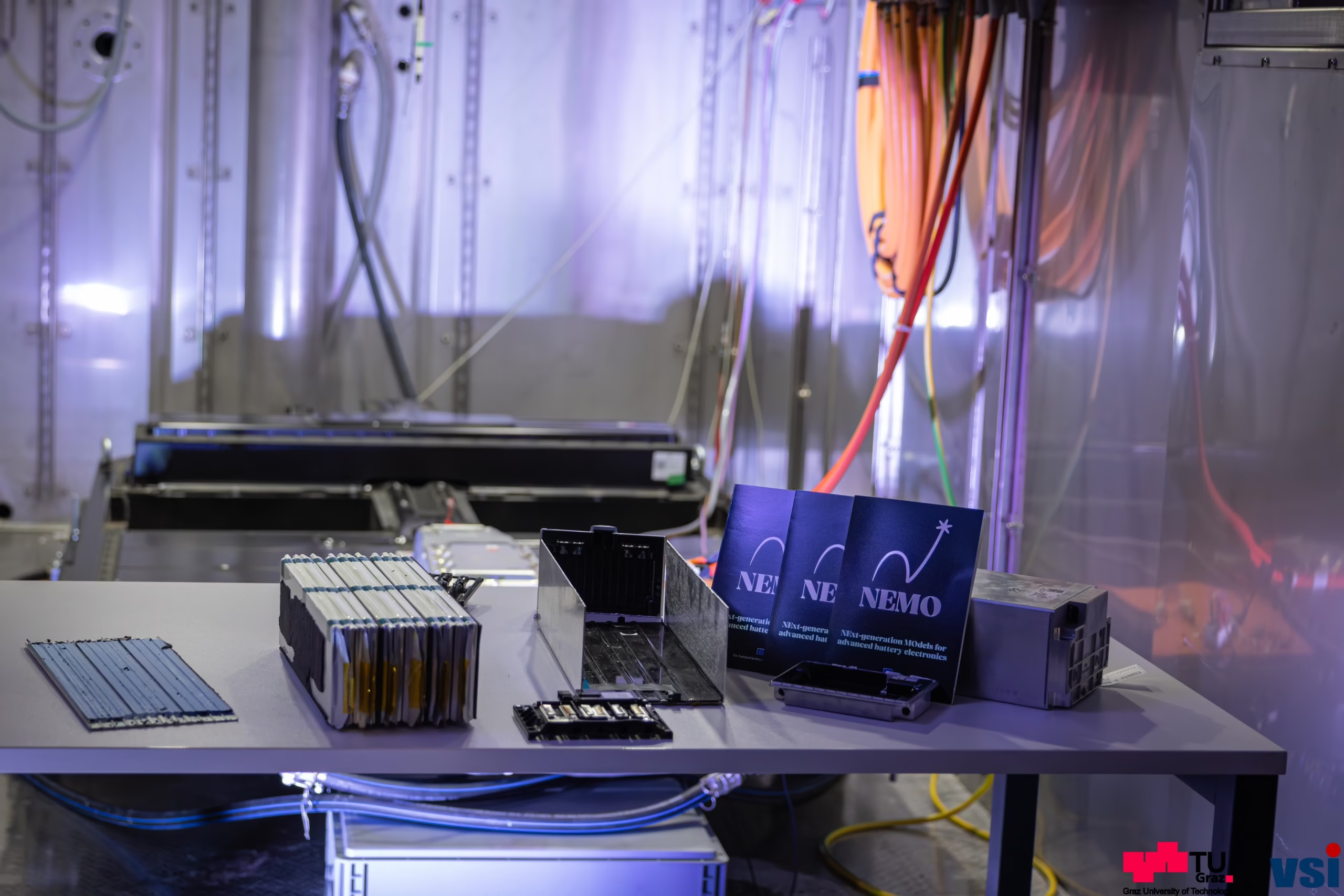

The Nemo project pushes EV battery management beyond basic monitoring. It adds smarter models that can detect damage earlier, track ageing more precisely, and improve safety across the battery’s life.
Smarter battery control
Conventional battery management systems mainly track voltage, current, and temperature. Those values are important, but they do not reveal everything happening inside a cell.
The new approach adds internal models that estimate battery condition more deeply. That makes the system more predictive and more useful for real-world driving.
Instead of waiting for a fault or visible performance loss, the BMS can respond earlier. That shift can help reduce stress on the pack and support better long-term operation.
Detecting hidden damage
A key part of the project is electrochemical impedance spectroscopy, or EIS. This technique helps identify internal resistance and other hidden changes inside battery cells.
Those changes matter because they often appear before a clear failure. EIS gives the system a way to look beyond surface measurements. The project also used mechanically deformed cells in its testing. Those cells mimic real damage scenarios and help train the system to recognize abnormal patterns.
That makes the model more practical. It learns from conditions that resemble actual vehicle use, not just controlled lab conditions.
Tracking swelling behavior
Battery cells expand and contract during use. This is normal, but too much swelling can become a safety issue. Excessive swelling creates pressure inside the battery pack. That pressure can lead to cracks, deformation, or internal short circuits.
The project includes a swelling model to monitor that behavior more closely. This gives the BMS another layer of insight into cell health. It also helps the system react before pressure becomes a larger problem. That is especially valuable in a dense battery pack, where small changes can spread quickly.
Ageing and service life
Battery ageing is one of the biggest challenges in EV development. Cells do not age evenly, and degradation can vary from one part of the pack to another.
The new models aim to estimate ageing more accurately. That allows the BMS to adapt control strategies as the battery gets older.
A more accurate ageing picture can support better performance management. It can also help extend usable battery life and improve reliability over time.
This is important for both drivers and manufacturers. Longer service life can lower replacement risk and improve total vehicle value.
Practical integration
One strength of the project is that the BMS does not need to become much larger or heavier. That makes the concept more realistic for vehicle integration.
At the same time, the EIS function does require extra sensors and system adaptation. So the technology is not plug-and-play, even if it is compact.
A module-level demonstrator already exists. That suggests the work has moved beyond theory and into a more applied stage.
Further development will continue in a follow-up project. That next phase should help refine the system for industrial use.
Project collaboration
Nemo is a cooperative project rather than a single-lab effort. It brings together university researchers and industrial partners from several fields.
The participating organizations include TU Graz, Vrije Universiteit Brussel, Infineon Technologies Austria, IAV, CSEM, TTTech, and ICONS. That mix is important because BMS development needs expertise in chemistry, electronics, software, and vehicle integration.
The project also received support from the European Union and the Swiss State Secretariat for Education, Research and Innovation. That backing shows how central battery safety has become in electric mobility.
Why it matters
This work matters because EV batteries must be safe, durable, and efficient at the same time. Improving one area while ignoring the others is not enough.
A smarter BMS can balance those needs more effectively. It can watch for hidden damage, respond to swelling, and adapt to ageing in a more precise way.
That kind of intelligence is especially valuable as battery packs become more important in vehicle performance and lifecycle cost. Better monitoring can help EVs stay reliable for longer periods.
Main points
- The BMS moves from basic monitoring to deeper battery intelligence.
- EIS helps detect hidden internal changes inside cells.
- Deformation testing supports earlier damage recognition.
- Swelling models help reduce pressure-related safety risks.
- Ageing models support longer and more stable battery life.
- The system stays compact enough to remain relevant for vehicle use.
Sources: TU Graz