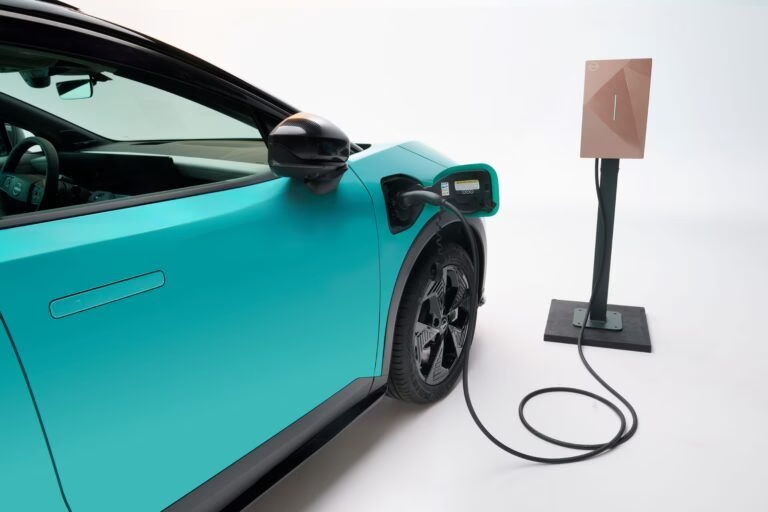

Valeo and Nissan have moved V2G from a concept into a commercial rollout plan. The announcement centers on bidirectional charging, which lets Nissan EVs draw power from the grid and send energy back when conditions are favorable.
V2G takes the lead
V2G, or Vehicle-to-Grid, is the main technical and strategic point of this announcement. It allows electric vehicles to act as mobile energy storage and as grid-support assets.
That changes the role of the car. It becomes part of the energy system, not just a consumer of electricity. Valeo says the agreement supports Nissan’s V2G roadmap in Europe and starts in the UK.
That early market choice suggests a staged launch, likely shaped by certification and regulatory readiness. The commercial focus is clear: make V2G usable, scalable, and deployable in real markets.
Valeo’s charging package
Valeo will commercialize bidirectional AC charging stations for Nissan across Europe. These chargers support two-way energy flow, which is the core requirement for V2G.
Valeo will also supply a Smart Unidirectional AC charger for customers who only need conventional smart charging.
This dual offer matters because not every user will need full V2G capability. Some customers will want efficient, controlled charging only, while others will want energy-return functions.
That gives Nissan a more flexible charging portfolio.It also helps the brand address different customer segments with one roadmap.
Why V2G matters
V2G creates value in both directions. EVs can charge when electricity is cheaper or cleaner, then discharge power when the grid needs support.
That can help with demand management, peak reduction, and broader energy balancing. On users part, the appeal is potential savings and better use of battery capacity.
For grid operators, the value is access to distributed energy resources without building a separate storage network. For automakers, V2G expands the vehicle’s function beyond mobility.
Standards behind the system
Valeo’s smart charging work includes ISO 15118-20 communication support. This protocol helps the charger and vehicle exchange secure data and coordinate energy flow.
That is important because V2G depends on reliable, standardized communication. Valeo also says its software can adapt to local grid codes through the cloud.
That matters in Europe, where market rules and technical requirements differ by country. So this is not just a charger story. It is a software, compliance, and interoperability story too.
Europe rollout path
The agreement starts in the UK and is expected to extend into Europe. That phased path suggests a rollout built around certification, customer readiness, and regulatory alignment.
It also gives Nissan and Valeo time to validate the model before broader expansion. The announcement was tied to Power2Drive Europe, which underscores the charging and energy focus of the deal.
Valeo used that platform to position its Ineez smart charging lineup as part of a broader electrification strategy.
Nissan, meanwhile, continues to emphasize bidirectional charging as an energy benefit for EV owners.
Strategic meaning
This partnership shows how V2G is becoming a commercial product category instead of a future concept.
Valeo is not only supplying hardware. It is helping define how the charging experience will work in different markets. Nissan, in turn, is pairing vehicle strategy with infrastructure strategy.
The broader shift is easy to see. EVs are increasingly treated as flexible energy assets that can interact with homes, fleets, and power networks.
That opens new revenue and service opportunities around charging infrastructure. It also strengthens the link between automotive electrification and power-system decarbonization.
Key details
- V2G is the core theme of the Valeo-Nissan deal.
- The launch begins in the UK, with Europe expansion planned.
- Valeo will provide bidirectional and smart unidirectional AC chargers.
- ISO 15118-20 supports secure communication and energy coordination.
- The goal is to turn EVs into active energy assets.
Sources: Valeo