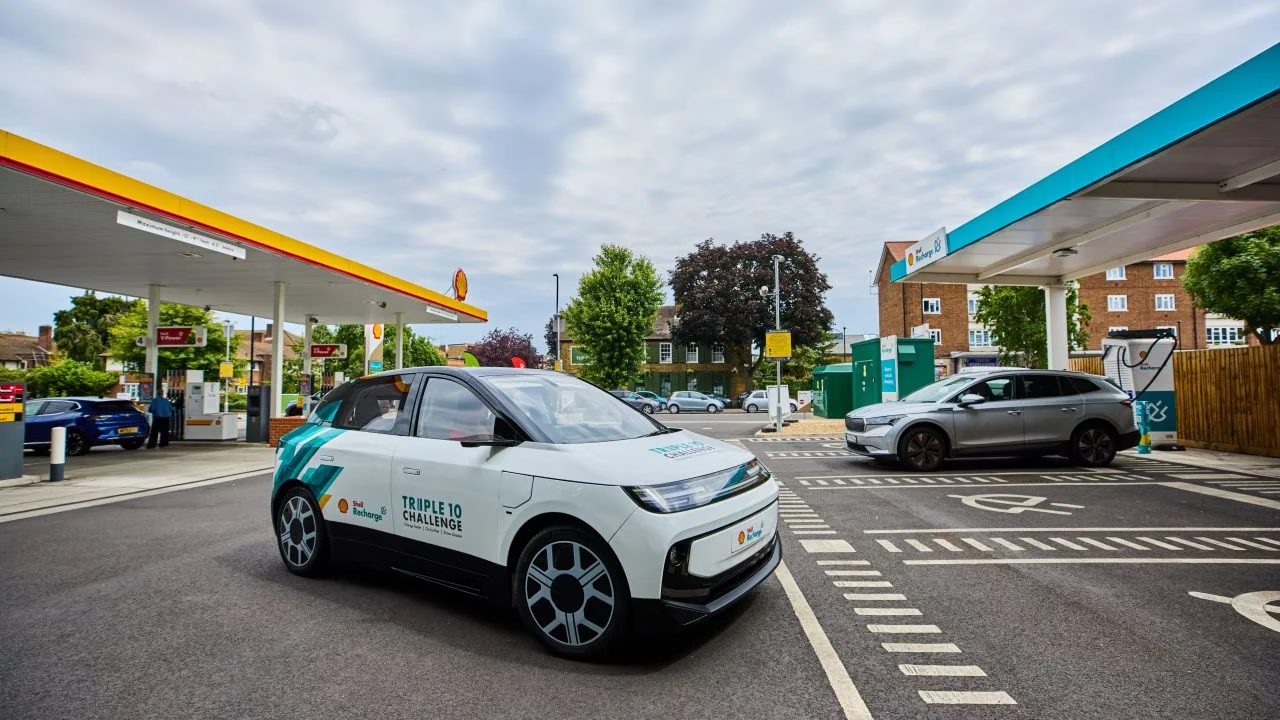

Shell has unveiled its Triple 10 Challenge concept car as a proof of concept for next-generation EV design. The project centers on a smaller battery, immersive thermal management, and lower lifecycle emissions.
Triple 10 goals
Shell built the concept around three targets: sub-10-minute charging, 10 km/kWh efficiency, and a 10-tonne CO2e lifecycle footprint. The company says the vehicle is a compact, mass-market EV rather than a futuristic show car. It is meant to demonstrate a practical path away from ever-larger batteries.
Charging target
The concept car can charge from 10% to 80% in 9 minutes 54 seconds. Shell says it reaches that result on a standard 175kW charger, not an uncommon ultra-fast unit above 300kW. The company also says the vehicle adds 24 km of range per minute, compared with about 13 km per minute for typical BEVs on the same charger.
Efficiency target
Shell says the car achieves 10 km/kWh and delivers more than a 30% improvement in energy efficiency versus many current EVs. That improvement comes from a smaller battery, lighter packaging, and advanced thermal fluids. In practice, the concept shows how better thermal design can support range without simply increasing battery size.
Carbon target
Shell estimates a lifecycle footprint of about 10 tonnes CO2e. The company links that result to lightweight design, recyclable materials, and renewable charging. Shell also says the design could cut lifecycle emissions by about 50% versus typical European-market BEVs.
Thermal design
The central technology is Shell Recharge thermal fluid. Unlike water-glycol systems, this dielectric fluid enables direct immersion cooling for the battery and indirect cooling for powertrain parts. Shell says the simplified single-circuit architecture helps manage extreme fast-charging heat loads in real-world conditions.
Why it matters
This approach reduces the need for heavy, complex piping and separate cooling circuits. Shell says that simplification lowers mass, supports faster charging, and improves overall lifecycle efficiency. The company also says the concept cuts battery pack cost by about 25% versus a conventional EV.
Shell says the fluid can safely handle heat across the battery, motor, and power electronics. It also says the system works with a standard radiator and remains compatible with common infrastructure. The company frames this as scalable technology that already exists today.
Partner network
Shell developed the concept with several engineering partners. RML handled battery pack architecture and high-performance integration. Empel Systems developed the motor and drive units, while HORIBA MIRA led integration, testing, and validation.
The collaboration emphasizes British co-engineering and real-world validation. HORIBA MIRA’s testing included simulated extreme weather conditions. Shell says this work helped prove the single-fluid architecture’s practical use.
Shell’s EV strategy
Shell also said it is bringing its EV capabilities under the Shell Recharge brand. That means charging, fluids, and battery solutions will sit under one end-to-end offer. As part of that shift, the Shell EV-Plus brand will be retired.
This move signals a broader attempt to connect products, services, and vehicle thermal management. Shell presents the concept as part of a longer mobility innovation story that includes Project M, Starship, and Eco-marathon. The company positions the Triple 10 car as another step in that sequence.
Industry significance
The concept matters because it challenges a common EV assumption: bigger batteries are the main answer. Shell instead argues that smarter thermal control can unlock faster charging and better efficiency. That could matter for mass-market EVs where cost, weight, and charging access all shape adoption.
It also highlights the role of thermal fluids in EV engineering. For OEMs and suppliers, the message is that thermal architecture can influence charging speed, battery size, packaging, and total cost. Shell’s claim is not that the concept is production-ready, but that the platform proves a different design path is technically possible.
Triple 10 Concept Highlights
- Shell’s Triple 10 Challenge Concept Car targets sub-10-minute charging, 10 km/kWh efficiency, and a 10-tonne CO2e lifecycle footprint.
- The concept uses a smaller battery to reduce mass and improve overall energy use.
- It relies on direct immersion cooling to manage heat during fast charging.
- Car can charge from 10% to 80% in 9 minutes 54 seconds on a 175kW charger.
- The company claims the design can add 24 km of range per minute.
- Concept improves efficiency by more than 30% versus many current EVs.
- It also claims about a 50% reduction in lifecycle emissions versus typical European-market BEVs.
- Shell developed the vehicle with RML, Empel Systems, and HORIBA MIRA.
- Concept shows how thermal design can support faster charging without relying on larger batteries.
Sources: Shell