
Valeo and Calyos have signed an MoU to develop passive two-phase cooling for chips. The agreement targets mobility and data center applications, where heat loads keep rising.
The two companies want to industrialize standalone cooling systems for high-performance chips. Valeo brings thermal engineering, global scale, and manufacturing depth. Calyos contributes Loop Heat Pipe expertise and passive two-phase cooling know-how.
The collaboration focuses on efficiency, compact design, and reliability. It also aims to reduce maintenance needs by removing active pumping elements.
Why thermal demand is rising
Electrification is increasing the thermal burden in vehicles. Software-defined vehicles also centralize more computing power in tighter spaces. That combination raises heat density around power electronics and processors.
AI growth is creating similar pressure in data centers. Higher rack density and stronger chip power levels make direct-to-chip cooling more important. Valeo says the market now needs better energy efficiency and lower power usage effectiveness.
Mobility applications
Valeo highlights several vehicle uses for the new cooling approach. These include on-board chargers, inverters, and x-in-1 power electronics. The company says the system can work as a compact plug-and-play unit.
The solution also targets software-defined vehicle architectures. Centralized controllers need dependable heat dissipation without complex distributed liquid loops. Valeo says the passive design can simplify integration and reduce energy use.
Data center use cases
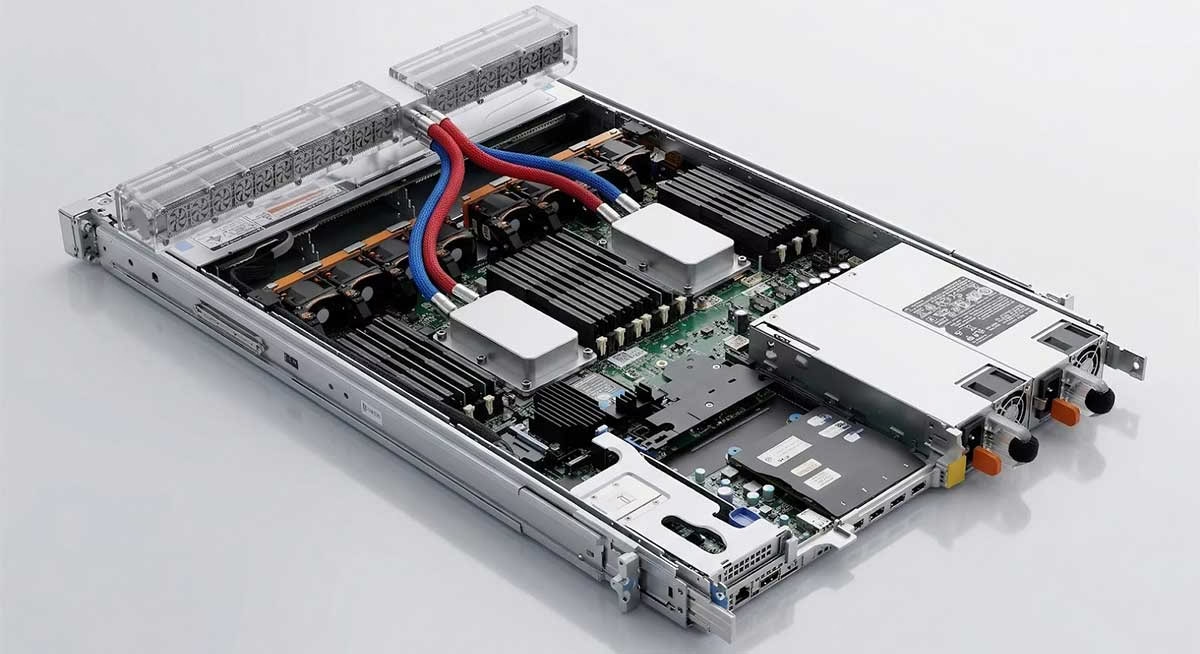
For data centers, the first joint solution uses passive two-phase chip cooling. It is designed to improve cooling efficiency without active parts such as pumps. Valeo says this can support higher processor power and heat flux levels.
The company also emphasizes retrofit potential. Each server can use a standalone unit inside a rack, which may help operators upgrade cooling without rebuilding the whole facility. Valeo presents this as a practical path for direct-to-chip adoption.
Core technical benefits
The announcement highlights three main advantages. First, the system improves energy efficiency through the loop heat pipe effect. Second, it reduces integration complexity and supports compact layouts. Third, it improves reliability by lowering leak risk and removing active fluid pumps.
A passive system also fits longer-term sustainability goals. Valeo frames the technology as a way to cut cooling losses while supporting heat management in electrified and AI-driven environments.
Industrial strategy
Valeo says its role is not only technical. It will also support large-scale production, system reliability, and local-for-local manufacturing. That approach is meant to secure industrial capacity across regions.
The new technology adds to Valeo’s broader thermal portfolio. The company already offers rear door heat exchangers, one- and two-phase CDUs, and immersive cooling for edge data centers. The Calyos deal extends that portfolio into standalone passive cooling.
What company leaders said
Valeo’s Power Division leadership describes the agreement as another step in its thermal management strategy. The company says the goal is to deliver an easy-to-integrate solution that raises efficiency across automotive and data center markets.
Calyos’ leadership says the partnership can move its technology from a specialized solution toward broader industrial adoption. The company sees Valeo’s manufacturing scale as a way to meet cooling needs for AI and electric vehicles.
Company profiles
Valeo positions itself as a global automotive technology company working across electrification, advanced driver assistance, lighting, and software. Its business is organized around the POWER, BRAIN, LIGHT, and Valeo Service divisions.
Calyos focuses on two-phase heat transfer technologies. Its solutions target power electronics, processors, batteries, and other applications where passive thermal management matters. The company serves e-mobility, computing, and renewable energy markets.
Key points
- Passive two-phase cooling removes the need for active pumps.
- The system targets both vehicles and data centers.
- Valeo wants compact, reliable, and easier-to-integrate thermal solutions.
- Calyos brings Loop Heat Pipe expertise to the partnership.
- The deal supports industrialization and large-scale deployment.
Sources: Valeo