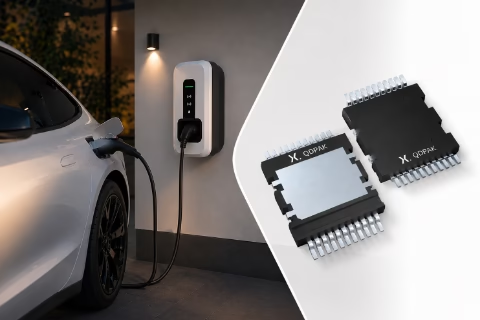

Nexperia announced 1200 V silicon carbide MOSFETs in QDPAK packaging. This top-side cooled surface-mount package optimizes high-power density applications effectively. The new devices extend Nexperia’s growing wide-bandgap portfolio significantly. Engineers face heat dissipation challenges through PCB in conventional high-voltage systems frequently. QDPAK packaging addresses this key limitation in high-voltage power conversion systems directly.
The package enables a direct die-to-heatsink thermal path from the top side. This design reduces reliance on the board as the primary heat-spreading path considerably. Semiconductor and PCB thermal domains can be managed more independently now. Compared to conventional D2PAK-7 packaging, top-side cooled packages deliver up to 3 kW higher output power. These devices provide around 40 °C additional thermal headroom at the same power level too.
Expanded RDS(on) Options Enable Scalable Platform Design
Available variants include both industrial-grade and automotive-qualified options for diverse applications. The portfolio offers RDS(on) options of 17, 30, 40, 60 and 80 mΩ comprehensively. This delivers a scalable QDPAK platform for applications ranging from high-power systems. Compact designs with demanding thermal and mechanical constraints benefit significantly from this platform. Engineers can select the optimal resistance value for their specific power conversion requirements easily.
Building on the existing X.PAK platform, QDPAK further extends power handling capability substantially. Operation at approximately 3 kW higher power occurs at comparable case temperatures reliably. The package offers around 23 °C additional thermal headroom at similar power levels too. This represents a meaningful advancement over previous Nexperia top-side cooled packaging solutions. Designers gain more flexibility when optimizing thermal management in space-constrained applications now.
Key Electrical Characteristics Support Efficient High-Voltage Conversion
Nexperia ‘s 1200 V SiC MOSFETs in QDPAK leverage top-side cooled packaging benefits effectively. The devices deliver electrical characteristics required for efficient high-voltage power conversion applications. Excellent RDS(on) temperature stability supports predictable conduction losses during operation reliably. Reliable operation at elevated junction temperatures occurs without performance degradation concerns typically.
Low-inductance package design supports efficient operation with controlled switching behavior consistently. The additional Kelvin source pin enables faster commutation and improved switching control significantly. Designers manage ringing, EMI and switching transients more effectively with this feature. Switching performance improvements translate to reduced system losses and better overall efficiency metrics. These electrical advantages complement the thermal benefits of top-side cooled packaging architecture.
Top-Side Cooling Advantages for Power Designers
Top-side cooled packages address cooling requirements by enabling maximum power dissipation optimally. Thermal performance optimization occurs through direct heatsink integration without PCB thermal resistance limitations. TSC designs also optimize system-level thermal management strategies for high-power applications effectively. Power density increases while maintaining acceptable junction temperatures under demanding operating conditions consistently.
Industry Applications Span EV Charging and Solar Infrastructure
High-efficiency, high-voltage power conversion applications represent the primary target market for these devices. The devices enable electrical performance of Nexperia’s SiC technology with simplified thermal management. Mechanical integration becomes more straightforward compared to traditional through-hole packaging approaches significantly. Higher output power, increased efficiency and improved thermal performance occur in compact designs notably.
Electric vehicle onboard chargers benefit from the enhanced power density and thermal characteristics substantially. 800V architecture EV charging systems require 1200 V SiC devices for reliable operation at high voltages. Photovoltaic inverters also leverage these MOSFETs for improved efficiency in solar energy infrastructure applications. System losses reduce by up to 70% when using advanced SiC MOSFET technology in solar inverters. This enables smaller size, weight and cost for solar energy conversion systems overall.
Automotive Qualification Supports EV Powertrain Integration
Automotive-qualified variants meet AEC-Q101 certification requirements for vehicle integration applications reliably. Temperature stability becomes more critical with SMD packaging since devices cool through the PCB primarily. Nexperia adjusted its process technology to ensure industry-leading temperature stability for these devices. The nominal value of RDS(on) increases by only 38 percent over operating temperature range from 25 °C to 175 °C. This feature allows getting more power out of selected Nexperia SiC MOSFET devices compared to competitors.
Compared to other SiC devices, Nexperia’s temperature stability enables higher power extraction consistently. Designers can push devices closer to thermal limits without performance degradation concerns typically. This advantage is particularly valuable in automotive applications where operating temperatures vary widely. Vehicle powertrain integration requires robust devices that maintain performance across extreme temperature ranges reliably.
Competitive Positioning Within Wide-Bandgap Market Segment
Nexperia positions itself as a discrete device designer and manufacturer in the semiconductor industry. Class-leading figures-of-merit distinguish Nexperia SiC MOSFETs from competitor offerings in the market. RDS(on) represents a particularly critical parameter due to its impact on conduction power losses significantly.
The initial X.PAK portfolio included products with RDS(on) values of 30, 40, 60 mΩ previously. A part with 17 mΩ was released in April 2025 as planned successfully. Automotive qualified SiC MOSFETs portfolio in X.PAK packaging followed later in 2025. Further RDS(on) classes like 80 mΩ were added to expand application coverage comprehensively. The QDPAK launch represents the next evolution in Nexperia’s top-side cooled packaging strategy.
QDPAK vs Previous Packaging Platforms Comparison
| Packaging Type | Power Increase | Thermal Headroom | Key Advantage |
|---|---|---|---|
| D2PAK-7 (conventional) | Baseline | Baseline | Standard SMD package |
| X.PAK (previous) | ~3 kW | ~23 °C | First top-side cooled |
| QDPAK (new) | ~3 kW | ~40 °C | Enhanced thermal performance |
Strategic Partnership Extensions Expand Market Reach
Nexperia and Semikron Danfoss explored strategic collaboration opportunities in recent press releases. Such partnerships strengthen Nexperia’s position in high-power applications across multiple market segments. Collaboration with power module specialists enables broader system-level solution offerings for customers. This strategic approach supports Nexperia’s growth strategy in the wide-bandgap semiconductor market.
The QDPAK launch demonstrates Nexperia’s commitment to advancing power semiconductor technology continuously. Engineers gain access to improved thermal performance without sacrificing electrical characteristics typically. Compact design requirements in modern power electronics favor top-side cooled surface-mount packages increasingly. Market demand for higher power density drives continued innovation in packaging technology approaches.
Sources: Nexperia