
Modern vehicles require efficient power solutions to handle advanced electronic systems. The transition from traditional 12V architectures to advanced high-performance 48V power platforms addresses growing electrical loads. Advanced driver assistance systems and automated driving functions increase the total power consumption significantly. Software-defined vehicle architectures also add serious burden to traditional low-voltage power networks.
Thicker wiring harnesses become necessary when designers attempt to increase power delivery within standard 12V boundaries. This modification increases total vehicle weight, raises manufacturing costs, and complicates the physical component packaging. Therefore, global automotive manufacturers actively adopt decentralized 48V distributed power systems to solve these layout issues. Higher voltage delivery naturally lowers the electrical current requirement for any given power level.
According to basic electrical power equations, a fourfold increase in voltage minimizes line current to exactly one-quarter. Consequently, this engineering approach reduces resistive power losses across the vehicle network by a factor of sixteen. Lighter wiring harnesses save significant chassis weight and improve vehicle energy efficiency over long driving ranges. However, this high-voltage transition simultaneously creates complex power management problems during vehicle standstill periods.
Managing Vehicle Standby Current Constraints
High Input Voltage Power Challenges
Vehicle electronic control units must operate continuously even when the main ignition switch remains completely off. Always-on tracking systems, security gateways, and communication modules draw energy from the auxiliary battery constantly. The cumulative standby current of these parallel networks can deplete the storage cells during extended parking. Therefore, component-level efficiency during the ignition-off state represents a critical design restriction for power networks.
Microamp Level Target Budgets
Platform engineers distribute ultra-low current budgets to individual electronic modules to prevent complete battery drainage. Total vehicle shutdown current often reaches tens of milliamps, requiring individual devices to consume microamp-level energy. Minor reductions in current consumption at the integrated circuit level yield massive improvements for the entire platform. Specialized analog semiconductor designs focus heavily on minimizing this quiescent current across all operational temperature ranges.
Specialized Low Power Semiconductor Solutions
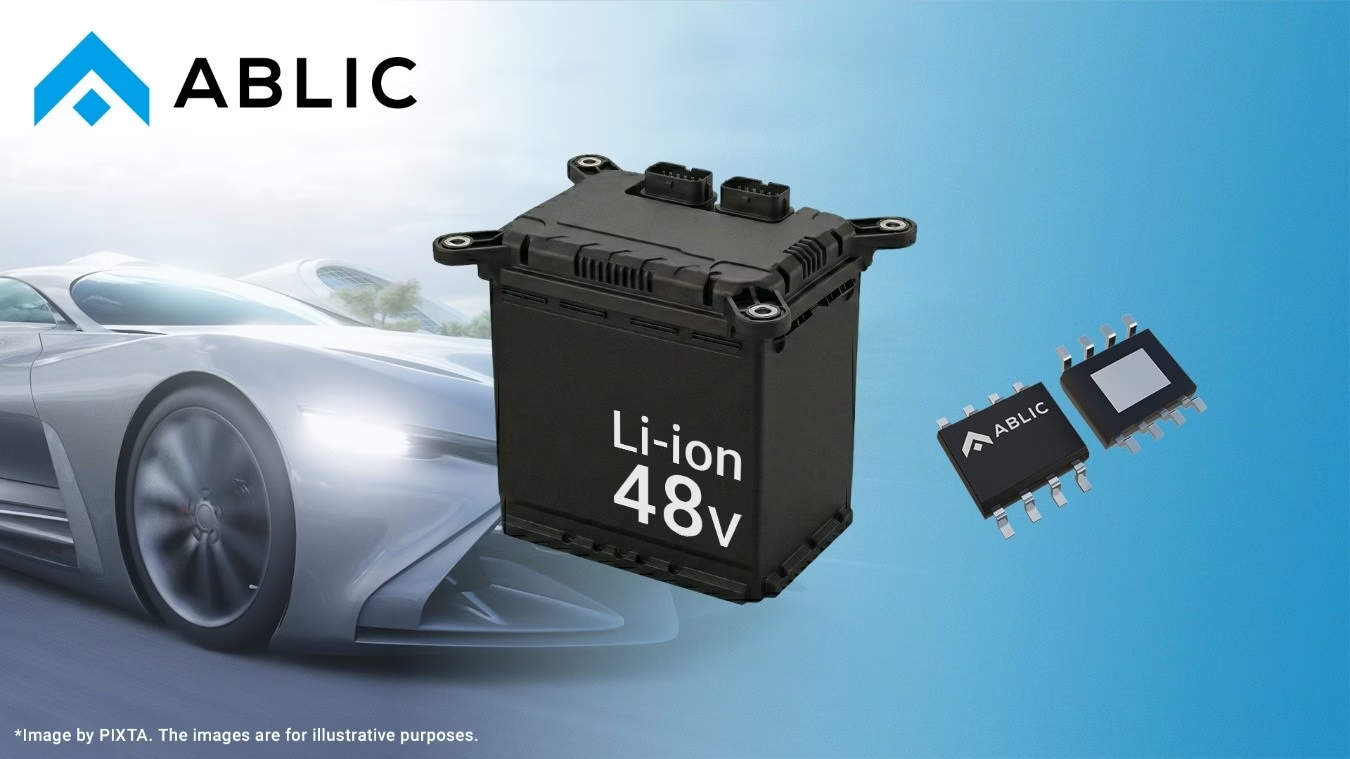
Analog semiconductor manufacturer ABLIC expands its component portfolio to solve modern high-voltage power network challenges. The organization deploys its historical expertise in ultra-low-power analog circuit design directly to 48V domains. This ongoing power strategy prioritizes microamp-level current optimization across diverse integrated circuit families. These developments specifically target low-dropout linear regulators, step-down switching converters, and precision voltage monitoring components.
The introduction of the S-19230 and S-19231 series linear regulators marks a major milestone. These automotive-grade low-dropout regulators operate reliably within the auxiliary battery networks of modern high-voltage vehicles. The primary engineering achievement centers on a remarkably low operating current of just 2.0 microamps. This low quiescent profile prevents unnecessary battery drain while maintaining active voltage regulation for standby microprocessors.
Furthermore, these integrated circuits feature a robust 80V absolute maximum input voltage rating. This high threshold protects internal components against sudden load dumps and inductive voltage spikes. The adjustable output voltage variants include an innovative integrated open-loop protection mechanism. This specialized safeguard suppresses sudden output overvoltage conditions if external setting resistors fail completely.
- AEC-Q100 qualification guarantees high reliability under harsh automotive thermal environments.
- Integrated protection circuitry reduces external component count and saves printed circuit board space.
- Device-level diagnostic safeguards simplify the safety validation process for vehicle platform architects.
Industrial High Voltage Ecosystem Evolution
The transition toward 48V vehicle architectures progresses steadily across various regional manufacturing hubs. Global semiconductor suppliers develop distinct approaches to satisfy these modern power delivery network needs. For example, STMicroelectronics delivers comprehensive high-voltage linear regulators and direct power conversion chips for advanced data systems. Their technology focuses on precise post-regulation stages to supply clean energy to sensitive processing cores.
Similarly, Infineon Technologies manufactures smart high-side power switches designed specifically for next-generation 24V and 48V distribution networks. Their Power PROFET architecture replaces traditional electromechanical relays and discrete fuse components with solid-state silicon. These devices provide low standby current states combined with advanced diagnostic feedback during active switching. They also comply with strict ISO 26262 functional safety requirements for autonomous driving systems.
Meanwhile, modular power component manufacturers like Vicor Corporation advocate for highly dense distributed power architectures. Their engineering strategy utilizes isolated bidirectional converter modules to bridge high-voltage traction batteries with low-voltage loads. This architecture enables a gradual transition by allowing legacy 12V subsystems to coexist with newer 48V buses. This modular methodology optimizes packaging flexibility and maintains fast transient responses across shifting operational conditions.
Advanced Power Optimization and Monitoring
Expanding the product portfolio allows analog designers to address complex efficiency challenges beyond simple voltage regulation. Conventional step-down switching converters often suffer from severely degraded efficiency under very light electrical loads. Therefore, specialized DC-DC converters must utilize advanced pulse-frequency modulation modes during vehicle standby states. This technical adaptation ensures efficient power transformation even when the electronic control unit consumes minimal current.
Simultaneously, the development of dedicated 48V battery monitoring integrated circuits eliminates old system design compromises. Older safety layouts relied on large external resistor dividers to step down high voltages for monitoring. These passive components consumed continuous current and expanded the total bill of materials for the manufacturer. Modern monitoring chips evaluate high-voltage rails directly, decreasing component counts and maximizing measurement accuracy.
Predictable fault behavior remains a top priority for tier-one automotive suppliers worldwide. Silicon-level protection mechanisms minimize the dependency on external software monitoring loops and redundant defensive circuits. Consequently, this engineering approach shortens the validation cycle for complex safety-critical vehicle programs. Microamp-level hardware optimization ultimately defines the true parking duration capability of modern electrified transport platforms.
Source: ABLIC