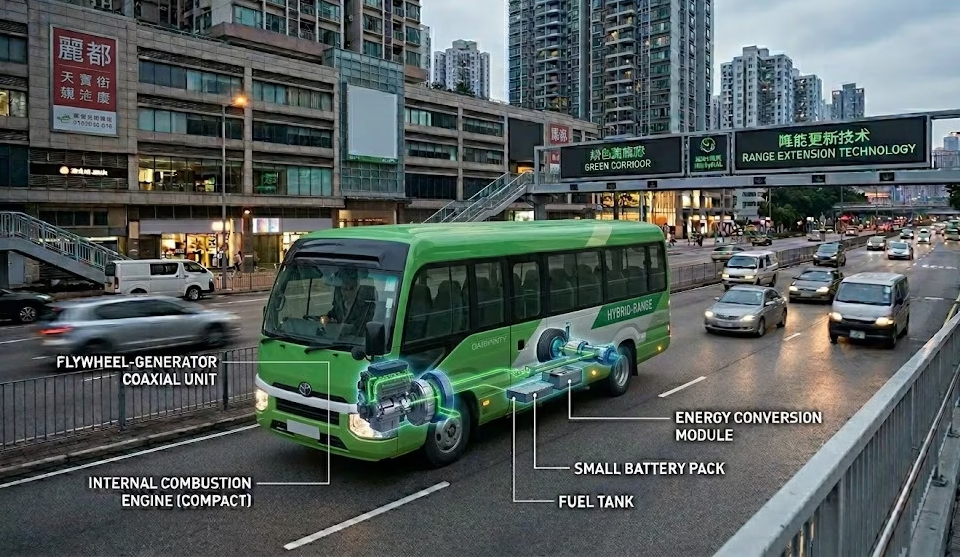

The public transit sector in the Guangdong-Hong Kong-Macao Greater Bay Area is embracing advanced eco-friendly powertrain architectures. Wisdom Motor recently integrated commercial minibuses with the YCY24-65kW Flywheel Range Extender Tech System developed by China Yuchai International. This modern machinery resolves critical issues that typically hamper pure electric configurations within dense populations. Operators usually face steep initial purchase expenses, severe battery degradation, and limited charging grids.
This advanced mechanism completely removes the dependency on fixed electrical recharging networks. Instead, the vehicle relies on an innovative dual fuel-electric replenishment framework to maintain power. This setup provides an unlimited operational driving range during continuous daily use. Therefore, regional mass transit networks can function smoothly without encountering scheduling interruptions or battery charging delays.
Furthermore, the design proves ideal for the heavy traffic conditions found in Hong Kong. The metropolitan landscape demands constant stop-and-go driving patterns from public transit buses. This system allows the engine to produce power consistently within its most optimal parameters. Consequently, small-displacement public transit vehicles can achieve remarkable fuel savings of up to 50 percent.
Coaxial Mechanical Engineering Upgrades Power Generation
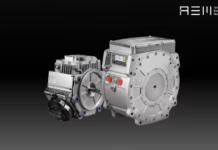
The primary innovation of this machinery lies within its unique integrated configuration. Conventional range extenders rely on a detached engine combined with a separate generator component. In contrast, the YC-FRS fuses the flywheel directly to the engine crankshaft using a rigid coaxial layout. This sophisticated setup unites the combustion engine and alternator into a single physical block.
By eliminating multiple redundant mechanical links, the hardware layout achieves extreme simplicity. The total weight and structural length of the power pack decrease significantly. Because there are fewer moving connections, overall system reliability experiences an enormous boost. In fact, the manufacturer guarantees lifelong maintenance-free operation for this unified core power block.
This deep physical coupling creates an ideal overlap between the high-efficiency zones. The mechanical power generation process reaches an excellent peak output efficiency rate. For instance, the diesel configuration produces an impressive 4.8 kilowatt-hours of electrical energy per liter. This seamless mechanical execution dramatically drops operating costs below the baseline of pure battery-powered alternatives.
Smart Operations and Intelligent Power Balancing
Advanced algorithmic systems regulate the energy flow across diverse urban driving environments. The powertrain utilizes intelligent coupling control algorithms alongside highly adaptive energy management programs. These programs continuously analyze real-time variables to select the best operating modes. The vehicle can shift dynamically between power-following, full-time driving recharge, and silent pure-electric propulsion.
Additionally, the software closely tracks and maintains exhaust aftertreatment temperatures. Ensuring the exhaust components remain inside optimal thermal windows guarantees complete environmental compliance. The setup meets stringent global emission standards while maintaining high peak system efficiency. Operators can monitor performance indicators seamlessly while minimizing environmental impacts across crowded urban routes.
Urban Noise Reduction and Deceleration Energy Capture
A major highlight of this powertrain centers on its exceptional acoustic management. The optimized configuration minimizes vibrations to deliver very low operational sound levels inside cities. Passengers enjoy a quieter ride, which greatly enhances comfort during long traffic delays. Reducing transit noise helps lower the overall environmental acoustic footprint in residential zones.
Moreover, the system incorporates highly efficient regenerative braking hardware to harvest kinetic energy. The alternator acts as a generator during vehicle deceleration to capture lost power. This captured energy is redirected immediately back into the onboard storage cells. This continuous loop boosts system utility while lowering friction wear on traditional brakes.
Commercial Propulsion Matrices
- Broad Power Scalability: The technology platform easily scales to deliver power outputs ranging across a versatile 15 kW to 600 kW spectrum.
- Diverse Vehicle Support: The adaptive layout fits logistics trucks, passenger transit buses, heavy mining equipment, and large agricultural machinery.
- Strategic Industry Adoption: Prominent global equipment manufacturing brands like FAW Jiefang, Dongfeng, Sany, and Caterpillar deploy these advanced configurations.
- Regulatory Road Privileges: Vehicles utilizing this green alternative powertrain qualify for special priority road access privileges within busy metropolitan zones.
Technical Innovations Drive Next-Generation Fleets
This deployment marks a monumental advancement for sustainable transportation technologies. The project strengthens industrial supply chains by proving the viability of alternative powertrains. It establishes an excellent green footprint for clean operations across international logistics markets. The platform addresses long-standing challenges like infrastructure shortages that slow modern fleet updates.
Furthermore, the manufacturing parent entity continues to diversify its green propulsion portfolio. The enterprise builds everything from conventional clean diesel options to hydrogen fuel cells. They recently introduced an innovative ammonia-fueled commercial combustion engine boasting high thermal traits. This continuous drive for alternative propulsion guarantees cleaner air across global transportation networks.
Sources: China Yuchai International