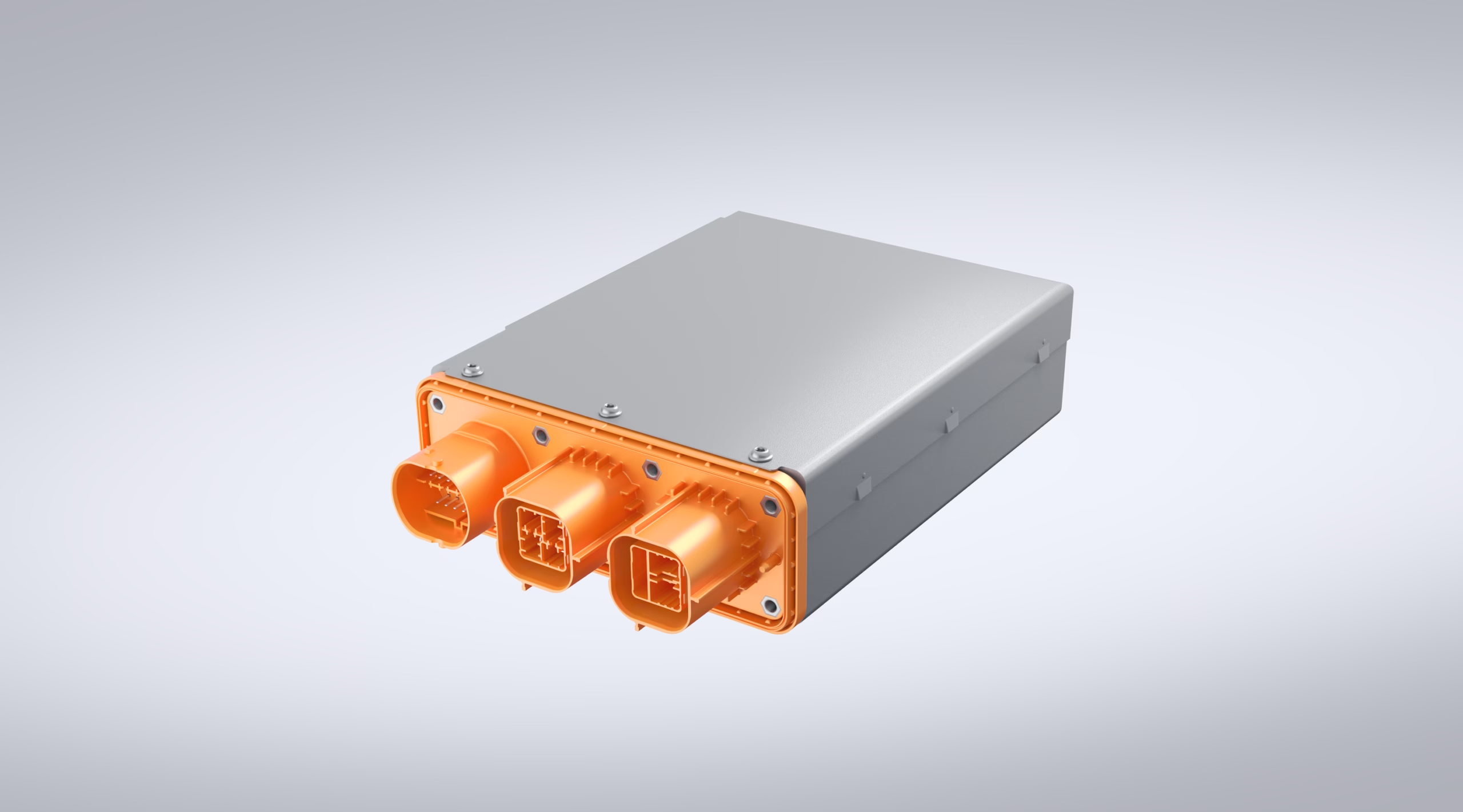

FORVIA HELLA has secured two major series orders for its EnergyCore solutions. The contracts cover a 3-in-1 high-voltage battery management system and a 48-volt PowerPack.
Two international automakers placed the orders. One customer operates in the Americas, while the other operates in Europe. The combined order volume falls within the mid-three-digit million-euro range. Series production is scheduled to begin in December 2027 and spring 2028, respectively.
The contracts provide commercial validation for FORVIA HELLA’s integrated electrification strategy. They also demonstrate how automakers are seeking simpler, lighter, and more compact electrical systems.
EnergyCore combines battery electronics
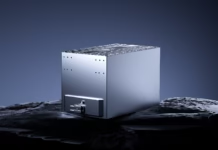
EnergyCore is FORVIA HELLA’s scalable battery and power-electronics portfolio. The technology combines functions that manufacturers traditionally install as separate components.
The new orders cover two different system architectures. One targets larger full-hybrid vehicles, while the other supports 48-volt hybrid applications.
FORVIA HELLA says these solutions reduce vehicle cost and complexity. They also reduce weight, space requirements, component numbers, and wiring effort.
This integrated approach supports FORVIA Group’s IGNITE strategy. The strategy aims to develop FORVIA HELLA from a component supplier into an integrated system provider.
EnergyCore can adapt to different vehicle architectures and battery-pack designs. This flexibility allows automakers to use related technologies across several vehicle platforms.
3-in-1 system integrates battery functions
The first series order covers FORVIA HELLA’s 3-in-1 high-voltage battery management system. The architecture integrates three important battery functions.
It combines:
- A Battery Management Unit.
- Cell Measurement Units.
- A Battery Junction Box.
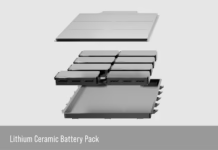
These components normally operate as separate elements within a high-voltage battery pack. Combining them creates a more compact and integrated battery-control system.
The Battery Management Unit supervises the battery’s operating condition. It processes voltage, temperature, and other information from the cell measurement units.
The Cell Measurement Units monitor individual cells or cell groups. They provide the data needed for cell balancing and battery protection.
The Battery Junction Box manages high-voltage electrical connections. It controls current flow between the battery and the vehicle’s electrical system.
Faster high-voltage control
The integrated unit can directly control high-voltage current between the battery and vehicle. This arrangement enables faster system responses.
Faster responses can support improved functional safety. The system can react more quickly when it detects abnormal voltage, current, or temperature conditions.
The architecture also uses optimized cell monitoring. This reduces the number of required Cell Measurement Units.
Fewer measurement units reduce the number of components inside the battery pack. They also reduce wiring effort, weight, space requirements, and system costs.
The result is not simply a smaller battery controller. It is a complete architecture that combines monitoring, switching, and battery-management functions.
Larger hybrids are the first target
FORVIA HELLA designed the 3-in-1 system initially for larger full-hybrid vehicles. These vehicles require more powerful electrical systems than standard 48-volt mild hybrids.
Full hybrids can drive using electric power for limited periods. They therefore require stronger battery management and high-voltage control.
The system must manage current between the battery and vehicle powertrain. It must also maintain safe operation during charging, discharging, and regenerative braking.
The scalable architecture can adapt to different OEM requirements. It can also accommodate different battery-pack designs.
FORVIA HELLA says the basic concept can apply to fully electric vehicles. However, the current series application targets larger full-hybrid vehicles.
This distinction is important. The company presents battery-electric use as a potential extension, rather than the confirmed application for these orders.
Functional safety supports premium vehicles
FORVIA HELLA made functional safety a major focus during series development. The company designed the PowerPack for future premium vehicle platforms.
Hybrid battery systems control electrical energy during several operating conditions. These include braking, acceleration, coasting, engine starting, and battery charging.
A failure in the battery-management or conversion system can affect vehicle operation. Therefore, the electronics must detect faults and respond within strict time limits.
The 3-in-1 architecture supports faster high-voltage current control. This feature can improve the system’s ability to respond to electrical faults.
Integration can also reduce the number of interfaces. Fewer interfaces may simplify communication between battery electronics and vehicle controllers.
However, the combined architecture requires extensive validation. Engineers must assess the hardware, software, electrical connections, thermal conditions, and fault responses as one system.
Potential for electric vehicles
The 3-in-1 battery-management concept currently targets larger full-hybrid vehicles. However, FORVIA HELLA says the basic architecture can also apply to fully electric vehicles.
Battery-electric vehicles use larger high-voltage battery packs. They require accurate cell monitoring and rapid protection against electrical faults.
The integrated system could reduce the number of measurement units. It could also shorten wiring paths and reduce battery-pack space requirements.
Those benefits may become more valuable as battery packs grow larger. They could also support standardized architectures across several vehicle programs.
However, the company has not announced a specific battery-electric series program for this system. Its potential BEV application should therefore remain separate from the confirmed hybrid orders.
Sources: FORVIA HELLA