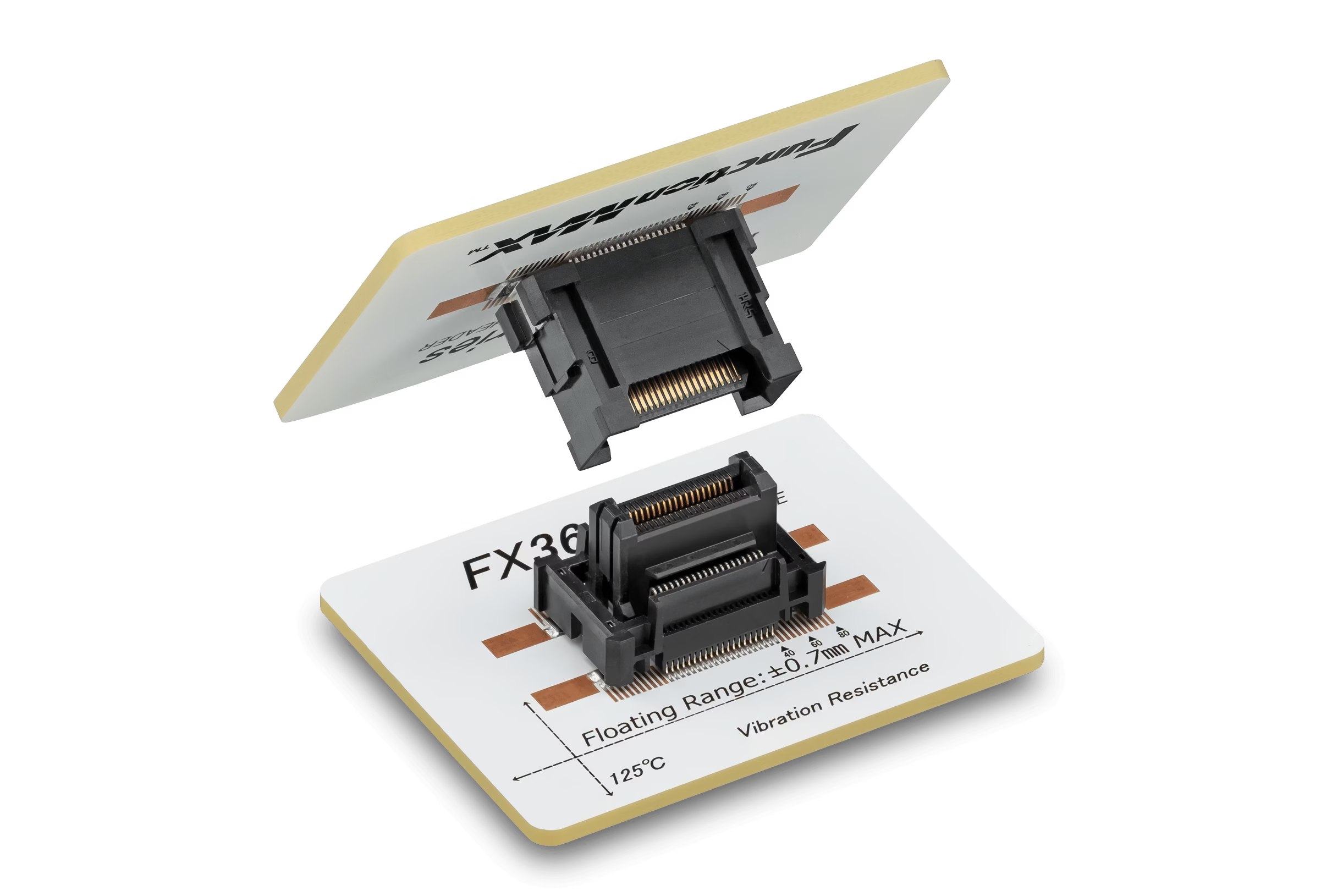

Hirose Electric launched the FX36 series connectors. It is a 0.5 mm pitch board-to-board connector built for BEV and HEV powertrain equipment. The company designed it for compact modules that must handle heat, vibration, and tight board layouts.
The FX36 sits in Hirose’s FunctionMAX family and targets high-vibration environments. It combines floating motion, vibration absorption, and two-point contact in one automotive connector. Hirose positions it for X-in-1 units, inverters, converters, onboard chargers, EPS, and domain controllers.
Why Hirose made it
Electrification is increasing the number of functions inside each vehicle module. That creates more pressure on enclosure size, board layout, and assembly efficiency. Hirose says cable connections have often filled this role, because few board-to-board options could handle harsh vibration and high temperature together.
The company first addressed this gap with the FX26 series. FX26 used a 1.0 mm pitch and gained adoption in inverters and converters for large drive motors. FX36 builds on that base and reduces the pitch to 0.5 mm for more miniaturization and space savings.
Main design points
The FX36’s biggest advantage is its floating structure. It allows misalignment during mating, which helps assembly and improves layout tolerance. Hirose lists a floating range of ±0.7 mm in X and Y, plus an effective mating length of ±0.5 mm in Z.
It also uses a vibration absorption structure that reduces PCB amplitude in the Z direction. Hirose states the total vibration absorption amount is 0.05 mm while the application is running. That feature matters in powertrain systems, where vibration can weaken connection reliability over time.
Key specifications
The FX36 series is aimed at compact automotive packaging and high reliability. Hirose highlights the following features:
- 0.5 mm pitch for high-density mounting.
- Floating range of ±0.7 mm in X and Y.
- Effective mating length of ±0.5 mm in Z.
- Vibration absorption of 0.05 mm in Z.
- Two-point contact for stable electrical connection.
- Heat resistance up to 125 C.
The current mass-production version is a 40-position, 20 mm-height model. The product page also lists a rated current of 0.5 A and rated voltage of 50 V AC or DC. Hirose says the connector is SMT-mounted, straight, gold-plated, and rated for operating temperatures from -40 C to 125 C.
What the structure does
Hirose separates the connector’s vibration behavior into two functions. One is misalignment absorption during mating, which helps the connector connect even when boards are not perfectly aligned. The other is vibration absorption during operation, which reduces PCB movement in the mating direction.
That distinction matters in automotive electronics. Assembly tolerance helps during manufacturing, while vibration damping helps during long-term use. In other words, the FX36 is built to solve both build-time and run-time problems.
Where it fits
Hirose says the FX36 is well suited for harsh-environment powertrain applications. That includes multifunction systems such as X-in-1 units, where several functions are integrated into one module. It also fits inverters, converters, onboard chargers, electric power steering, and domain controllers.
The product page labels it as a recommended connector for high-vibration environments. It is also presented as a space-saving solution for designs that need compact height options between 15 mm and 20 mm. That makes it useful for engineers balancing packaging limits, reliability, and assembly constraints.
Product roadmap
Hirose says the FX36 series will expand beyond the first 40-position version. Planned variants include 40, 50, 60, and 80 positions. Height options under development include 15 mm, 18 mm, and 20 mm.
This roadmap suggests Hirose wants the platform to cover more layouts and module types. It also signals that the company sees demand for compact, vibration-resistant board-to-board connectors in automotive power electronics. The launch looks like a broader push to replace cable-heavy designs with denser interconnect solutions.
Sources: Hirose