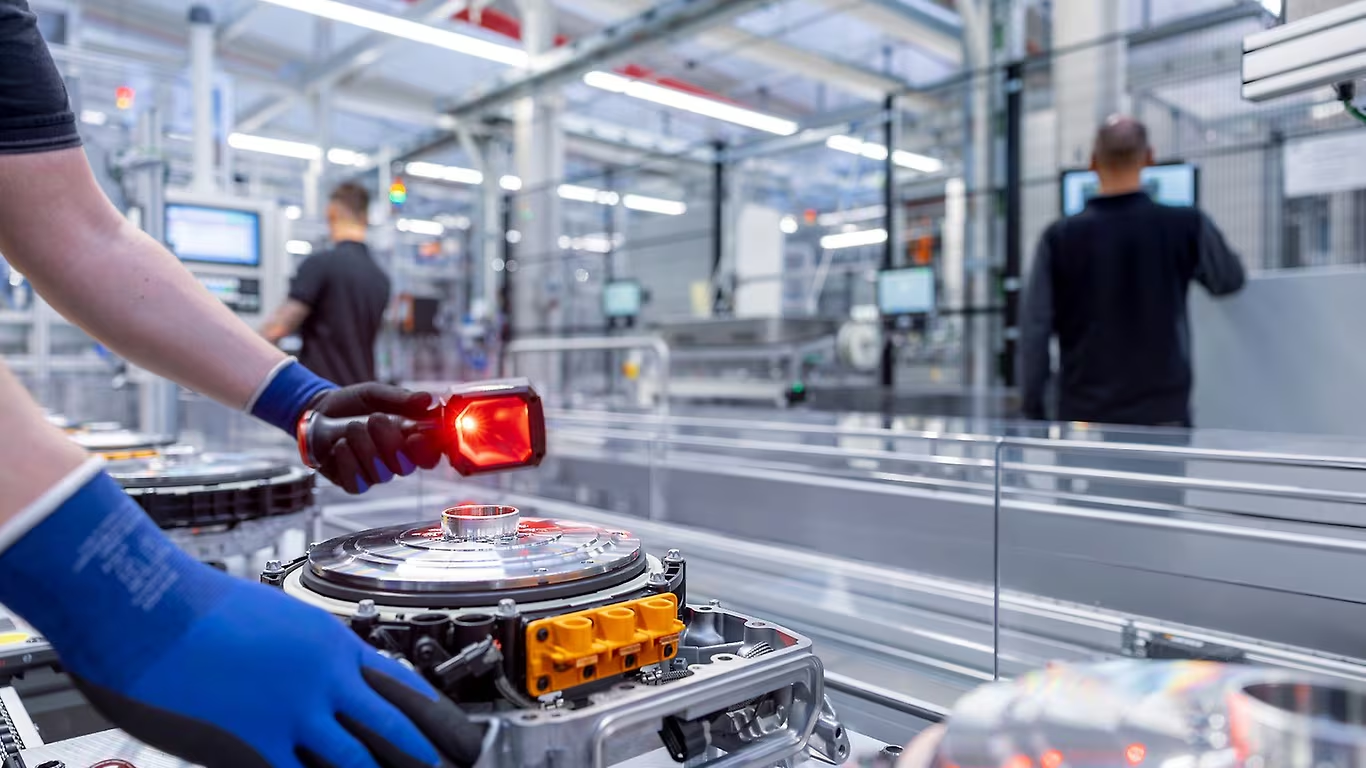

Mercedes-Benz has moved its axial flux motor program from concept to production. The Berlin-Marienfelde plant now builds a motor architecture that promises high output, compact packaging, and stronger performance for the AMG line.
Production shift
The Berlin-Marienfelde site is a major step for Mercedes-Benz’s electric drive strategy. The company says the plant has become a center of excellence for high-performance electric motors and digital manufacturing.
This matters because advanced motor concepts often struggle when they leave the prototype stage. Mercedes-Benz is now showing that the axial flux design can be built repeatedly, with quality control and industrial discipline.
Why axial flux stands out
Axial flux motors use a different magnetic flow path than conventional radial motors. Instead of pushing force outward from the center, the design works along the shaft axis, which creates a flatter, more compact layout.
That geometry is the reason the motor attracts attention in performance EVs. It allows high torque density in a smaller space, which helps engineers package more capability into the same vehicle footprint.
Technical wins
Mercedes-Benz’s biggest win is power density. The motor delivers strong performance without requiring a large, heavy drivetrain, which is valuable in a high-output electric AMG.
A second win is packaging efficiency. The compact design supports front- and rear-axle integration, which gives Mercedes more freedom in vehicle layout and weight distribution.
A third win is weight reduction. Axial flux motors are widely described as much lighter than comparable conventional motors, and Mercedes has highlighted the architecture as a major step forward for performance EVs.
A fourth win is sustained performance. The YASA-based design uses cooling and motor geometry that support strong output under demanding driving conditions. That makes it better suited to AMG use than many ordinary EV motors.
What Mercedes had to solve
The engineering challenge was not just designing the motor. Mercedes also had to industrialize it, which meant building new processes for winding, assembly, inspection, and final calibration.
The company says the production chain contains 98 process steps, including many that were new to Mercedes-Benz and even new worldwide. That shows the difficulty of translating advanced motor theory into repeatable factory output.
One especially difficult stage is final assembly. Mercedes describes a “wedding” step where the stator is placed between two magnet-equipped rotor discs, with very tight tolerances and strong magnetic forces.
Why the Berlin plant matters
Berlin-Marienfelde is more than a manufacturing address. It now acts as a proving ground for digital production, automation, AI-supported checks, and precision assembly methods.
Mercedes says the Digital Factory Campus has helped develop and test these processes since 2022. That makes the site useful not only for the current motor, but for future electric drive programs as well. This is one of the most important wins in the story. Mercedes-Benz is building manufacturing capability, not just launching a new component.
AMG application
The first production use is in the Mercedes-AMG GT 4-Door Coupe. That choice is strategic because AMG gives the company a real-world platform to prove the motor’s performance claims.
Mercedes says the car can accelerate from 0 to 100 km/h in as little as 2.1 seconds. That figure helps show the motor’s value in a vehicle where instant torque and repeatable output matter most.
The launch also strengthens AMG’s electric identity. Instead of relying on battery size alone, Mercedes can point to drivetrain engineering as a source of performance.
Key wins
- Compact axial flux layout.
- High torque and power density.
- Lighter drivetrain packaging.
- Better fit for performance EVs.
- Real series-production launch in Berlin.
- Stronger AMG differentiation.
Broader significance
The launch shows that Mercedes-Benz is serious about premium electric performance. It also signals that advanced motor architecture can move from specialist applications into regular production.
That is a meaningful development for the wider EV market. Many manufacturers talk about next-generation motors, but few can show a full production system with this level of complexity and scale.
Mercedes-Benz is also reinforcing the strategic value of its YASA acquisition. The company now has a motor technology advantage that is tied to both engineering depth and factory execution.
Sources: Mercedes-Benz