
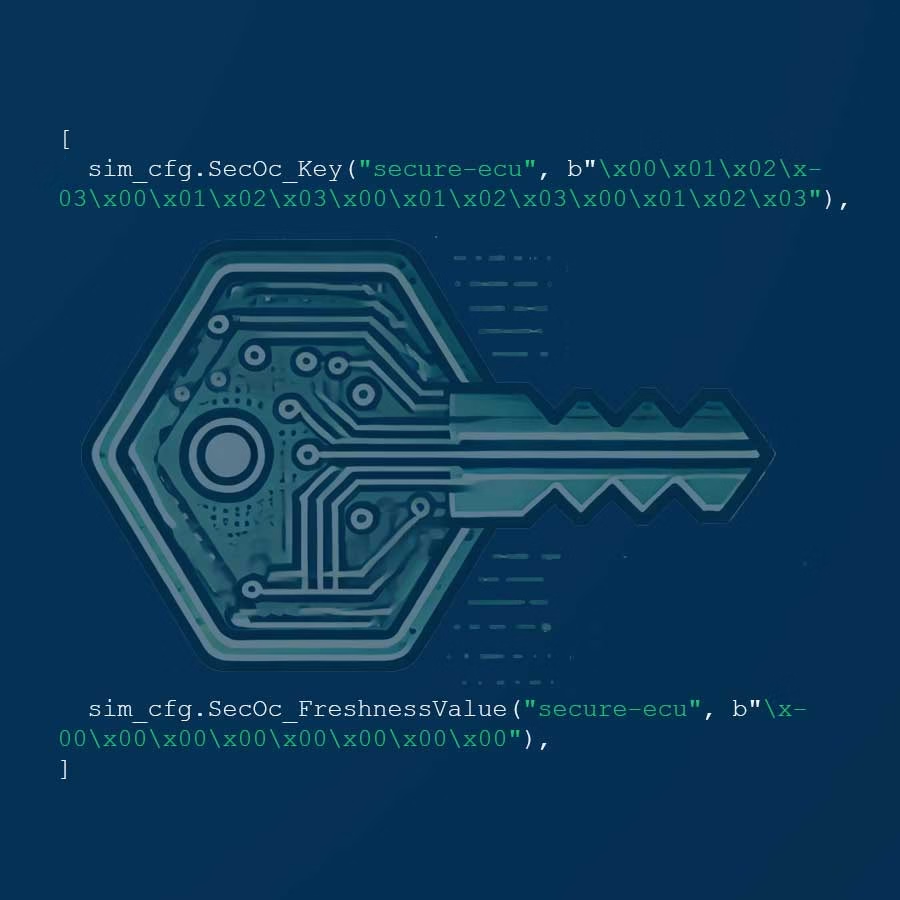

RemotiveLabs says SecOC is now integrated into RemotiveBroker, its platform core. The update focuses on secure message authentication for modern automotive communication. It aims to protect ECU-to-ECU traffic against cyberattacks while keeping integration practical for developers.
SecOC, or Security On-board Communication, provides integrity and authentication for messages. In this implementation, the protection applies to signal groups and PDUs. RemotiveLabs frames the feature as a way to make secure communication easier across automotive protocols.
Why SecOC matters
Vehicle networks move large amounts of control data between ECUs. That traffic needs more than encryption alone, because receivers also need trust in message origin and freshness. RemotiveLabs presents SecOC as a security layer that helps detect replay attacks and verify authenticity.
The post also positions SecOC as part of a broader AUTOSAR-oriented workflow. It notes that the mechanism relies on CMAC and a Freshness Value Manager in order to support validation and anti-replay protection. That matters because secure communication in vehicles must stay deterministic and manageable.
Signal database integration
A major part of the announcement is the way RemotiveBroker handles configuration. The platform supports ARXML, LDF, DBC, and Fibex formats. It then extracts SecOC and E2E protection data and stores it directly in the signal database.
This approach reduces manual setup work. It also helps avoid integration mistakes that can slow engineering teams down. RemotiveLabs describes the method as “baking” the security data into the database used by the developer.
The company argues that this makes SecOC easier to adopt in real projects. Instead of stitching together separate security settings, teams can work from a more unified configuration flow. That can save time during development, validation, and iteration.
Practical developer benefits
RemotiveLabs says the feature is meant to help developers avoid common implementation roadblocks. The platform can generate both correct and intentionally incorrect SecOC frames for testing. That flexibility matters when teams need to validate how their ECUs respond to malformed or invalid traffic.
The company also says the platform works in multiple environments. It can run in-vehicle, on a developer laptop during early mocking, or in CI pipelines in the cloud. That broad deployment model makes the feature useful across the full development cycle.
A 30-day free trial is available for RemotiveBroker. RemotiveLabs says users can begin with hardware they already have, including a Linux computer. The company presents the trial as a low-friction way to explore SecOC integration.
What the update signals
This update shows how security is moving closer to the developer workflow. Instead of treating SecOC as a separate specialist task, RemotiveLabs folds it into the same platform that handles signal data. That reduces friction and may improve consistency across teams.
The announcement also reflects a broader trend in automotive software development. Security, validation, and signal management are increasingly being handled together rather than in separate toolchains. For developers, that can mean fewer handoffs and more repeatable results.
RemotiveLabs is clearly targeting engineers who need secure communication without excessive tooling overhead. The company’s message is simple: secure ECU messaging should be easier to configure, test, and deploy. Its platform update is designed around that promise.
Common questions
How SecOC works
SecOC helps the receiver verify message authenticity and freshness. It also helps detect replay attacks and validate integrity. RemotiveLabs says the feature uses CMAC and FVM concepts to support this process.
SecOC versus CMAC
CMAC is the cryptographic method. SecOC is the broader automotive security framework that uses such mechanisms for secure communication. In other words, CMAC helps perform the protection, while SecOC defines how the vehicle system uses it.
Testing bad SecOC frames
RemotiveLabs says users can create incorrect SecOC packages in different ways. They can alter freshness values or send binary data directly. This supports negative testing and helps teams understand how systems react to invalid messages.
Where the platform runs
The company says the component can be used in the vehicle, on laptops, and in cloud CI pipelines. That makes the feature flexible for early development and later-stage verification. It also supports more continuous security testing across environments.
List of key points
- RemotiveLabs added SecOC support to RemotiveBroker.
- The feature protects ECU communication with authentication and integrity checks.
- The platform supports ARXML, LDF, DBC, and Fibex inputs.
- SecOC and E2E data are stored directly in the signal database.
- Developers can test both valid and invalid SecOC messages.
- The feature can be used on laptops, in vehicles, and in cloud CI.
Wider context
RemotiveLabs’ blog describes the company’s content as a mix of insights, guides, case studies, and product updates. That framing matters here, because the SecOC post sits squarely inside a product-update strategy. It is not only a feature announcement; it is also a positioning statement about simpler automotive software tooling.
The wording of the post emphasizes ease of use, practical integration, and faster development. Those themes align with the company’s broader positioning around smarter vehicle software and product updates. The result is a message aimed at engineering teams that want security without adding unnecessary process complexity.
Sources: RemotiveLabs