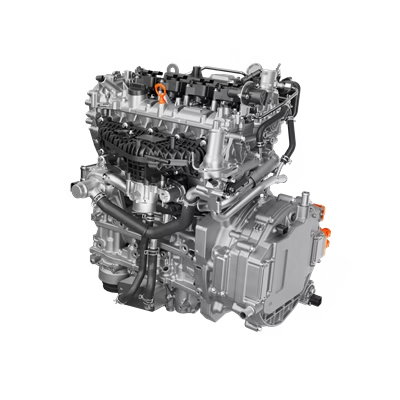

Horse Powertrain’s D20 Methanol is a compact range-extender powertrain for REEV. It combines a 2.0-liter methanol engine, an axial-flux generator, and power electronics in one integrated module.
The company presents it as an “industry first” in its spotlight portfolio. It is also meant to fit both new and existing vehicle platforms.
System layout
The D20 Methanol uses a 4-cylinder, 2.0-liter turbocharged engine running on pure methanol. Horse says the engine can operate on M0 to M100 fuel content, depending on calibration and application.
The generator side uses a yokeless dual-rotor axial-flux machine mounted on the crankshaft. Horse says this packaging cuts axial length by 46 percent and raises power density by 63 percent versus a comparable radial-flux design.
That layout matters because it keeps the unit compact. It also supports a cleaner installation in REEV and BEV-derived architectures.
Performance figures
Horse says the unit can deliver up to 105 kW of power and weighs about 170 kg. The company also claims the system can provide up to 2 kWh of power per liter of methanol in REEV operation.
The generator reaches 96.4 percent electrical efficiency, helped by silicon carbide power electronics and an embedded power module. Horse also reports a 47 percent fuel-to-energy conversion ratio, which it says equals roughly 1 kWh of electrical output for every 2.1 kWh of methanol burned.
In practical terms, Horse claims 19.6 liters of methanol can recharge a 40 kWh battery. That makes the unit attractive for long-range use cases where rapid refueling still matters.
Methanol operation
The D20 Methanol is designed for pure methanol use rather than gasoline or mixed fuel strategies. Horse says a 240 mJ high-energy ignition system enables ultra-lean combustion, which supports efficiency and cleaner operation.
Horse also says the engine can cold-start on pure methanol at temperatures as low as -35 C, or even -40 C in its product page wording. That is a notable claim because methanol usually needs stronger ignition control in cold conditions.
The company’s materials also point to China 6b and Euro 7 compliance targets. That positions the system for markets with tighter emissions regulations.
Why the generator matters
The generator is not a standard cylindrical motor. Horse says it uses a dual-rotor, single-stator axial-flux layout with immersion cooling and SiC electronics.
That design gives the system a high power-to-size ratio. It also supports the REEV role, where the combustion engine mainly acts as an electricity source rather than a direct drive unit.
Horse’s broader spotlight page shows the company is pushing modular powertrains for hybrids, REEVs, and alternative fuels. The D20 sits beside other products such as the B15 Methanol + EG50, B20, DHTS210, and hydrogen concepts.
Market positioning
Horse frames the D20 Methanol as a bridge between electrification and liquid-fuel convenience. That approach targets drivers who want EV driving most of the time, but still need fast energy replenishment on long trips.
The company also stresses platform compatibility. It says the module can support 400V and 800V architectures, which broadens its use across vehicle programs.
That makes the D20 more than a technical showcase. It is also a product aimed at OEM integration and packaging flexibility.
Key technical points
- 2.0-liter, 4-cylinder turbocharged methanol engine.
- Pure methanol operation, with M0 to M100 flexibility noted on the product page.
- Axial-flux generator mounted on the crankshaft.
- Yokeless dual-rotor design with immersion cooling.
- Up to 105 kW output and about 170 kg total weight.
- 96.4 percent electrical efficiency and SiC power electronics.
- 47 percent fuel-to-energy conversion ratio.
- Cold starts down to -35 C or -40 C, depending on source wording.
- China 6b and Euro 7 compliance claims.
Sources: Horse Powertrain