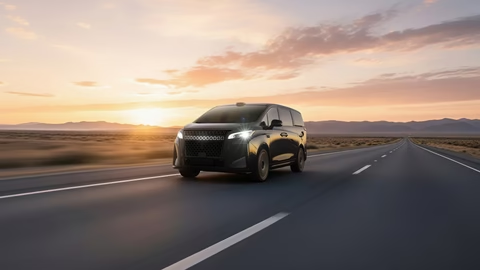

Faraday Future has obtained a U.S. patent for a new range-extending hybrid transmission system. It is designed to boost driving range and simplify powertrain mechanics in future FX series models. The patent is assigned to its dedicated powertrain subsidiary, Future AIHER AI Hybrid Extended-Range Electric Powertrain System Inc. It is intended for integration into upcoming AIHER-based vehicles.
Patent Grant and Scope
In May 2026, the U.S. Patent and Trademark Office issued U.S. Patent No. 12,630,004, titled “Range-Extending Hybrid Transmission System.” The application was filed in June 2025 and includes 13 claims that collectively define a new hybrid transmission architecture focused on decoupling power sources.
The patent is an important step in Faraday Future’s strategy to build a leadership position in hybrid electric powertrains alongside its battery-electric programs. It supports the company’s broader goal of embedding AI-driven energy and powertrain management into its next-generation FX-branded vehicles.
Key Technical Architecture
The patented system features a multi-clutch, multi-shaft transmission that separates the engine, generator-motor, and drive wheels. Meanwhile still allowing them to operate together when needed. This configuration is intended to enable all power sources to contribute either concurrently or independently. It depends on drive mode and operating conditions.
At the core of the design is a first rotary power source connected to a first shaft, on which a first clutch is mounted. A second clutch is positioned away from the first. With a generator-motor connected either to the first shaft or to a second shaft mechanically tied to the first shaft and/or the second clutch.
A third shaft, which links to the differential and subsequently to the drive wheels, is mechanically coupled to the first shaft and/or the second clutch. This layout allows torque routing flexibility and enables decoupling of engine output, generator-motor operation, and wheel drive torque in several possible configurations.
Decoupling Strategy and Multi-Mode Operation
By decoupling the engine, generator-motor, and wheels, the system supports multiple drive modes tailored to different driving scenarios. All power sources can drive the wheels simultaneously for high-output situations. Or selected sources can operate independently for efficiency-focused use cases.
This decoupling enables what Faraday Future positions as a “strong extended range, light hybrid” architecture within the AIHER framework. The engine can focus on optimal operating points for range extension. The generator-motor and traction drive system manage transient power demands and dynamic response.
Addressing Limitations of Existing Plug-In Hybrids
Faraday Future highlights several shortcomings of conventional plug-in hybrid systems that the new transmission aims to address. Existing designs are described as suffering from slow power output response, limited performance, constrained driving control, and high total vehicle costs.
The company also points to complex mechanical layouts in many current hybrids. This can negatively affect vehicle handling, reliability, and perceived driving quality. With simplified transmission architecture and cleaner decoupling of key components, the new system aims to improve both drivability and long-term robustness.
Range Extension with Reduced Complexity
This architecture has a design to deliver robust range extension. While relying on a relatively “weak” level of hybridization compared to traditional full hybrids. In practice, this means the combustion engine and generator-motor are to maximize range and efficiency. Besides, the electric drive remains central to propulsion.
This approach is expected to improve power efficiency and dynamic performance. Yet reduce the number of mechanical elements typically required in complex hybrid gearsets. The result is a powertrain that offers extended driving range with fewer mechanical compromises and lower structural complexity.
Integration into AIHER Powertrain
The newly granted patent is expected to be incorporated into the broader AIHER powertrain system under development for future FX models. Future AIHER, established in March 2025, is positioned as the world’s first AI hybrid extended-range electric powertrain system company.
AIHER targets Extended Range Electric Vehicles (EREVs) with two core product directions. A super AI hybrid extended-range system and a super AI extended-range system. Both concepts focus on combining extended-range capability with intelligent hybrid control. It emphasizes range extension as the primary function and hybrid drive as a secondary, supporting layer.
“Strong Extended Range, Light Hybrid” Concept
Under the AIHER concept, the powertrain emphasizes strong range extension while maintaining a lighter hybrid function compared to conventional full-hybrid systems. This hybrid-plus-range-extender fusion seeks to leverage the strengths of both architectures while mitigating their individual weaknesses.
In this scheme, the combustion engine acts primarily as a high-efficiency range extender. The electric drive system handles most traction duties. The multi-clutch transmission allows the engine and generator-motor to be engaged or disengaged strategically, balancing efficiency, performance, and NVH characteristics.
Cold-Weather and Regional Focus
Faraday Future positions AIHER, and by extension the patented transmission, as particularly suitable for extreme-cold winter regions. Extended range architectures can maintain vehicle usability when ambient temperatures reduce battery-only range. And AIHER will provide strong energy efficiency in such conditions.
By enabling the engine to operate in optimized thermal and load windows, the system aims to mitigate cold-weather efficiency penalties often seen in conventional hybrid and pure battery-electric vehicles. The company frames this as an advantage for customers who require reliable long-range capability in harsh climates.
Planned Super One Vehicle Applications
Faraday Future intends to deploy AIHER technology in its Super One lineup, which targets mass-production FX models. The company plans for the first batch of mass-produced Super One vehicles to be either an 800 V battery electric model. Or an AIHER-based hybrid extended-range variant, depending on market and funding conditions.
This dual-track strategy allows Faraday Future to address both customers seeking high-voltage BEVs and those who favor extended-range hybrids with AI-powered energy management. Both powertrain routes are presented as part of the company’s roadmap to scale its FX series and embodied AI portfolio.
Funding-Dependent Delivery Timeline
The Super One delivery schedule depends directly on Faraday Future securing strategic or medium-to-long-term financing. Once funding is in place, Faraday Future expects to begin mass-production deliveries for the 800 V BEV and AIHER hybrid variants in staged phases.
For the Super One 800 V BEV, Faraday Future targets phase one deliveries 6 to 9 months after funding. Phase two would follow at 12 to 15 months, and phase three at 21 to 24 months. For the AIHER hybrid model, Faraday Future plans phase one deliveries 9 to 12 months after funding. Phase two comes at 21 to 24 months, and phase three follows at 24 to 28 months.
Customer Value Propositions
Faraday Future emphasizes several customer-facing benefits enabled by the new transmission and AIHER architecture. These include longer usable driving range, reduced mechanical complexity, improved power response, and enhanced driving control versus conventional plug-in hybrid systems.
The company also highlights the potential for AI-based control strategies to optimize energy usage based on driving patterns, road conditions, and battery status. Over time, these systems can learn from real-world use and improve efficiency and performance.
Embodied AI and Powertrain Strategy
Faraday Future describes itself as a Physical AI or Embodied AI ecosystem company, integrating AI into robotics and mobility solutions. Its product strategy spans EAI humanoid and bionic robots as well as automotive-focused robots, framed within a “Device, Data, EAI Brain & Open-Source and Open Platform” ecosystem.
This ecosystem aims to create a flywheel where scaled device deployment generates data. Which in turn trains and improves the EAI Brain, leading to stronger products and further deployment. Faraday Future positions the AIHER powertrain and extended-range hybrid transmission patent as key building blocks in its AI-centric mobility roadmap.
FX Series and Future Deployment
Within the FX-branded lineup, Faraday Future envisions offering multiple powertrain options. Including battery electric, super AI extended range, and super AI hybrid extended range systems. The company expects AIHER-based solutions to launch first in FX vehicles before potentially expanding to other OEM partners.
By combining high-voltage BEV platforms with AI-driven extended-range systems, Faraday Future aims to address different use cases, markets, and infrastructure constraints under a unified AI framework. The newly patented transmission is a foundational technical element in enabling that flexible powertrain portfolio.
Core Features of the Patented Transmission
- Multi-clutch, multi-shaft hybrid transmission decoupling engine, generator-motor, and drive wheels.
- Capability for all power sources to operate concurrently or independently, supporting multiple drive modes.
- First rotary power source linked to a first shaft with a primary clutch, plus a second clutch positioned on a separate shaft.
- Generator-motor connected to either the first shaft or a second shaft mechanically tied to the first shaft and/or second clutch.
- Third shaft connected to the differential and mechanically linked to the first shaft and/or second clutch, routing torque to the wheels.
- Architecture intended to provide strong range extension with reduced mechanical complexity and “light hybrid” characteristics.
- Designed for integration into AIHER extended-range powertrains in future FX models, including potential Super One variants.
About Faraday Future
Faraday Future was founded in 2014 as a U.S.-based company focused on AI-enabled mobility and robotics. It trades on Nasdaq under the symbol FFAI and positions its business around AI-enhanced vehicles, embodied AI robotics, and open AI platforms.
Through its three-in-one ecosystem of devices, data, and EAI Brain with open platforms, Faraday Future targets continuous product evolution and commercial scaling. The patented range-extending hybrid transmission and AIHER initiatives exemplify the company’s effort to merge intelligent powertrains with its broader Physical AI strategy.
Sources: Faraday Future