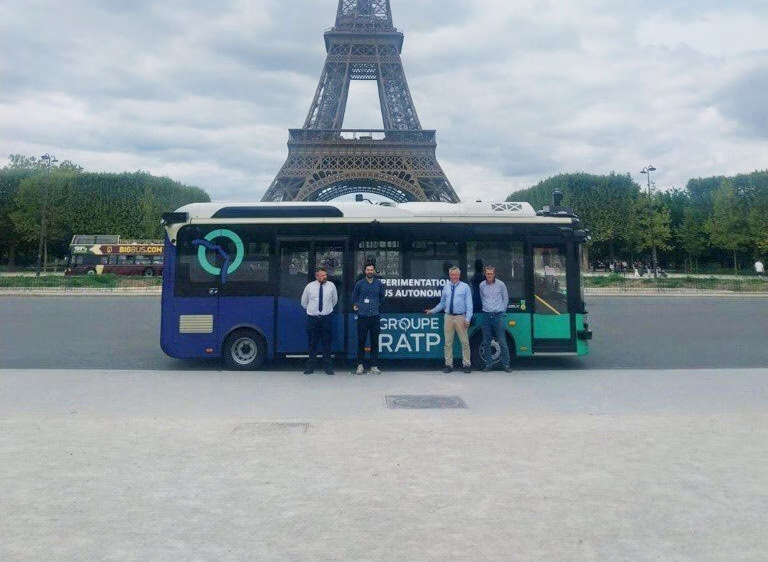

Karsan’s Autonomous e‑ATAK has completed a six‑month pilot with RATP on one of Paris’s busiest bus corridors, Route 393, and earned nationwide testing approval from France’s DGEC. The project covered around 3,000 kilometers of autonomous driving under real‑world conditions, with an average of five hours of daily operation through open traffic and mixed pedestrian environments. This deployment marks one of the first autonomous public‑transport applications in Europe to receive formal regulatory backing for use in dense urban traffic.
High‑Traffic Paris Route 393 as a Real‑World Testbed
Route 393 runs between Sucy–Bonneuil RER and Thiais–Carrefour de la Résistance, crossing one of the busiest and most critical sections of Paris’s bus network. The Autonomous e‑ATAK operated on an 8.5‑kilometer central stretch, handling frequent stops, high‑capacity intersections, and complex BRT‑style traffic flows. By choosing this route, RATP and Karsan created a demanding benchmark that closely mirrors everyday operational stress for city transit agencies.
Technical Validation and Regulatory Approval in France
Before open‑traffic deployment, the Autonomous e‑ATAK underwent rigorous technical validation at UTAC, France’s leading automotive testing and certification organization. Tests included dynamic and static assessments of safety, perception accuracy, and decision‑making performance under variable weather and traffic loads. Following these evaluations, the French Ministry of Transport’s DGEC granted nationwide testing approval, allowing the bus to run autonomous operations in open traffic nationwide.
Operational Performance and 98% Autonomy Rate
During the six‑month pilot, the Autonomous e‑ATAK achieved a 98 percent success rate in autonomous driving without driver intervention. This figure covers full‑route segments, including lane changes, queue‑handling in mixed traffic, and precise docking at bus stops. The vehicle also synchronized with traffic‑light systems and intersections in real time, illustrating how connected‑vehicle infrastructure can support Level‑4 autonomy in cities.
Level‑4 Autonomy in Public Transport Today
Karsan and its technology partner ADASTEC describe the Autonomous e‑ATAK as a Level‑4 driverless solution, capable of fully autonomous operation within defined areas. Trials in Paris and earlier projects in cities like Stavanger and in Germany show that Level‑4 buses are already integrating into scheduled public‑transport networks. European regulators remain cautious, yet successful pilots are gradually shifting the narrative from “future concept” to “operational reality.”
Strategic Implications for Karsan and Urban Mobility
For Karsan, the Paris approval reinforces its positioning as a global leader in autonomous, electric buses. The company plans to expand with a fully driverless deployment in Stavanger by 2026, removing the safety driver and scaling up operational autonomy. These projects contribute to broader urban‑mobility goals, including lower congestion, improved safety, and more predictable, cost‑efficient bus services across Europe.