
Audi launches the RS 5 as its first high-performance plug-in hybrid. This model blends a potent V6 engine with electric power for thrilling dynamics. Moreover, it introduces groundbreaking quattro with Dynamic Torque Control.
The RS 5 delivers 470 kW system output from a 2.9-liter twin-turbo V6 and 130 kW electric motor. It achieves 0-100 km/h in 3.6 seconds and up to 285 km/h top speed. Additionally, drivers enjoy over 80 km electric range in the city.
Breakthrough Quattro with Dynamic Torque Control
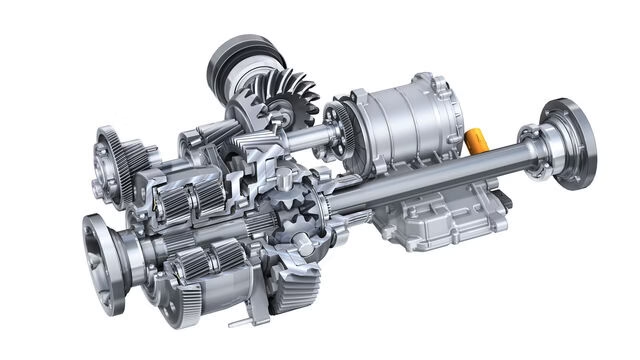
Quattro with Dynamic Torque Control marks a world first in production cars. It enables electromechanical torque vectoring at the rear axle. This system shifts torque between wheels in just 15 milliseconds.
A water-cooled 8 kW electric actuator powers the rear transaxle. Overdrive gears and a differential distribute up to 2,000 Nm torque differences. Consequently, the RS 5 gains unmatched agility and stability on curves.
Unlike mechanical systems, it works during braking and off-throttle. Drivers feel precise control even at dynamic limits. For instance, it counters oversteer by boosting inner wheel torque.
The striking RS 5 design features wider bodywork and darkened Matrix LED headlights. Its RS sport exhaust adds bold sound. Inside, premium details enhance the sporty cabin feel.
How Dynamic Torque Control Transforms Handling
Electromechanical torque vectoring elevates cornering precision. It uses sensors for real-time data on steering and grip. Thus, the HCP1 control unit harmonizes all components seamlessly.
In sporty modes, it maximizes rear bias for playful drifts. Reviews praise its “Torque Rear” setting for effortless slides. However, it stabilizes quickly if needed.
This tech integrates with electronic diff lock and adaptive dampers. Together, they ensure fast responses during high-speed turns. As a result, drivers maintain full command without surprises.
Independent tests confirm the RS 5’s neutral balance. It outperforms predecessors in traction and yaw control. Furthermore, electric assist reduces weight penalties effectively.
Powertrain Excellence and Efficiency Gains
The modular PHEV pairs a 375 kW V6 with hybrid gearbox. A 25.9 kWh battery supports 54 miles EV range. Therefore, it cuts CO2 to under 100 g/km while delivering 62-74 mpg.
Fuel use drops to 9.5-10.1 l/100 km when depleted. Yet, performance stays ferocious at 639 PS total. Transitions between modes feel natural and responsive.
Audi’s engineering focuses on daily usability too. City driving goes fully electric often. Plus, fast charging keeps it practical for long trips.
RS 5 vs. Rivals: A Competitive Edge
The RS 5 challenges BMW M3 with superior hybrid power. It boasts 639 PS against M3’s 530 PS. Also, torque vectoring gives it handling advantages.
Mercedes-AMG C63 hybrid offers 671 hp, but RS 5 excels in all-electric range. Its 87 km potential beats many peers. Moreover, quattro system ensures superior wet grip.
Early drives highlight its drift-friendly nature. The 5,192-pound weight adds stability without dulling fun. In short, it redefines performance hybrids.
Driving Experience
Drive select modes range from balanced to rear-focused agility. Electromechanical vectoring makes every input predictable. Drivers report heightened confidence at limits.
The RS 5 Avant variant adds practicality without compromise. Its 2,370 kg curb weight handles dynamically. Hence, it suits families seeking thrills.
Audi positions this as a benchmark for hybrids. Future RS models may adopt similar tech. Overall, it promises emotional driving with modern efficiency.