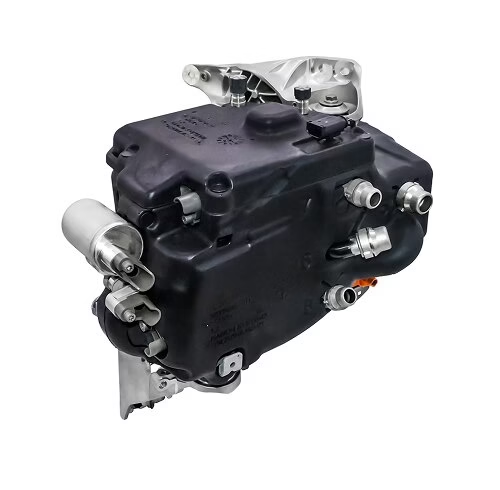

Hanon Systems has unveiled its highly integrated cooling entity, a compact thermal management module designed specifically for battery electric vehicles. Weighing only 16 kg, the module integrates several key components into a single high‑power‑density unit. These components include an eCompressor, electronic expansion valve block, a combined water‑cooled condenser, an internal heat exchanger, chiller, A/C lines, and multiple pressure and temperature sensors.
By consolidating these parts into one module, Hanon reduces system complexity and component count across the vehicle platform. This approach also shrinks the footprint needed under the hood, freeing up space for other systems. Packaging and material savings directly support automakers’ efforts to simplify EV architectures and cut production costs.
Intelligent thermal management for EV performance
The module functions as an intelligent thermal management system that dynamically regulates refrigerant flow and temperature. It responds in real time to fast charging, high‑performance driving, and extreme ambient conditions. This active control helps maintain battery pack temperature within the optimal window, improving efficiency and prolonging cell life.
Hanon emphasizes that the HICE module enhances energy utilization, which in turn supports longer driving range. By minimizing parasitic losses from the cooling system, the vehicle can direct more electricity to the wheels. Thermal management now acts as a performance enabler, not just a safety requirement.
First application on BMW iX3 BEV platform
The company first deployed this module on the BMW iX3, the German automaker’s midsize electric SUV. As the first application of the HICE concept, the iX3 demonstrates how OEMs are adopting highly integrated thermal architectures. BMW gains a more compact climate‑and‑battery‑cooling solution that still meets stringent thermal performance targets.
According to Hanon, the module supports multiple vehicle subsystems, including the battery pack, power electronics, and cabin conditioning. This multi‑domain control allows coordinated optimization of energy use across different mission scenarios. OEMs can also simplify calibration and controls development by relying on a single thermal hub.
NVH‑optimized design and scalable architecture
Beyond thermal performance, Hanon has tuned the module for noise, vibration, and harshness (NVH). The integrated unit includes vibration isolation components and a sound‑absorbing cover to reduce audible compressor noise in the cabin. These features help maintain the quiet, premium driving experience that EV buyers expect.
Designers also aimed for scalability across battery electric vehicle platforms. The highly integrated architecture lends itself to modular production and streamlined vehicle assembly. As EV portfolios grow, automakers can reuse this refrigerant module on different body types and battery sizes.
Strategic role in the EV thermal ecosystem
Hanon Systems positions the HICE module as a core technology within its broader EV thermal ecosystem. The company already supplies other thermal modules using refrigerants like R744 and R290, which are gaining traction because of their low global‑warming potential. By integrating these refrigerant‑based solutions into compact modules, Hanon supports both efficiency and sustainability goals.
The launch reflects a wider industry shift toward centralized, software‑driven thermal management in electric vehicles. Instead of multiple discrete cooling units, OEMs now favor fewer, smarter modules that can cross‑control subsystems.