
Automotive domain architecture centers around high-performance systems-on-a-chip. Advanced driver assistance systems need stable power regulation. Driver monitoring systems demand low-voltage and high-current electrical operation.
Traditional vehicle power supplies require unique circuit customization. Redesigning systems during vehicle model rollouts increases development cycles. Circuit validation workloads lengthen manufacturing delays considerably. Engineering teams suffer from repetitive hardware design cycles. Platform diversification strains corporate resources and budgets.
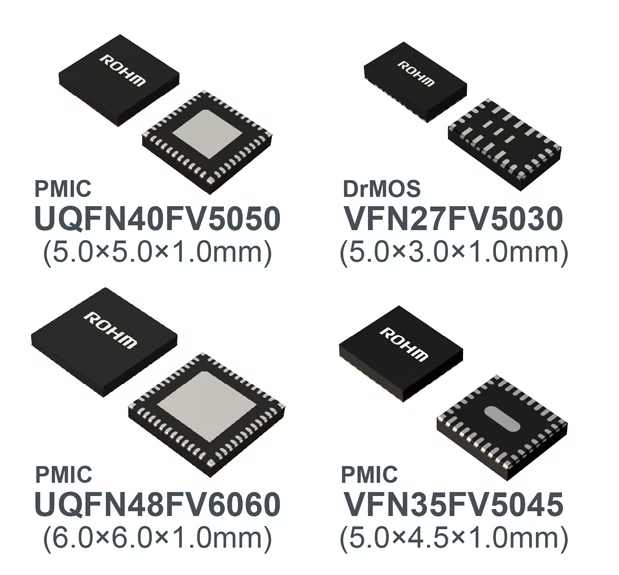
ROHM developed a modular power management system. This configuration integrates the flexible BD968xx-C series controllers. The structure incorporates the specialized BD96340MFF-C integrated driver. Engineers can scale automotive power networks effortlessly. This breakthrough simplifies electronic architecture deployment.
Modular Microelectronics Solve Complex Vehicle Board Engineering
Modern processing units require diverse voltage levels. Autonomous hardware architectures process complex imaging sensor pipelines. The configurable technology adapts to fluctuating vehicle chip demands. Redesigning fundamental power stages becomes obsolete. Scalable configurations drastically improve long-term system prototyping reuse.
The power management devices handle multiple chip tiers. System developers mix main controllers and secondary sub-chips. Adding driver chips boosts current delivery capacities seamlessly. The versatile architecture supports inexpensive low-end camera chips. The identical core framework regulates complex high-end cockpit computing nodes. This design flexibility cuts verification time drastically.
- High-precision point-of-load remote voltage monitoring ensures stable delivery.
- Programmable one-time memory allows sequence control configuration.
- Dual-phase operation splits thermal dissipation loads evenly.
- Built-in digital self-test functions check internal logic states.
Low-power applications utilize standalone management chips. The specialized BD96803Qxx-C component operates independently. The compact BD96811Fxx-C module supplies minor peripheral rails. These chips operate without external driver stages. They reduce peripheral part counts on tight circuit boards.
Advanced Integrated Components Meet Strict Vehicle Safety Standards
High-performance vehicular processors command vast electrical currents. Core processing circuits run at low fractionated voltages. Advanced BD96805Qxx-C microchips supply up to forty amperes. This performance depends on external integrated driver stages. The system guarantees reliable high-current power delivery.
The integrated driver stage incorporates high-frequency switching. Internal power transistors run up to four megahertz. High switching frequencies reduce external coil physical dimensions. Compact circuit boards fit easily into tiny automotive camera enclosures. Miniature electronic packages save valuable vehicle interior space.
Automotive chips must withstand harsh vehicular environments. The power microchips feature rugged wettable flank packaging. Automated optical inspection systems verify board solder joints perfectly. High-quality production methods prevent hidden field connection failures. Vehicles operate safely over extensive operational lifespans.
Severe thermal conditions require robust protective circuits. Internal thermal monitoring triggers protective shutdowns early. Over-voltage protection blocks harmful incoming voltage spikes. Under-voltage detection prevents system malfunction during cranking drops. These mechanisms fulfill rigid international automotive criteria.
Scalable Silicon Engineering Enhances Next Generation Flight Cockpits
Advanced power supply configurations serve global market platforms. ROHM created verified reference blueprints for modern cockpits. The architecture powers the advanced SemiDrive X9SP processing unit. The design meets modern entertainment computing energy needs. This framework speeds up product commercialization schedules.
The scalable ecosystem supports Telechips Dolphin5 processor modules. The multi-rail power network optimizes multimedia system throughput. Vehicle manufacturers deploy uniform power platforms across models. Reusing identical circuit designs minimizes validation expenses. Corporate engineering productivity reaches optimum historical levels.
Mass manufacturing of these silicon components has commenced. Global automotive suppliers can acquire production quantities now. Sales departments distribute datasheets through international company networks. Hardware engineers can access electronic simulation models online. Digital circuit tools accelerate early schematic development stages.
The entire product lineup carries AEC-Q100 certification. The manufacturing processes comply with strict ISO 26262 guidelines. Devices achieve the highest ASIL-D safety rating levels. Electronic component integration protects autonomous vehicle passengers. Reliable semiconductor infrastructure secures the future transport network.
Sources: ROHM