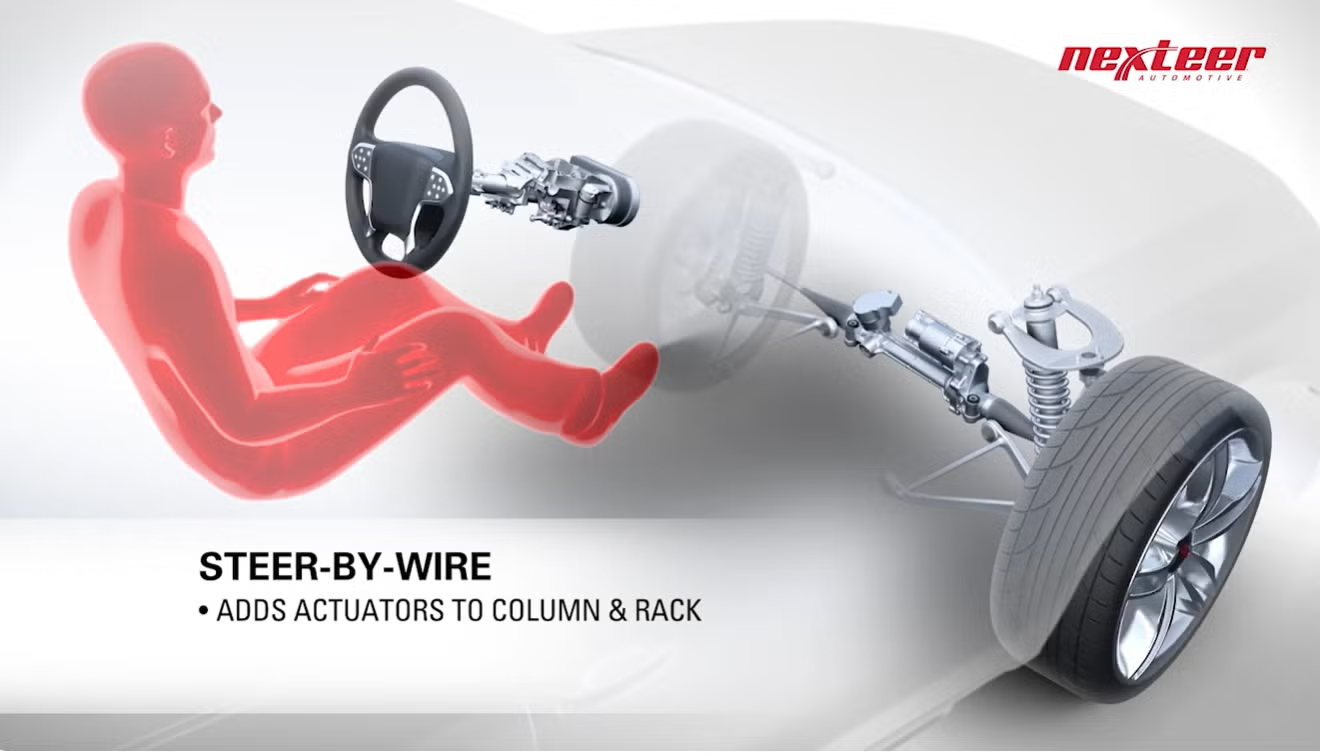

Nexteer Automotive has moved its Steer‑by‑Wire (SbW) system into series production for a leading Chinese new‑energy‑vehicle (NEV) OEM. This marks the first time the company’s SbW technology is scaling beyond prototypes and into mass‑produced vehicles. The program enables the world’s first production passenger car with a full drive‑by‑wire chassis and shows how electric steering is reshaping the software‑defined car.
Steer‑by‑Wire enters mass production
Nexteer’s SbW system launched on a series‑production passenger vehicle built by a major Chinese NEV manufacturer. The OEM chose Nexteer’s solution as a core actuator for an advanced chassis that replaces mechanical links with electronic signals and actuators. By doing this, the vehicle can deliver more flexible handling, faster tuning, and tighter integration with ADAS and automated‑driving stacks.
The move from validation to series production signals that SbW has passed rigorous safety and reliability checks. Automotive engineers now treat SbW as a practical platform technology rather than a lab‑only concept. This shift helps OEMs standardize motion‑by‑wire architectures across multiple vehicle families and price segments.
Safety design at the highest ASIL level
Nexteer’s SbW implementation achieved ASIL D functional safety approval in late 2025 through DAkkS, Germany’s national accreditation body. ASIL D is the strictest Automotive Safety Integrity Level, covering fault diagnosis, redundancy, and continuous monitoring. This certification reassures OEMs that the system can support advanced driver‑assistance and conditional‑or‑higher‑level autonomous features.
The system uses a multi‑layered redundancy design with dual controllers, dual power supplies, and multiple communication links. Each module also has dual actuation paths so that a single fault can be isolated and bypassed in milliseconds. This architecture keeps steering available even if one subsystem fails, which is critical for unsupervised or higher‑automation modes.
Additional safety features include full‑scenario functional‑safety mechanisms for sensors, controllers, actuators, and communication interfaces. Multi‑level monitoring and fault‑handling strategies allow the system to detect anomalies early and react appropriately. These layers help maintain safe operation in diverse conditions, from highway cruising to low‑speed parking maneuvers.
Tuned steering ratios and adaptive road feel
Nexteer’s drive‑by‑wire platform offers an adjustable steering ratio that changes with vehicle speed and driving mode. At low speeds, the system can make steering lighter and more direct to aid parking and city driving. At higher speeds, it tightens the ratio to improve stability and reduce unnecessary inputs. This flexibility lets OEMs tailor behavior for sport‑tuned, family‑oriented, or luxury‑focused models.
The system also uses intuitive road‑feel simulation technology to generate realistic steering feedback in software. Instead of relying on mechanical linkages, Nexteer’s algorithms model how forces from the tires and road should translate into hand‑wheel torque. This software‑defined feel can be tuned for different brands, regions, or even driver profiles within the same vehicle.
Drivers experience a more responsive and precise steering character across a wide range of scenarios. The software can emphasize sharpness on twisty roads or smoothness on long highway stretches. Such tuning would be harder and more expensive to achieve with traditional mechanical steering systems.
Open interface for ADAS and autonomous driving
Nexteer’s SbW system acts as a key actuation layer for ADAS and autonomous‑driving stacks. It provides real‑time, high‑precision control of front‑wheel angles with minimal latency. That responsiveness is essential for emergency lane‑keeping, automated lane changes, and parking‑assist functions.
The platform includes an open interface that integrates with the OEM’s domain or zone controllers. This lets the vehicle manage steering, braking, and acceleration as part of a unified motion‑control strategy. The openness also supports over‑the‑air updates and future‑proofing so that new driving‑assistance features can be added without hardware changes.
By combining drive‑by‑wire with other motion‑by‑wire technologies, automakers can move toward a fully software‑defined chassis. This evolution reduces the need for fixed mechanical layouts and frees up space inside the cabin. It also simplifies the addition of new driver‑assistance or autonomous‑driving capabilities as regulations and sensors evolve.
Modular SbW and broader motion‑by‑wire portfolio
Nexteer’s SbW offering is part of a larger Motion‑by‑Wire™ portfolio that includes Rear‑Wheel Steering, Brake‑by‑Wire, and the MotionIQ software suite. Together, these systems allow OEMs to coordinate all three axes of vehicle motion—steering, braking, and acceleration—through electronic commands. This modularity supports faster development cycles and lower engineering costs.
The company leverages its 120‑year engineering heritage to supply steering‑feel simulators and road‑wheel actuators as off‑the‑shelf modules. These components can be mixed and matched to suit different vehicle classes, from compact city cars to large SUVs and commercial vehicles. The modular approach also helps OEMs test different configurations and adapt them quickly to regional markets.
List of key motion‑by‑wire and chassis technologies from Nexteer:
- Steer‑by‑Wire (SbW) for front‑wheel actuation and hand‑wheel control
- Rear‑Wheel Steering (RWS) for enhanced agility and stability
- Brake‑by‑Wire for electronic brake actuation and integration with ADAS
- MotionIQ software suite for system‑level control and diagnostics
- Electric and hydraulic power‑steering systems for conventional platforms
- How SbW supports electrification and software‑defined cars
EV and NEV platforms benefit from drive‑by‑wire
Nexteer’s entry into SbW series production aligns closely with the broader trends in electrification and software‑defined vehicles. EV and NEV platforms benefit from drive‑by‑wire systems because they already rely on electric actuators and high‑speed data networks. Steering‑by‑wire fits naturally into this architecture and reduces the weight and complexity of mechanical components.
The company serves global OEMs including BMW, Ford, GM, Stellantis, Toyota, and Volkswagen, as well as Chinese brands such as BYD, Xiaomi, Li Auto, Chery, Great Wall, Geely, and Xpeng. Supporting such a wide range of automakers demonstrates that SbW can scale across different regional safety standards, performance targets, and cost structures.
Going forward, SbW will help OEMs differentiate their brands through software‑tunable steering feel and dynamic handling traits. Manufacturers can also use the same hardware base for multiple trims and markets, tuning behavior via software instead of physical changes. This flexibility is one of the main reasons analysts expect Steer‑by‑Wire to become a core building block for next‑generation intelligent chassis.