
Electric drives rely on inverters as their central heart component. These devices manage energy flow from battery to motor precisely. Fraunhofer IZM redesigned this key part with ultra compact SiC inverter entirely for today.
The new inverter processes 500 kilowatts within one single liter. Efficiency reaches an impressive 99 percent due to low inductance. Mitsubishi Heavy Industries tasked the team with this challenge.
Space constraints under EV hoods demand smaller yet powerful units. Powerful motors run on three-phase alternating current typically always. Batteries supply direct current so conversion proves essential here.
Power Module Engineering
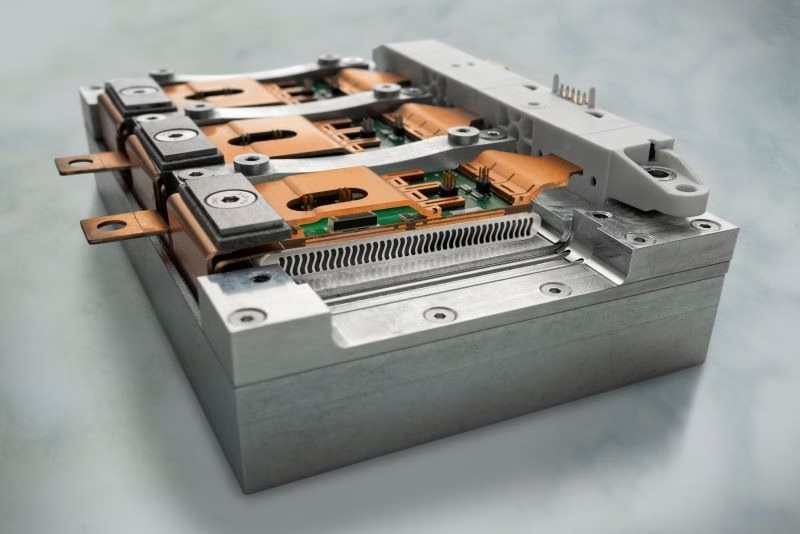
Teams built three identical power modules for each AC phase. Each module integrates twelve silicon carbide MOSFET switches from MHI. RC dampers separate modules from DC link capacitor effectively.
Special PCB technology embeds semiconductors straight into circuit board layers. This method yields extremely compact modules with small electromagnetic signatures. Inductance measures just one nanohenry in the final design.
MOSFETs switch at their peak 63 volts per nanosecond rate. Such rapid operation produces very few switching losses overall. Cooling requirements drop significantly because of these low heat gains.
Heatsink Design Mastery
A low-profile extruded aluminum heatsink mounts directly under the modules. It features over 40 thin slightly corrugated internal struts now. Coolant flows across struts for superior heat transfer surfaces.
Aluminum extrusion process manufactures the entire heatsink in one step. This approach saves both space and production costs effectively. Short paths carry heat quickly from semiconductors to coolant fluid.
The flat design fits tight EV packaging needs perfectly always. Struts maximize contact area without increasing overall volume much. Heat dissipation keeps components operating within safe temperature ranges.
Busbar Connection Innovation
Laser welding secures busbars right onto the circuit board surface. Traditional screws would consume extra space and boost inductance. Vertical arrangement positions busbars close for field cancellation benefits.
Shaped contact points enable precise laser welding applications every time. This technique eliminates mechanical fasteners and reduces parasitic effects. Wiljan Vermeer explains gains from screw-free construction clearly.
Inductance minimization supports full MOSFET switching speed potential. Electromagnetic interference drops as opposing fields neutralize each other. Overall system reliability improves with these solid welded joints.
Capacitor Technology Advance
PolyCharge supplied six custom NanoLam capacitors for DC link duties. They provide 300 microfarad capacitance at two nanohenries inductance. Nanotechnology delivers high power density in compact capacitor forms.
These caps generate more thermal losses from dense packing however. Copper terminals act as heat spreaders across horizontal and vertical planes. Operating temperatures limit to 130°C for extended lifespan.
Excess heat transfers rapidly to the overlying aluminum heatsink unit. Capacitor assembly nests inside housing below the cooling structure. This layout minimizes total inverter footprint dramatically.
System Performance Metrics
Combined innovations elevate 800V drive systems to superior new heights. Power density achieves 500 kW per liter unprecedented in industry. This surpasses standard designs by a factor of five.
It doubles top previous benchmarks while holding 99 percent efficiency. Moderate manufacturing costs make scaling for production feasible soon. Nearly 680 horsepower fits into one liter package easily.
Fraunhofer IZM showcases at PCIM Europe in Nuremberg Germany. The event spans June 9th to 11th 2026 actively. Visit Hall 6 Booth 1 for live demonstrations.
Feature Comparison List
- Modules: Three units with 12 SiC MOSFETs; PCB-embedded for density.
- Dampers: RC type reduces voltage overshoot and module stress reliably.
- Heatsink: Aluminum extrusion boasts 40+ struts for coolant efficiency.
- Welding: Laser joins busbars; cuts inductance via field cancellation method.
- Capacitors: NanoLam series at 300 µF; copper spreads heat effectively.
- Output: 0.5 MW/L with 99% efficiency in 800V architecture.
- Cooling: Short paths handle SiC and NanoLam thermal loads well.
Fraunhofer IZM Expertise
Fraunhofer Institute for Reliability of Microintegration drives electronics frontiers. Their website outlines SiC power module development processes in detail. Embedded tech cuts parasitic inductance substantially for all apps.
Power Electronic Systems group leads automotive inverter advancements consistently. Collaborations with industry partners accelerate practical EV innovations forward. Nuremberg events highlight real prototypes for expert feedback.
PolyCharge Capacitor Details
PolyCharge pioneers NanoLam for ultra-high capacitance density needs. Official pages describe thermal management via copper interfaces clearly. These caps suit fast-switching SiC inverter environments perfectly.
Reliability rises when temps stay below 150°C rating limits. Custom configs match Fraunhofer’s low-inductance DC link requirements exactly. Nanotechnology stacks enable slim profiles without performance tradeoffs.
MHI Partnership Role
Mitsubishi Heavy Industries provides MOSFET specs for rugged operation. Company site emphasizes 800V EV drive system priorities strongly. Joint efforts yield cost-effective high-density power solutions now.
MHI targets marine industrial and automotive powertrain sectors alike. Inverter tech supports their broad electrification strategy comprehensively. Future prototypes build on this 500 kW/L foundation solidly.
Manufacturing Process Benefits
Extrusion molds aluminum heatsinks with intricate struts in single pass. No multi-step machining reduces costs and lead times greatly. Scalable design suits high-volume EV production demands well.
PCB embedding streamlines assembly by integrating chips without wires. Laser welding delivers repeatable joints faster than screwing methods. Housing integrates all parts for IP-rated rugged enclosures.
EV Market Impact
Compact inverters free space for batteries or other components inside. 99 percent efficiency extends vehicle range noticeably per charge cycle. Lower cooling needs simplify overall thermal management systems.
800V architectures charge faster and handle higher powers smoothly. SiC materials enable smaller lighter designs versus silicon alternatives. Industrial motors gain similar density upgrades for factories.
Future Outlook Details
PCIM Europe draws global engineers to see inverter demos live. Fraunhofer booth offers deep dives into design tradeoffs openly. Attendees discuss scaling to megawatt-class systems next.
E-mobility shifts toward integrated power electronics rapidly now. Low inductance unlocks full wide-bandgap semiconductor potentials fully. Cost parity with legacy tech arrives soon through innovations.
Sources: Fraunhofer IZM