
Bosch is extending its cloud-based Road Hazard Service into BMW Group vehicles, starting with initial models and a gradual rollout over the coming years. The service uses continuously updated data from multiple sources to warn drivers about hazards such as fog and black ice.
What the service does
The Bosch system is designed to give drivers earlier notice of dangerous road conditions before they become visible. It gathers information from connected vehicles, weather data, and other sources, then turns that data into route-specific warnings. Bosch says the service is already used millions of times across passenger cars and commercial vehicles.
The practical value is simple: drivers can react sooner, and vehicle systems can support safer decisions. Bosch also describes the service as part of its connected map services, which help improve both convenience and safety. In that sense, the technology works as an extra layer of awareness beyond the driver’s direct line of sight.
BMW rollout details
Bosch has been gradually expanding its Road Hazard Service since its launch in June 2024. The cloud-based system first went live with a European vehicle manufacturer, then reached a large commercial vehicle maker about six months later. By now, the service is active in millions of vehicles across Europe and the U.S., showing that Bosch has moved beyond an early-stage trial.
The BMW Group joined the rollout in March 2026. Its vehicles using the service include the BMW iX1, iX2, iX3, X3, and several Mini models. This wider deployment suggests Bosch is scaling the technology across multiple brands and model families rather than limiting it to a single pilot program.
One of the service’s main strengths is flexibility. Automakers can set the warning sensitivity according to their own market strategy and driver-assistance philosophy. That means each manufacturer can decide how early the system should trigger an alert, instead of using one fixed threshold for all brands.
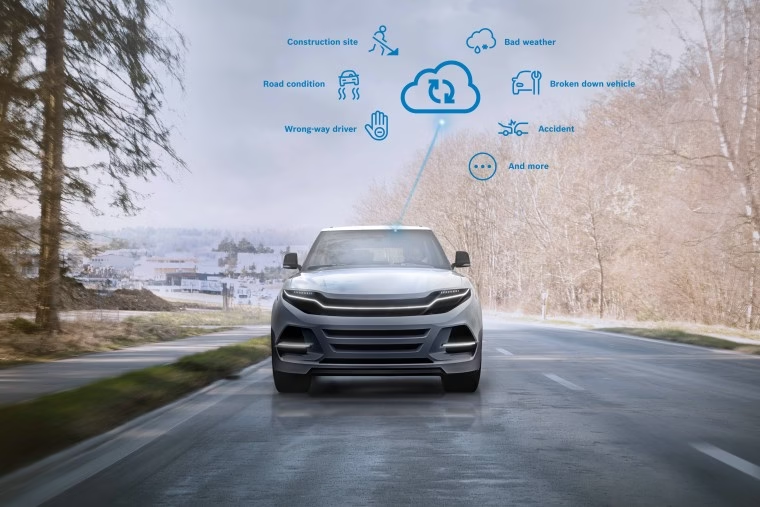
The service also goes beyond basic road warnings. It can notify drivers about accidents, abandoned vehicles, construction-zone hazards, heavy rain, heavy snow, and strong wind. Bosch also offers a cloud-based wrong-way driver warning, which it says is unique in the market and already used by a European high-volume manufacturer.
That wrong-way driver feature can be sold either as part of the full Road Hazard Service package or as a standalone option. Bosch says the warning gives drivers crucial seconds to react, often before the wrong-way vehicle is visible. It can appear in the cockpit display or on a smartphone through partner apps, which have already been downloaded more than 100 million times.
Why it matters
The biggest benefit is earlier warning. Bosch’s examples include sudden fog, black ice, heavy rain, wind, broken-down vehicles, accidents, and wrong-way drivers. When the system shares that information quickly, drivers and assistance systems can respond before a hazard becomes critical.
Bosch also says the service can support driver-assistance functions such as adaptive cruise control and automatic emergency braking. That matters because warning data is more useful when other vehicle systems can act on it. In effect, the service strengthens the connection between awareness and action.
Connected driving context
Bosch frames the Road Hazard Service as part of its broader connected map services strategy. Those services use swarm data and weather information to help vehicles understand the road more intelligently. In automated and assisted driving, that extra data can improve lane understanding, speed choice, and position accuracy.
This approach fits a wider industry trend toward predictive safety software. Cars are no longer just reacting to what sensors see right now. They are increasingly using cloud intelligence to anticipate what may happen next.
Key takeaways
- Bosch’s Road Hazard Service now appears in BMW Group vehicles.
- The service delivers real-time warnings using cloud-based data.
- It can alert drivers to fog, black ice, rain, accidents, and wrong-way drivers.
- Bosch says the rollout will continue across more BMW models over time.
- The system also supports driver-assistance features through connected map services.
Bosch’s wider strategy
The BMW rollout also shows how Bosch is positioning itself as a mobility software supplier, not only a hardware maker. Bosch Mobility says its focus spans electrification, software and services, semiconductors, sensors, and advanced driver assistance systems. That mix helps explain why the company is investing heavily in cloud-connected functions that can scale across brands and regions.
Bosch’s messaging is clear: safer mobility should come from combining vehicle intelligence with live data. By adding real-time hazard warnings to BMW vehicles, the company is turning that idea into a concrete product rollout.
Sources: Bosch