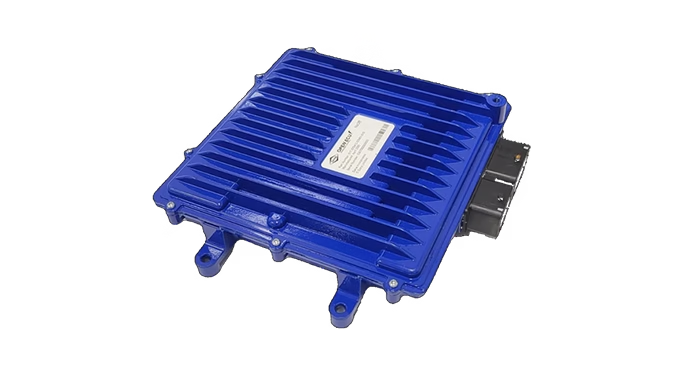

New Eagle’s OpenECU NX3 redefines how heavy‑duty EVs manage charging and vehicle control. The controller unites Megawatt Charging System (MCS) and Combined Charging System (CCS) in one ECU. This design reduces the number of separate charging and supervisory modules.
The NX3 supports both MCS high‑power and CCS wide‑coverage infrastructures. Fleet operators can deploy a single controller across mixed‑protocol charging networks. OEMs gain a common hardware and software base for different vehicle platforms.
NX3 also acts as a supervisory controller for the full EV system. It monitors powertrain behavior, charging status, and auxiliary loads. This central role simplifies coordination and fault management in large fleets.
How MCS and CCS combine in one ECU
Older architectures often need separate controllers for MCS and CCS charging. Each controller requires its own safety and communication layers. OpenECU NX3 collapses both into a single inlet controller platform.
The ECU can switch between MCS and CCS based on plug‑type detection. Charging logic, pre‑charge, and lock‑release sequences run on the same core. That reduces wiring complexity and limits points of failure.
NX3 also supports dual‑inlet configurations for mixed‑fidelity charging. A truck can use one inlet for MCS and another for CCS on the same controller. This flexibility helps OEMs design vehicles for evolving charging networks.
Vehicle supervisory control and system architecture
Beyond charging, NX3 manages overall vehicle supervisory control. It coordinates SOC, charging strategy, and grid‑aware behavior in real time. This makes it suitable for depot‑based and route‑based charging operations.
The controller links to inverters, motors, and auxiliary systems through standard interfaces. It can handle thermal‑management commands and power‑limiting logic. That centralization supports domain‑centric and zone‑oriented architectures.
NX3 also integrates with other OpenECU modules such as gateways and displays. These peripherals send driver prompts, status messages, and diagnostics. Together, they form a cohesive, production‑ready control stack.
Safety, security, and compliance for high‑power EVs
New Eagle built NX3 to meet automotive‑grade safety and security standards. The platform targets ASIL‑D functional safety for critical charging and powertrain functions. ISO 21434‑aligned cybersecurity layers protect communication and OTA paths.
Hardware and software are designed to isolate faults and limit cascading failures. Secure boot and authenticated firmware updates prevent unauthorized code changes. Each node can log events and support auditable diagnostics for fleets.
NX3 also supports tamper‑detection and secure key‑exchange protocols. These features help OEMs meet data‑privacy and grid‑integration requirements. Regulators and utilities increasingly demand this level of traceability.
Integration with Raptor and OpenECU ecosystem
NX3 is part of the unified Raptor and OpenECU platform shown at ACT Expo 2026. Engineers can design control logic in Simulink and deploy it directly to NX3. Raptor tools cover calibration, CAN interactions, and SIL/HIL workflows around the ECU.
New Eagle also offers CCUs, driveline controllers, and gateway modules under the OpenECU brand. These devices can attach to NX3 as subordinate nodes for motors, batteries, or auxiliaries. This modular approach supports scalable, multi‑vehicle architectures.
Teams can reuse the same NX3‑based design across different power classes. A common software stack simplifies validation and reduces regression‑test scope. As a result, OEMs gain a repeatable, scalable path to electrification.
Key NX3 benefits for commercial fleets
The following list highlights why OpenECU NX3 fits well with Automotive World‑style technical coverage:
- Removes redundant MCS and CCS controllers in heavy‑duty EVs.
- Cuts wiring complexity and single‑point‑of‑failure risks.
- Enables dual‑inlet MCS/CCS charging on a single ECU.
- Centralizes SOC, charging scheduling, and grid‑aware behavior.
- Supports ASIL‑D safety and ISO 21434‑aligned cybersecurity.
- Integrates with Raptor and the broader OpenECU ecosystem.
Impact on OEMs, fleets, and infrastructure
For commercial‑fleet operators, NX3 reduces maintenance and service costs. Fewer ECUs mean simpler spare‑parts inventories and fewer failure points. Charging‑related downtime also drops thanks to consolidated diagnostics and logging.
OEMs benefit from faster time‑to‑market and lower integration risk. They can standardize hardware and software across multiple chassis and power levels. This reusability aligns with the industry’s move toward software‑defined vehicles.
As charging networks add MCS fast‑charging lanes and CCS‑based sites, NX3 gives OEMs flexibility. One controller can handle both with minimal redesign. Overall, OpenECU NX3 positions New Eagle as a key enabler for next‑generation, scalable EV architectures.