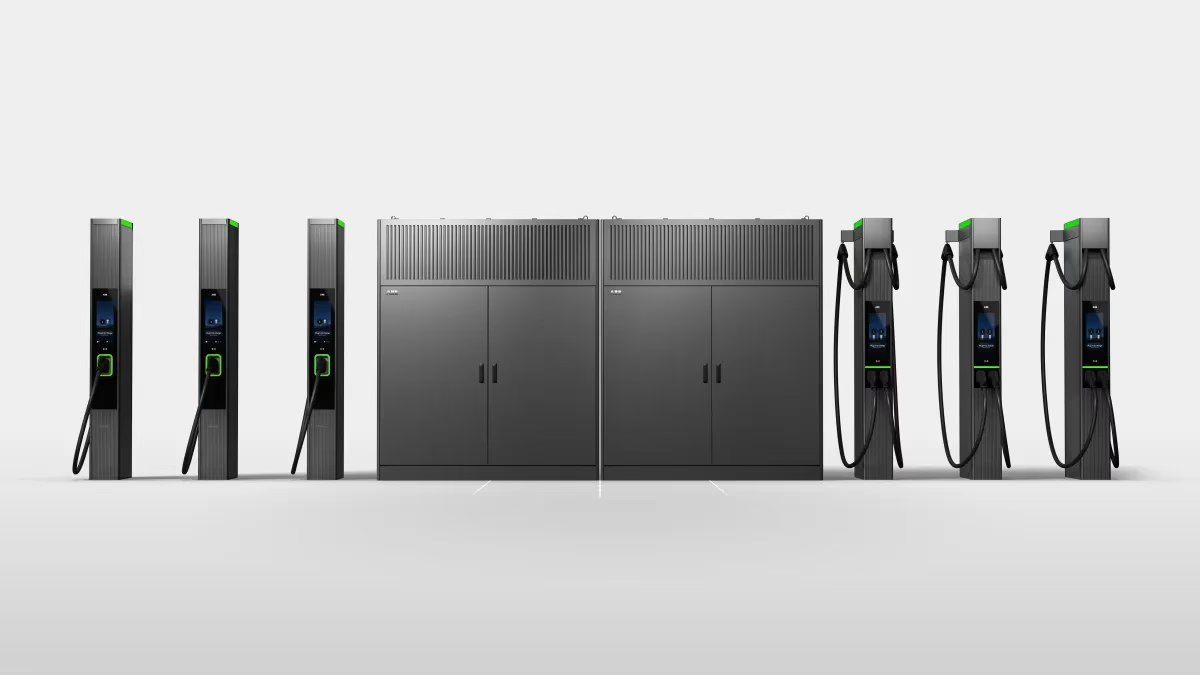

Transit depots, logistics hubs, and public charging corridors face a common challenge. More capacity alone cannot fix growing energy losses or operational friction. ABB E‑mobility now offers a site‑level architecture that scales from 800 kW to 10 MW and beyond, across more than 100 charge points. ABB OM X-Series replaces isolated clusters with one coordinated system to handle these heavy‑use environments.
ABB positions the X‑Series as the third step in its architecture roadmap. The A‑Series in 2024 set the standard for reliable high‑power charging. The OM M‑Series, launched in April 2026, extended this into split systems for diverse use cases. The X‑Series now targets the highest‑performance applications with sustained duty cycles and multi‑megawatt topology.
In such environments, charging economics depend on long‑term efficiency and uptime. X‑Series is built for 40%+ utilization sites where each kilowatt‑hour and each operating minute carry higher cost implications. The platform’s design focuses on minimizing losses and maximizing yield over many years of operation.
Liquid‑cooled architecture and efficiency
The X‑Series relies on an end‑to‑end liquid‑cooled power path. This path runs from the power cabinet with integrated cooling to proprietary liquid‑cooled power modules and liquid‑cooled charger cables. Thermal management is embedded at every conversion stage, which helps maintain performance under heavy loads and in harsh conditions.
ABB specifies that the liquid‑cooled silicon carbide modules sustain more than 98% conversion efficiency as a continuous operating condition. This efficiency is maintained over time instead of being a short‑term peak value. As a result, the system outperforms air‑cooled alternatives in sites that run at high duty cycles year‑round.
The X‑Series also supports long‑term reliability under continuous load. The liquid‑cooled architecture reduces component degradation and supports up to 100,000 charge cycles. Enclosures are rated IP65/NEMA 4X, which protects internal components in high‑heat, coastal, or dusty environments.
Site‑level DC bus and storage integration
A key innovation of the X‑Series is the site‑level DC bus. This bus acts as a shared power spine across the entire charging site. It allows power cabinets and storage assets to coordinate in real time, moving capacity where demand actually sits.
Battery energy storage connects directly on this DC bus rather than through an AC stage. ABB states that this DC‑coupled approach improves round‑trip efficiency by more than 5 percentage points versus AC‑coupled systems. Higher round‑trip efficiency means fewer energy losses and lower electricity costs when using storage for peak shaving or demand management.
The exposed DC‑bus design also future‑proofs the investment. Each expansion builds on the same backbone, which extends the original investment instead of creating stranded assets. A site that starts with 800 kW or 1.6 MW can scale toward multi‑megawatt levels without major civil rework.
Initial configuration and scalability
ABB’s initial X‑Series configuration is the X1600 platform. It consists of two 800 kW cabinets connected via a DC bus with direct battery storage integration, supporting up to 24 charge outputs. This setup targets demanding fleets and corridors that need both high‑power and flexible distribution.
The system can dynamically share power across multiple outlets per cabinet. For example, each cabinet can distribute its power to up to 12 outlets at 66.5 kW granularity. This fine‑grained sharing helps balance load and avoid over‑sizing individual connections.
ABB also emphasizes that OM X-Series is engineered for extreme utilization and long‑term operation. The platform is designed for sustained continuous load at high‑duty‑cycle sites, with an expected lifespan of up to 15 years under service coverage. That makes it suitable for bus depots, logistics centers, and heavy‑duty public corridors that run 24/7.
Mission‑profile flexibility and software layer
The X‑Series architecture allows one site to support multiple mission profiles. A depot can combine opportunity charging, overnight charging, and maintenance cycles on the same power backbone. This flexibility reduces the need for separate, siloed systems and simplifies operations.
ABB’s software and service layer further supports this flexibility. Remote management tools cover access control, configuration, diagnostics, and over‑the‑air software updates. These capabilities help operators maintain close to 99% uptime and adapt charging policies as demand patterns change.
The X‑Series also shares a common dispenser portfolio with the OM M‑Series. This means a site can start with M‑Series chargers and later upgrade to X‑Series topology as utilization and mission profiles intensify. This two‑dimensional scaling—both in hardware and in mission scope—lowers the risk of early obsolescence.
Vehicle‑to‑grid readiness and ecosystem role
ABB designed the OM X-Series to support vehicle‑to‑grid (V2G) energy flows in line with regulatory frameworks. The DC‑bus architecture and liquid‑cooled conversion modules make bi‑directional power transfer technically feasible without adding conversion stages. This enables fleets to return energy to the grid or to local loads during peak‑price periods.
Within ABB’s broader ecosystem, X‑Series sits at the high‑end of its charging spectrum. The company describes OM X, M, and A‑Series as a progression from reliable high‑power units to coordinated, multi‑megawatt sites. This tiered approach allows operators to match their charging architecture with duty‑cycle and business‑case requirements.
ABB E‑mobility also highlights the importance of DC‑based power systems in future mobility. DC architectures align well with battery‑powered vehicles and reduce the need for extra transformers and converters. As fleets and corridors grow, DC‑centric charging platforms like X‑Series will help operators balance performance, cost, and grid interaction.
Key strengths in a list
- Fully liquid‑cooled power path from cabinet to cable reduces thermal stress and derating.
- Over 98% efficiency at continuous duty improves energy yield in high‑utilization sites.
- Site‑level DC bus enables real‑time power sharing and seamless BESS integration.
- Direct DC‑coupled storage raises round‑trip efficiency by more than 5 percentage points.
- Configurations from 800 kW to multi‑megawatt allow organic, non‑stranded scaling.
Sources: ABB E-mobility