
Bosch’s 3rd-gen silicon‑carbide (SiC) chips target the heart of electric‑vehicle efficiency. They manage how energy flows between the battery and the motor. This control directly affects range and power use.
SiC semiconductors already switch faster and lose less energy than silicon chips. Bosch now builds on this with a Gen 3 design that shrinks chips while boosting performance. The result is a step change for traction inverters and on‑board chargers.
This move ties into Bosch’s broader push to lead in automotive semiconductors and e‑mobility components. Automakers can now design more compact, yet more powerful EVs. This supports longer range as a standard feature.
How Gen 3 SiC MOSFETs Improve Performance
Bosch’s Gen 3 SiC MOSFETs refine the company’s dual‑channel trench architecture from earlier generations. Each upgrade focuses on three pillars: electrical performance, thermal behavior, and ruggedness. This balanced approach keeps reliability high even as power density rises.
Electrical gains include roughly a 20 percent reduction in specific on‑resistance (RonA) versus Gen 2. Lower RonA means less heat during conduction and higher inverter efficiency. Capacitance improvements also cut switching losses by about 10 percent in typical EV traction‑inverter operation.
Thermal performance gets a boost from a 40 percent thinner die, around 100 µm in total. This thinner structure brings the active layer closer to the heat sink. Heat escapes faster, so modules can run cooler or deliver more power in the same package size.
Ruggedness, Miniaturization, and Cost Impact
Robustness remains a top priority for automotive power electronics. Bosch’s Gen 3 chips raise short‑circuit withstand capability by about 10 percent. A new two‑zone JFET region below each trench gives finer control over current paths and electric‑field distribution. This expands the design window between low on‑resistance and safe fault handling.
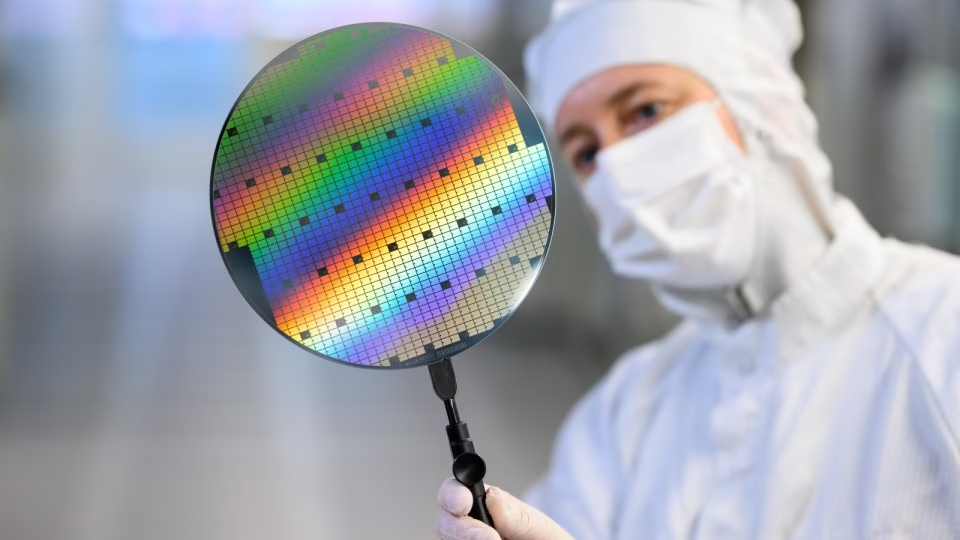
Miniaturization also drives down system‑level costs. Smaller die size means more chips per wafer, especially when combined with 200 mm wafer manufacturing. Bosch can scale output while reducing material use per chip. This improves cost efficiency for OEMs and power‑module makers.
Together, these factors help shift SiC from premium‑EV niches toward the broader EV market. Automakers can now justify SiC in mass‑market models where cost and efficiency targets are tight. Bosch’s roadmap for Gen 4 and Gen 5 continues this trend toward even lower RonA and higher power density.
Bosch’s SiC Ecosystem and Production Scale
Bosch does not treat SiC as a standalone component. The company integrates these chips into a wider ecosystem that includes sensors, software, and vehicle‑control systems. Power semiconductors, traction inverters, on‑board chargers, and DC‑DC converters all benefit from upgraded SiC technology.
Production scales fast at Bosch’s Reutlingen plant and other facilities. The company has already delivered more than 60 million SiC chips since volume production began in 2021. Bosch also helped launch the “Transform” project in Europe, which aims to build a full SiC supply chain from wafers to finished power modules.
This vertical push supports energy‑intensive sectors beyond passenger cars. Industrial drives, renewable‑energy converters, and fast‑charging infrastructure all gain from higher‑efficiency SiC devices. Bosch positions its Gen 3 chips as a core technology for electrification across multiple industries.
Impact on EV Range and Charging
Higher‑efficiency semiconductors translate into practical improvements for drivers. In traction inverters, the 3rd-gen SiC chips reduce energy losses during acceleration and deceleration. Less wasted energy means more of the battery’s capacity powers the wheels, extending real‑world range per kilowatt‑hour.
On‑board chargers and DC‑DC converters also become more efficient. Faster, cooler charging at home or at public stations helps reduce charging times or heat‑soak issues. This aligns with industry trends toward 800‑V architectures and higher‑power charging systems.
Bosch’s leadership in SiC supports a broader shift from premium‑only EVs to affordable, long‑range models. As SiC costs fall and performance rises, more OEMs can adopt these chips without sacrificing profitability. This accelerates the transition to electrified fleets.
Key Benefits of Bosch’s 3rd‑Gen SiC Chips
- Higher efficiency: Lower on‑resistance and reduced switching losses improve inverter and charger efficiency.
- Longer EV range: Less energy loss means more usable battery capacity and extended driving distance.
- Smaller systems: Thinner die and smaller chips allow more compact power modules and lighter designs.
- Better thermal behavior: Proximity to heat sinks improves cooling and enables higher continuous power.
- Stronger cost position: More chips per wafer, plus 200 mm‑wafer scaling, lower unit costs for OEMs.
- Wider EV adoption: From sports cars to mass‑market models, Gen 3 SiC enables broader use of high‑performance inverters.
By combining proven trench‑MOSFET know‑how with advanced manufacturing, Bosch consolidates its role as a key enabler of next‑generation e‑mobility. As the 3rd-gen SiC chips enter series production, they will shape the efficiency and cost curve of EVs for years to come.