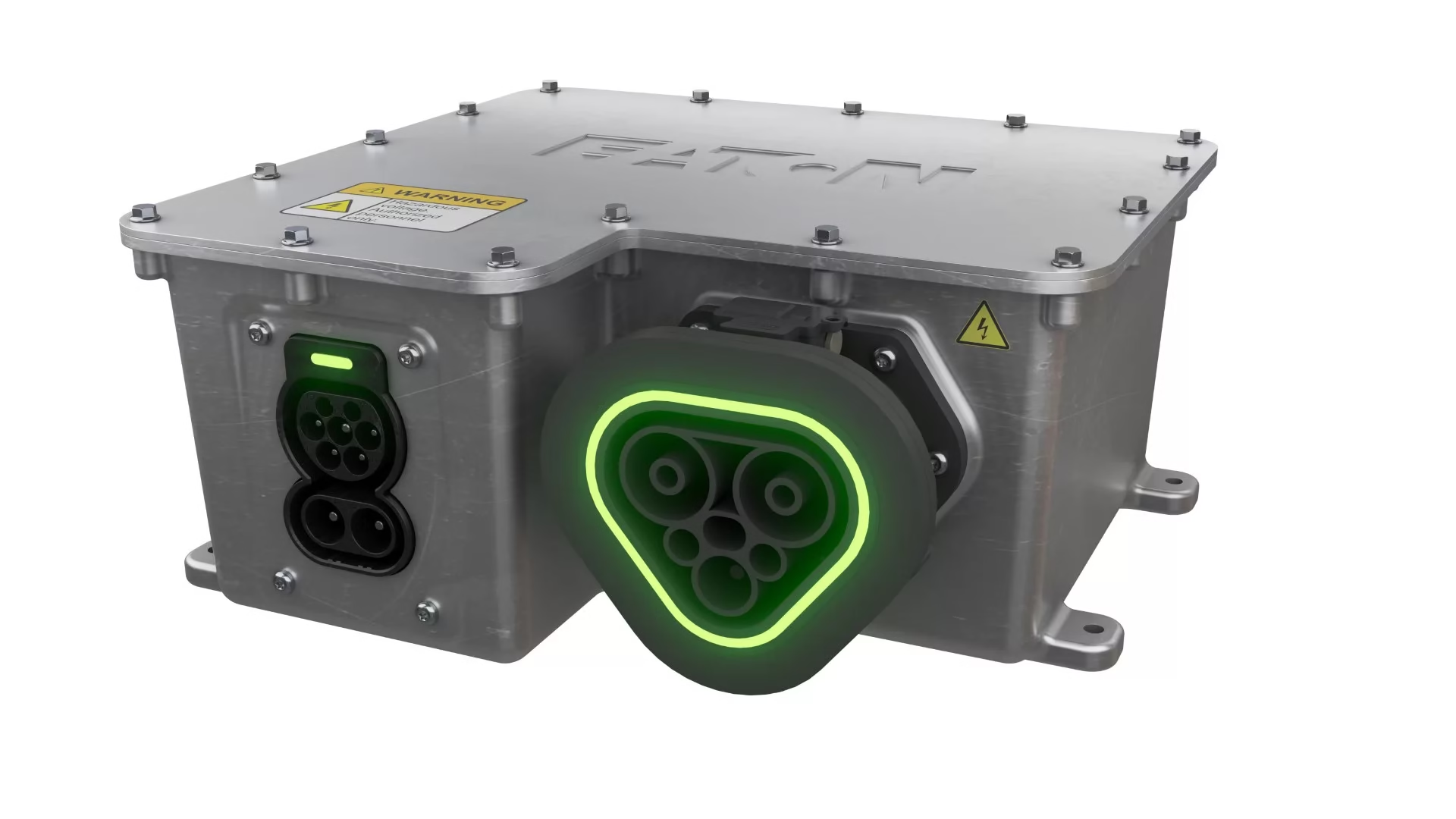

Eaton and Munich Electrification recently established a long-term alliance to design next-generation electric vehicle architecture. This strategic agreement merges durable mechanical hardware with highly advanced embedded computing systems. Automotive manufacturers can utilize these unified packages to reduce overall engineering complexity significantly. The cooperative project aims directly at improving passenger cars, heavy transport, and industrial machinery.
The engineering focus combines reliable circuit breaker mechanics with intelligent cell management programs. Both engineering teams seek to eliminate separate components inside modern battery packs. Merging these divisions lowers development expenses and mitigates critical vehicle development risks. Consequently, manufacturers can deploy high-voltage vehicle systems much faster than standard cycles.
High-Power Mega Charging and Voltage Standardization
Both enterprise groups are currently designing a new Combined Megawatt Charging System. This massive charging configuration safely delivers megawatt-level energy streams to heavy commercial trucks. The unified infrastructure remains fully backwards compatible with existing global charging standards. Operators can easily implement these systems into brand-new commercial vehicle fleets. Furthermore, fleet managers can execute straightforward retrofits on older vehicle models safely.
Engineers have simultaneously created an intelligent product called the battery configuration switch. This heavy-duty switcher changes battery topologies between 400-volt and 800-volt charging setups. The flexible electrical shifting permits vehicles to draw power from diverse grid chargers. Utilizing this hardware enables much faster replenishment times during long highway transit operations. Thus, heavy transportation networks can maintain strict delivery schedules without facing delays.
Intelligent Separation Systems for Next-Generation Electronics
A fundamental pillar of this project involves a formal preferred supplier layout. This agreement covers custom battery disconnect units and specialized charge box controllers. Eaton manufactures the primary electromechanical parts, smart distribution blocks, and robust connection terminals. Concurrently, Munich Electrification supplies the essential electronic boards and foundational software stacks. These digital platforms provide continuous insulation screening alongside rapid short-circuit tracking features.
The combination of Eaton’s electromechanical Breaktor technology and Munich Electrification’s ASIL D safety software creates a highly responsive, resettable protection matrix for high-voltage battery enclosures.
These advanced digital tools improve diagnostics while maximizing systemic safety during high-stress operation. The embedded programming protects vital vehicle electronics against sudden, destructive power surges. Rapid isolation sensing prevents hazardous electricity leaks from reaching the external chassis structure. As a result, the complete assembly achieves the highest automotive safety ratings.
Advanced Electronic Integration and Circuit Isolation Technology
The core architecture utilizes highly proprietary Eaton Breaktor circuit protection technology. This unique component effectively merges the best traits of traditional fuses and contactors. The integrated device can automatically reset itself immediately after clearing an electrical fault. Furthermore, the unit triggers independently during overcurrent anomalies or dangerous vehicle crash situations. This quick reaction protects expensive battery modules from permanent, severe thermal degradation.
The combined architecture simplifies the heavy internal wiring layout of the battery box. Eliminating traditional melting fuses removes the need for periodic manual parts replacement. The switching mechanism functions bidirectionally to control incoming and outgoing electrical energy streams. This versatile utility optimizes energy efficiency while lowering overall power distribution losses. Therefore, vehicle driving range increases without expanding the physical size of the battery.
Core Technical Offerings and System Components
- Eaton Breaktor Units: Resettable circuit protection hardware replacing standard vehicle fuses.
- Cell Monitoring Boards: High-precision data acquisition arrays checking voltage and heat levels.
- Battery Configuration Switches: Dynamically shifting hardware adjusting between 400V and 800V modes.
- Smart Charge Boxes: Secure power intake portals handling megawatt-level charging interfaces.
- Safety Software Stacks: Embedded software architectures reaching strict ASIL D safety compliance.
Comprehensive Battery Management and Global Grid Stabilization
Munich Electrification engineers construct highly adaptive platforms optimized for extreme electrical environments. Their technical portfolio delivers excellent measurement precision across expansive multi-cell layouts. The precise calculations track exact state-of-charge data throughout varying weather climates. Accurate operational information prevents deep cell discharging while extending overall pack life. Consequently, vehicle owners receive highly reliable driving range estimations during daily use.
| Unified Hardware-Software Safety Matrix | |
| Eaton Hardware Layer – Breaktor Protection Units – Smart Power Distribution – Bidirectional Switches | Munich Electrification Layer – ASIL D Safety Software Stacks – High-Precision Cell – Real-Time SoC/SoH Algorithms |
| System Benefits | |
| – Millisecond Fault Isolation | – Lower Structural Complexity |
| – Predictive Diagnostics | – Extended Battery Lifespan |
The technology group also services massive stationary battery energy storage systems globally. These stationary industrial systems operate at high potentials reaching up to 1500 volts. The storage modules help balance electrical grids during periods of high power demand. Integrating smart management software ensures reliable peak shaving for regional utility operators. Ultimately, this wide-ranging deployment accelerates the worldwide transition toward renewable energy.
Sources: Eaton, Munich Electrification