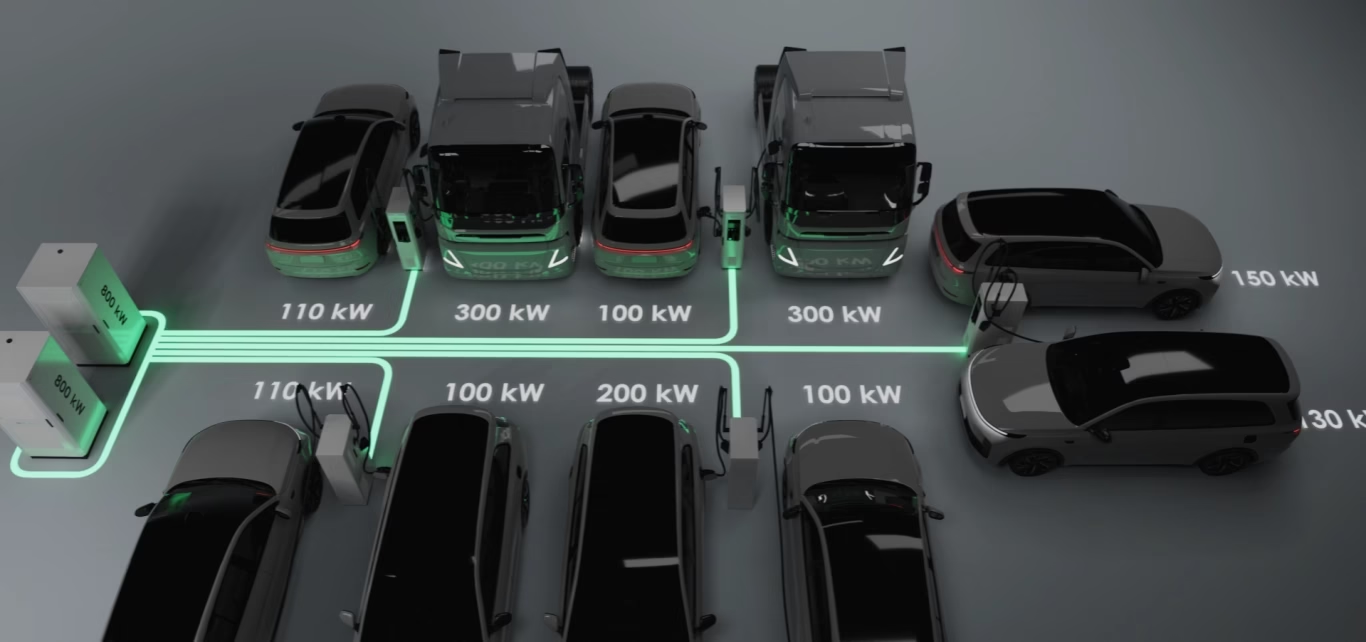

Efacec introduced a modular 1.6 MW Charging Hub for high-power electric vehicle applications. The platform targets fleets, heavy-duty vehicles, and high-traffic destinations. It combines scalable power, high availability, and flexible site configuration in one architecture.
Core Architecture and Power Design
The Charging Hub builds around 800 kW Modular Power Units. Operators can configure and expand capacity based on site-specific needs. Power modularity scales in precise 40 kW increments.
A single hub supports up to 16 DC charging outputs. This delivers high output density within a distributed architecture. Dispenser kiosks offer single or dual-connector options.
Four dispenser kiosk power ranges support continuous currents. Options include 2x 250 A, 2x 375 A, 2x 500 A, and 1x 700 A. Certified Active Boost Mode comes standard to optimize charging time.
The platform uses CCS connectors today. It is engineered to support future MCS deployment at 1000 V. This prepares sites for megawatt-class heavy-duty charging.
End-to-End MV-to-DC Integration
The Charging Hub can be delivered as a full MV-to-DC solution. This combines medium-voltage infrastructure, charging equipment, automation, and grid integration. Customers gain a single technology provider from grid connection to vehicle.
Efacec provides engineering support for grid assessment and analysis. This covers MV-to-DC integration up to 1.6 MW. Reduced supplier interfaces simplify project design and deployment.
The approach leverages Efacec’s broader energy value chain expertise. Medium-voltage equipment and automation come from in-house development. This ensures compatibility across electrical and digital layers.
EVCore Software Ecosystem
The hardware platform integrates with Efacec’s EVCore software ecosystem. This includes EVCore CPMS for charging management and EVCore LMS for load optimization. A new EVCore Asset Management platform supports monitoring and performance tracking.
Together, these tools help operators improve energy use and asset performance. They enable remote maintenance and data-driven operational efficiency. Open architecture allows integration with external systems.
Software features support dynamic load balancing across dispensers. This maximizes power utilization during peak demand periods. Asset analytics help plan maintenance and reduce downtime.
Key Technical Differentiators
Efacec highlights several features that distinguish this charging hub. Power modularity allows granular scaling in 40 kW steps. High output capacity delivers up to 16 DC outputs from one hub.
Flexible power ranges cover multiple vehicle types and use cases. End-to-end Efacec technology spans charging, MV infrastructure, and software. Integrated engineering support covers grid integration up to 1.6 MW.
Active Boost Mode enables temporary current increases. This reduces charging time without overprovisioning hardware. Future MCS readiness ensures long-term relevance for heavy-duty fleets.
Target Applications and Use Cases
The Charging Hub addresses fleet, heavy-duty, and high-traffic destination charging. Passenger cars and commercial vehicles can share the same infrastructure. Scalability supports phased deployment as demand grows.
High output density suits space-constrained urban sites. Distributed architecture allows kiosks to be placed across a parking area. This improves user experience and cable management.
Megawatt-class readiness aligns with emerging MCS standards. Heavy-duty trucks and buses will benefit from 1000 V compatibility. Fleet operators can plan long-term infrastructure roadmaps.
Development Background and Funding
Efacec developed the Charging Hub entirely in-house. The company draws on more than 15 years of electric mobility experience. Broader expertise across the energy value chain informed the design.
The project received support from the Alliance for the Energy Transition (56). Co-financing came from the Recovery and Resilience Plan (PRR) via the European Union. This underscores alignment with EU decarbonization goals. Efacec is owned by the German industrial group Mutares. Development took place at the company’s Matosinhos facility in Portugal.
High-Power Charging
High-power charging hubs are gaining traction across Europe and North America. Operators seek solutions that balance power density, scalability, and grid integration. Modular architectures reduce upfront costs and support incremental expansion.
Efacec’s 1.6 MW hub ranks among the highest-power distributed solutions available. Competing systems often cap at lower aggregate power or fewer dispensers. Integrated MV-to-DC offerings remain relatively rare in the market.
The focus on MCS readiness reflects industry momentum toward megawatt charging. Heavy-duty electrification requires infrastructure that can scale beyond 500 kW per dispenser. Efacec’s 1000 V preparation addresses this emerging need.
Sources: Efacec