
Battery developers need direct views inside cells during extreme events. Simulations and destructive tests cannot capture fast internal dynamics. Fraunhofer EMI now reveals those hidden processes in real time. The method supports safer cell designs for European automakers.
High‑speed X‑ray system architecture and capabilities
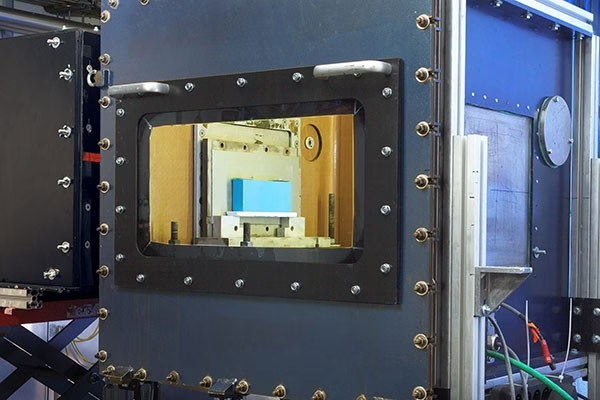
The system merges powerful X‑ray sources with a custom battery test chamber. It records up to 1,000 images per second with high spatial resolution. Sensors track temperature, pressure, voltage, and gas flow in parallel. This multi‑sensor fusion links internal visuals to external measurements.
Engineers can observe gas formation, material shifts, and crack growth. These events unfold within fractions of a second during thermal runaway. The chamber protects X‑ray hardware from heat, pressure, and ejected materials. That protection enables repeated, controlled abuse tests on large prismatic cells.
Real‑time visualization of thermal runaway and failure modes
Thermal runaway triggers rapid exothermic reactions inside lithium‑ion cells. External triggers include heat, mechanical abuse, or internal short circuits. The X‑ray system captures sidewall rupture and venting sequences in detail. Researchers see how failure initiates and propagates across cells.
In‑situ imaging reveals safety mechanism behavior such as CID activation. It also shows vent obstruction and terminal ejection during runaway. These visuals clarify why some designs fail sooner than others. Teams can then adjust vent paths, separators, and electrode layouts.
Integration with multi‑sensor data and simulation workflows
External sensors provide synchronized time stamps for each X‑ray frame. This alignment enables precise correlation of internal events with voltage drops. Pressure spikes and gas flow rates map to visible structural changes. The dataset becomes a ground truth for model calibration.
Simulation teams use these observations to refine thermal and mechanical models. They adjust material parameters until predictions match recorded sequences. This loop reduces uncertainty in pack‑level safety assessments. It also shortens certification cycles for new cell formats.
Industrial deployment with PowerCo and Volkswagen Group
Fraunhofer EMI partners with PowerCo to transfer the technology to industry. PowerCo is a Volkswagen Group company focused on cell production. The system will be installed at PowerCo’s Salzgitter site in 2028. It will operate as a modular platform for multiple cell formats.
PowerCo gains direct access to dynamic failure data from real cells. Engineers can optimize production cells with targeted safety improvements. The collaboration accelerates innovation from lab insights to factory lines. It also strengthens Europe’s battery technology ecosystem.
Applications across cell formats, chemistries, and pack designs
The platform scales to different prismatic, pouch, and cylindrical cells. It supports new chemistries as manufacturers iterate toward higher energy density. Modular design allows quick reconfiguration for varied test fixtures. This flexibility future‑proofs the investment for evolving portfolios.
Pack designers use the data to evaluate propagation barriers and cooling strategies. They test multi‑cell configurations under controlled abuse scenarios. Results inform spacing, vent routing, and structural reinforcement choices. These decisions directly impact pack safety and weight targets.
Benefits for safety certification and product development cycles
Certification bodies require robust evidence of safe failure behavior. In‑situ X‑ray videos provide clear, repeatable documentation of internal events. This evidence complements standard abuse tests and post‑mortem analysis. It reduces reliance on indirect inference from external measurements.
Development teams iterate faster with immediate visual feedback on design changes. They identify weak points before building large prototype batches. This approach cuts material waste and shortens test campaigns. It also improves confidence during regulatory reviews and customer audits.
Complementary diagnostics and related Fraunhofer capabilities
Fraunhofer institutes also explore synchrotron‑based 4D tomography for batteries. These methods achieve high temporal resolution at beamline facilities. They reveal microstructural changes during cycling and abuse events. Such insights support materials research and recycling processes.
Other diagnostic tools include ultrasound imaging for lithium plating detection. These methods operate non‑invasively during cell cycling. They complement X‑ray data by capturing electrochemical phenomena in real time. Together, they form a comprehensive toolkit for cell engineers.
Key technical features and outcomes
- Records up to 1,000 X‑ray images per second during cell failure.
- Captures gas formation, material displacement, and crack propagation.
- Synchronizes internal visuals with temperature, pressure, voltage, and gas flow.
- Protects X‑ray hardware with a heat‑resistant, gas‑tight test chamber.
- Supports multiple cell formats and new chemistries on a modular platform.
- Provides ground‑truth data for simulation model calibration and validation.
- Accelerates safety‑focused design iterations for European automotive programs.
- Enables clearer certification evidence through direct internal event documentation.
Sources: Fraunhofer EMI