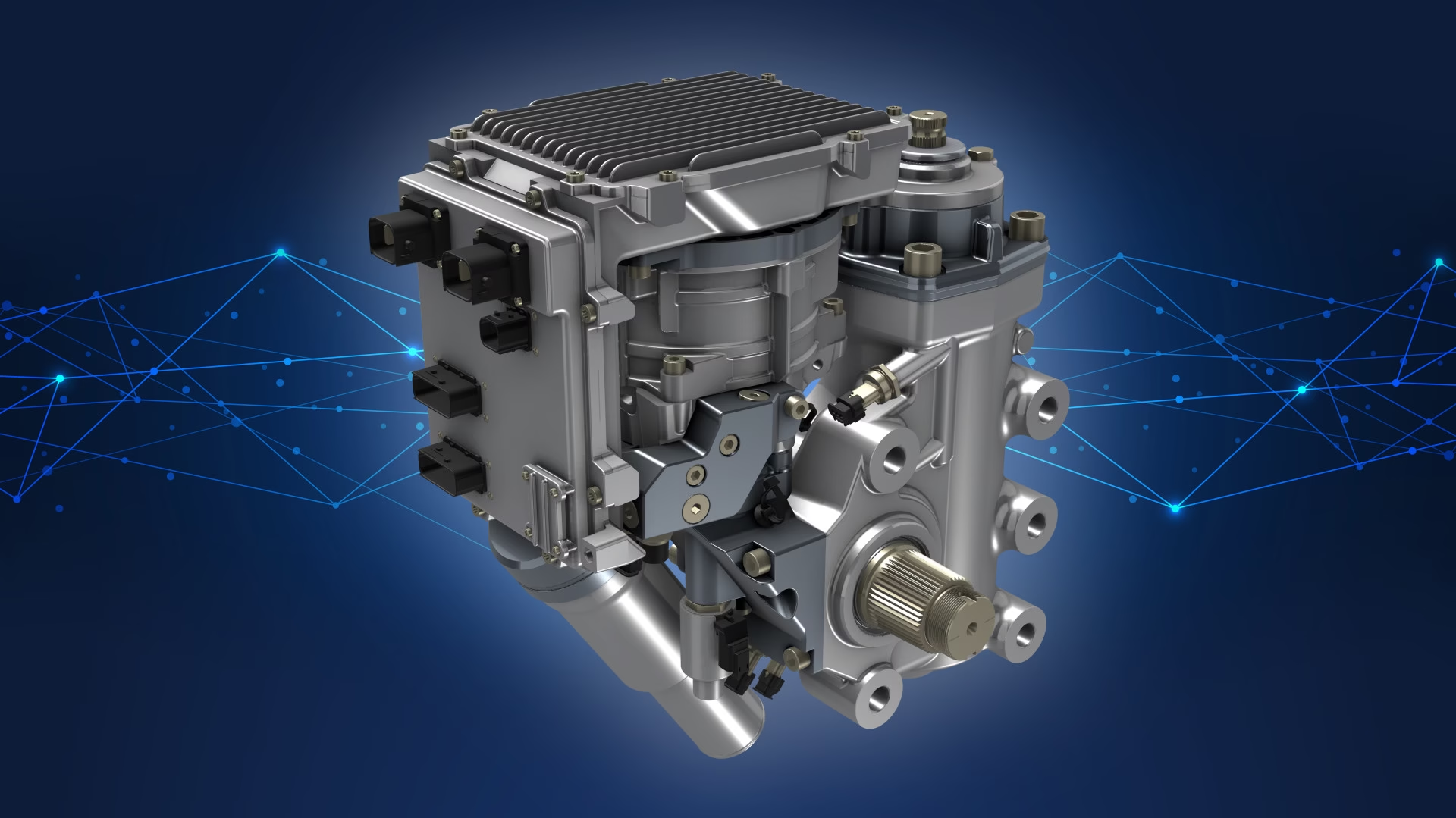

Knorr-Bremse is establishing new benchmarks in steering performance through its Electric Power Steering system. The EPS consumes energy only during active steering operations, making it highly efficient. This Asia-Pacific series order strengthens the company’s steering market position significantly. Production will begin in 2028 under the new customer agreement.
The system represents a true game-changer for heavy-duty commercial vehicles like trucks and buses. EPS delivers superior energy efficiency while reducing CO2 emissions across all powertrain technologies. Manufacturers can integrate it seamlessly into existing vehicle architectures without costly modifications.
Power-On-Demand Principle Drives Massive Energy Savings
The “power-on-demand” principle reduces fuel consumption regardless of the vehicle’s powertrain technology. EPS enables energy savings of up to 90 percent compared to conventional hydraulic steering systems. This efficiency booster also lowers operating costs substantially for commercial vehicle operators.
Relative energy consumption drops significantly since the system avoids constant hydraulic pump operation. Estimated fuel reductions reach around 0.2 liters per 100 kilometers in combustion vehicles. Electric platforms benefit from improved energy efficiency with savings up to 91 percent in single turning scenarios.
Lower CO2 emissions result directly from reduced energy consumption during operation. An average bus can reduce approximately 1,000 kilograms of CO2 per year using EPS. European commercial vehicle fleets could cut emissions by up to 5.8 million tonnes over ten years.
Seamless Integration and Smart Safety Features
EPS adapts to customer-specific installation spaces for flexible integration. The modular structure allows flexible component assembly across different vehicle classes. Manufacturers avoid costly packaging modifications since the system fits existing architectures.
The Smart Safety concept eliminates redundant power supply requirements, reducing manufacturing costs. EPS meets all regulatory requirements in global markets as a ready-to-use system solution. The system delivers pre-configured plug-and-play functionality for vehicle assembly lines.
Maintenance-free operation throughout the lifecycle reduces total ownership costs. No servo oil changes or wear part replacements are needed during operation. This sustainability feature contributes significantly to reduced operational expenses.
Key Advantages for Commercial Vehicle Operators
Knorr-Bremse’s EPS offers multiple benefits that reduce overall operating costs during operation. The system provides valuable driver assistance functions that increase driving comfort significantly. City buses particularly benefit from improved comfort at comparatively low operating speeds.
Road safety improves through enhanced steering precision and better vehicle control. EPS adjusts steering assistance according to vehicle speed, steering angle, and driver input. This precise control improves stability and maneuverability in demanding operating conditions.
The electric motor operates with minimal noise, contributing to improved driver comfort. Multi-axle vehicles receive hydraulic operating principle support across all vehicle classes. EPS can achieve steering forces up to 8.5 kNm in regular configurations.
Critical Enabler for E-Mobility and Automated Driving
“Our EPS is one of the key enablers for e-mobility and automated driving for commercial vehicles”.
Bernd Spies, Executive Board Member globally responsible for Commercial Vehicle Systems, emphasizes this strategic role. The additional series order proves innovations play decisive roles in shaping future mobility. EPS serves as a key enabling technology for advanced driver assistance systems.
The system supports SAE automation level L2 with modular expansion capacity for L4+. High responsiveness and redundancy-ready architecture make EPS a core actuator for automation. Electric power steering is regarded as essential for Highly Automated Driving implementations.
EPS forms the foundation for advanced driver assistance systems in commercial transport. The electric interface enables highly-automated driving with maximum security up to SAE-Level 4. This technology positions Knorr-Bremse as a leader in automated driving solutions.
Global Production Orders Demonstrate Technology Leadership
Knorr-Bremse now holds EPS production orders for commercial vehicles and buses in Europe and Asia. A previous multi-year project worth over EUR 300 million began supplying EPS systems in 2025. This first-for-the-group commission came from a top truck manufacturer for series production.
The company strengthened its position as one of the top three global commercial vehicle steering suppliers. Series production at Knorr-Bremse was slated for 2025, installing EPS in leading truck manufacturer fleets.
| Feature | Specification |
|---|---|
| Energy Savings | Up to 90% compared to hydraulic systems |
| Steering Force | Up to 8.5 kNm in regular configurations |
| Automation Support | SAE L2 with modular expansion to L4+ |
| Voltage Variant | 24V with optional 48V future capability |
| Output Torque | 8,800 newm for electrified vehicle weight needs |
| CO2 Reduction | ~1,000 kg per bus annually |
| Maintenance | Fully maintenance-free lifecycle |
EPS supports applications in all commercial vehicle categories through its modular approach. The system connects auxiliary hydraulic cylinders for extremely high front axle loads. Two driven front axles can utilize fully-integrated motor and pump control by ECU.
Sources: Knorr-Bremse