
Researchers at the University of Cambridge say a simple mechanical approach may extend EV battery life far more than chemistry tweaks usually do. Their study found that keeping lithium-ion cells under constant pressure can double lifespan in laboratory tests.
Why this matters
Battery developers often chase gains through new materials, additives, or cell chemistry. Cambridge’s result stands out because it shows that controlling stress inside the cell can produce a much larger effect than usual incremental improvements.
The practical importance is broad. Longer-lived batteries can delay replacement, reduce waste, and improve the economics of used EVs. They can also reduce the need for fresh raw materials, especially nickel and cobalt, which have high environmental costs.
What the researchers tested
The team studied commercial lithium-ion pouch cells rather than custom-made experimental batteries. That matters because the work shows a pathway that could be relevant to real EV hardware, not just a lab-only chemistry concept.
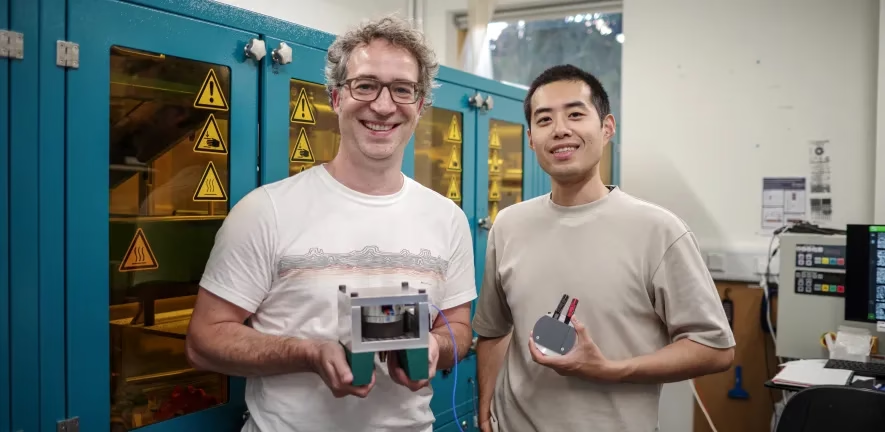
They used a custom device with pneumatic bellows to hold the battery under steady load during charge and discharge cycles. The bellows worked like a self-adjusting clamp, while sensors tracked tiny changes in battery volume as the cell expanded and contracted.
The researchers did not change the electrolyte or electrode recipe. Instead, they focused on stack pressure, which is the force compressing the layered parts of the cell together.
The pressure window
The study found a narrow operating range where the battery performed best. Cambridge described this as a “Goldilocks” zone, meaning the pressure had to be neither too low nor too high.
The optimal pressure was about 12.5 bar, which is roughly four times the standard pressure used in conventional coin cell batteries. Above that range, lithium plating could form on the anode. Below it, the cathode could crack more easily.
That balance is important because both failure modes shorten battery life. In other words, the cell needs enough compression to stay mechanically stable, but not so much that it creates new damage.
Mechanical stress in batteries
Lithium-ion batteries naturally expand and contract during cycling. As lithium ions move between the anode and cathode, the cell “breathes,” which creates repeated mechanical stress.
Cambridge’s work suggests that this stress is not just a side effect. It is a major factor in degradation, and it can be managed with mechanical design. That perspective is especially relevant for engineers who work on battery packs, modules, and thermal-mechanical integration.
The study therefore widens the usual battery discussion. It shows that electrochemistry alone does not explain durability, and it gives designers another lever to improve cycle life.
Environmental consequences
The environmental implications are significant. If batteries last longer, fewer packs need replacement, and fewer materials must be recycled or mined. Cambridge specifically linked this to lower pressure on nickel and cobalt supply chains.
That matters because battery recycling remains limited in practice. Cambridge’s researchers said the world is still “very bad at recycling batteries,” so extending service life can reduce strain before the recycling system fully catches up.
There is also a broader sustainability angle. A longer-lasting EV battery reduces the hidden footprint of vehicle production, especially when measured across the full life of the car.
Commercial potential
The concept has been proven only at laboratory scale, so the next step is engineering validation in larger and more complex battery systems. EV packs will need a practical way to maintain uniform pressure across many cells, under vibration, heat, and long-term wear.
Still, the idea is attractive because it does not require a new chemistry platform. If scaling works, manufacturers may be able to improve durability with packaging, compression hardware, and control systems rather than a full battery redesign.
Cambridge Enterprise has already filed a patent, which suggests the researchers see commercial potential. The study was published in Nature Energy and supported by the European Research Council, the Faraday Institution, and EPSRC.
Key takeaways
- Constant pressure may double EV battery life in lab testing.
- The best performance came at about 12.5 bar.
- Too much pressure can trigger lithium plating on the anode.
- Too little pressure can lead to cathode cracking.
- The method may reduce mining demand and recycling burdens.
Sources: Cambridge University