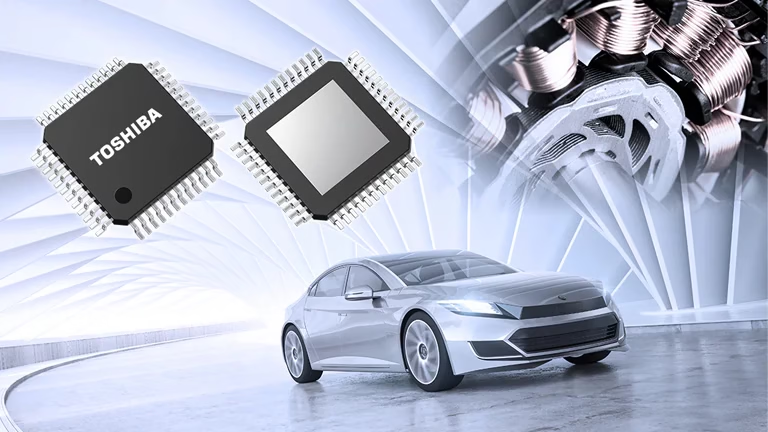

Toshiba Electronic Devices & Storage Corporation has begun shipping engineering samples of its latest “SmartMCD” series device, the TB9M030FG, for automotive brushless‑DC motor control. The part integrates a microcontroller (MCU) and a motor driver into a single 9×9 mm QFP48 package, targeting applications such as electric water and oil pumps, fans, and blowers. This move aligns with industry trends toward higher‑performance, more compact power electronics in battery‑driven and hybrid vehicles.
Integration of MCU and Motor Driver
The TB9M030FG combines an Arm Cortex‑M0–based 32‑bit MCU, flash memory, and a three‑phase gate driver for N‑channel power MOSFETs in one IC. It also includes a LIN transceiver and a power system that can operate directly from typical automotive battery voltages, easing level‑shifting on the board. This integration helps engineers reduce electronic‑control‑unit (ECU) footprint and component counts, which is critical as modern cars pack more ECUs into limited space.
By folding the MCU and motor driver into one device, Toshiba reduces gate‑driver‑to‑MCU parasitics and simplifies PCB layout with SmartMCD. Fewer discrete ICs mean fewer solder joints and connectors, which can improve reliability under harsh automotive temperature and vibration profiles. At the same time, built‑in AEC‑Q100 Grade‑0 qualification ensures the chip meets stringent automotive‑electronics reliability standards.
Sensorless Control from Zero Speed
A key advance in the TB9M030FG is its sensorless control technology for three‑phase brushless‑DC motors at low and zero speed. Conventional sensorless schemes often struggle with accurate rotor‑position detection when the motor is starting or crawling, yet Toshiba’s proprietary vector‑engine hardware and algorithms enable stable field‑oriented control (FOC) from standstill through the low‑speed range. This capability is especially useful for salient‑pole motors, where magnetic‑axis asymmetry supports torque‑by‑reluctance and improves sensorless detection.
The device avoids the noise associated with high‑frequency‑signal‑injection methods, which typically inject harmonic currents to infer rotor position. By eliminating these high‑frequency injections, TB9M030FG reduces electromagnetic interference and mechanical whine, so pumps and fans run more quietly. Quieter operation matters in luxury and electric vehicles, where cabin comfort strongly influences user perception of refinement.
On‑chip Vector Engine and Motor‑control Hardware
Built into the TB9M030FG is a dedicated vector engine (VE) that handles complex FOC computations in hardware rather than relying solely on the CPU. Programmable‑motor‑driver (PMD) blocks generate PWM patterns, manage current‑conduction timing, and detect faults, which sharply lowers software load on the Cortex‑M0 core. This hardware‑offload reduces the size and complexity of motor‑control code, making it easier for Tier‑1s and OEMs to maintain and update their in‑vehicle software stacks.
The chip also includes a 1‑shunt resistor current‑sense amplifier, plus 12‑bit and 10‑bit ADCs for precise current and voltage monitoring. On‑chip memory with ECC (error‑correction code) protects code and data integrity, supporting 1‑bit error correction and 2‑bit error detection. These features help prevent silent data corruption that could destabilize motor control, especially in safety‑related functions such as coolant‑pump health and thermal management.
Communication Flexibility and Safety Features
TB9M030FG supports multiple communication interfaces, including LIN with a one‑channel responder, UART, and SPI, as well as PWM‑based communication. This flexibility allows each ECU to choose the most appropriate protocol for its role, whether it is a simple pump node on a LIN bus or a more complex subsystem that uses SPI for higher‑speed data exchange. The unified interface set also simplifies integration with existing automotive communication architectures that mix LIN, CAN, and Ethernet‑based backbones.
On the safety side, the IC implements several built‑in error detections, such as under‑voltage and over‑voltage supervision, thermal shutdown, and overcurrent monitoring. It can also detect open or short faults in external power MOSFETs, helping to prevent catastrophic failures in motor‑drive stages. These integrated protections align with functional‑safety principles in automotive design, reducing the need for extra monitoring components while still supporting ASIL‑ready systems.
Huge Impact on Multiple Systems
Toshiba plans to expand the SmartMCD family with additional devices that address evolving automotive‑system requirements. The company expects this product line to help minimize board space and component counts across multiple motor‑control nodes, including pumps, fans, and auxiliary actuators. For automakers, that means smaller ECUs, lower assembly costs, and easier thermal management in densely packed engine‑bay or cabin modules.
Across the EV and hybrid marketplace, compact, quiet, and reliable motor‑control ICs are becoming as important as the main traction‑inverter components. Toshiba’s approach with the SmartMCD™ series fits into a broader industry shift toward highly integrated power‑semiconductor solutions that combine processing, isolation, and safety in a single package. As a result, TB9M030FG is positioned not only as a new motor‑driver IC, but as a platform element for next‑generation automotive electrification.