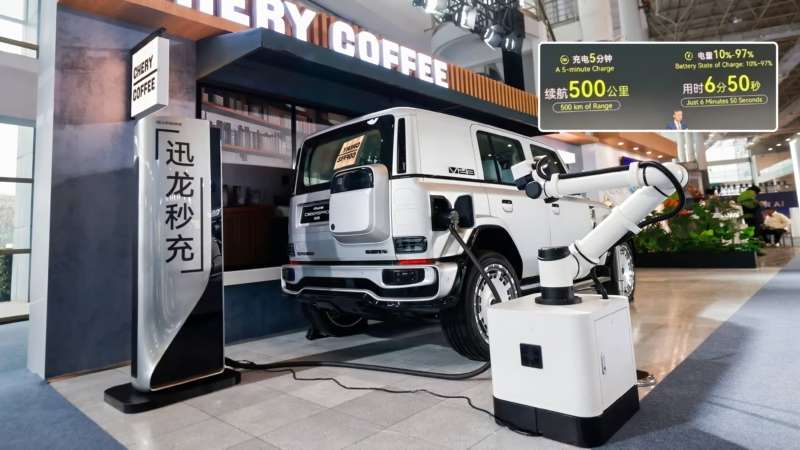

Chery has entered China’s intensifying megawatt-charging contest with Volt-dragon, an ultra-fast charging system rated at 1.44 MW peak power. The company says the technology can add 500 km of driving range in five minutes and replenish a battery from 10% to 97% in 6 minutes and 50 seconds.
The announcement came at the 2026 Chery Global Innovation Conference in Wuhu. Chery presented Volt-dragon alongside CheryMind, its domain-specific foundation model for physical AI, and its in-house Ziwei chips.
Volt-dragon is therefore more than a standalone charger. Chery positions it as part of an energy and mobility ecosystem that includes solar generation, stationary battery storage, bidirectional charging, autonomous driving, and robotics.
Chery Claims
Chery’s headline figure is 500 km of added range after five minutes of charging. The company also states that a more conservative scenario delivers the same range gain in eight minutes.
The claimed 10%-to-97% charging time is 6 minutes and 50 seconds. That places Volt-dragon behind CATL’s third-generation Shenxing system, which is reported to charge from 10% to 98% in 6 minutes and 27 seconds.
Chery has not yet identified the vehicle model, battery capacity, cell chemistry, or test conditions behind the five-minute range claim. This lack of detail makes direct comparison with rival systems difficult.
The company expects compatible vehicles to use 800 V architectures or even platforms above 1,000 V. High-voltage electrical architectures reduce current for a given power level, which can limit cable heating and support faster energy transfer.
How Volt-dragon Works
Volt-dragon uses Chery’s latest-generation silicon carbide power electronics. Chery claims a grid-to-plug system efficiency of 96.5%, meaning relatively little energy is lost between the electricity supply and the vehicle inlet.
Silicon carbide devices are important at megawatt power levels. They can operate at higher voltages and temperatures than conventional silicon components, while reducing switching losses and helping shrink power-conversion hardware.
The charging stations also employ immersion liquid cooling. This approach surrounds heat-generating components in a dielectric fluid, allowing more effective thermal management during sustained high-power operation.
Thermal control is central to ultra-fast charging. High current raises temperatures in power electronics, connectors, cables, and battery cells. Without active cooling, a charger may need to reduce output before the vehicle reaches a high state of charge.
Chery says the charging cable and connector together weigh 2 kg. A lighter cable can improve everyday usability, particularly at public stations where drivers handle the connector themselves.
The company also claims operating noise below 50 dBA. That is comparable with a normal conversation and could matter for charging sites close to residential areas, offices, or city-centre locations.
AI and CheryMind
Chery links Volt-dragon to CheryMind, a foundation model designed for physical AI. According to Chery, CheryMind and Ziwei chips support applications across robotics, autonomous mobility, electric aircraft, agriculture, and energy.
The company describes CheryMind as a system that understands the physical world. In the charging context, it is expected to help manage power delivery and battery conditions.
However, Chery has not published a detailed technical explanation of how CheryMind controls Volt-dragon. It has not clarified whether the model adjusts current, voltage, thermal limits, station load, or several variables at once.
Geely offers a clearer example of this approach. Its Xingrui PowerMind energy model reportedly predicts battery-cell temperature changes 30 seconds ahead and adjusts the maximum permitted charging power accordingly.
Chery’s announcement suggests a similar direction, but the available information remains high level. Independent validation of the AI’s effect on charging speed, battery ageing, and safety will therefore be important.
A Microgrid Approach
Chery demonstrated Volt-dragon with a vehicle-to-grid, or V2G, station. The demonstration combines solar generation, battery storage, and megawatt-level charging within a local microgrid.
In this arrangement, electric vehicles are not only energy consumers. Through bidirectional power flow, they can act as distributed storage assets and return electricity to the grid during periods of peak demand.
This model could help station operators manage grid connection costs and local power constraints. It could also support renewable-energy use by storing solar generation for later vehicle charging or grid export.
Chery says the concept has already shown commercial potential in Europe. At an electric heavy-truck facility in Spain, a solar-plus-storage microgrid replaced diesel generators and reduced operating costs.
The Spanish example is significant because it extends the technology beyond passenger cars. Heavy-duty fleets often have predictable routes, large energy demand, and space for on-site solar and storage systems.
V2G and Vehicle Role
Chery plans to launch V2G functionality globally in the first half of 2027. The first application is expected on the Fengyun A9 battery-electric model.
V2G could give owners a new source of value. A vehicle parked at a compatible station could sell electricity back to the grid when prices are high, then recharge when electricity is cheaper.
The concept also creates technical and commercial challenges. Vehicles need bidirectional power electronics, grid-compliant communication, cybersecurity protections, suitable tariffs, and clear rules for battery warranty and degradation.
Chery’s plan to combine V2G with ultra-fast charging is notable. Most current V2G projects focus on slower AC bidirectional charging, while Volt-dragon aims to connect that capability with megawatt-class DC infrastructure.
Rollout Plans
Chery says it will open 100 Volt-dragon stations in 10 Chinese cities. The company plans to reveal further expansion details before the end of 2026.
The longer-term target is more than 20,000 V2G-capable stations worldwide by 2029. Chery says the network will also include markets with developing electricity infrastructure.
That target is ambitious. It implies not only charger production, but also land acquisition, grid upgrades, energy-storage integration, maintenance capacity, payment systems, and local regulatory approval.
The first deployment locations reported in Chinese coverage include Shanghai, Guangzhou, Hefei, and Wuhu. These cities offer dense vehicle populations and strong industrial or policy support for new-energy infrastructure.
Competitive Position
China’s leading automakers and battery suppliers are competing to reduce charging times to below seven minutes. Chery’s claimed 6 minutes and 50 seconds places it near the front of that group.
| System | Claimed 10% to 97/98% time |
|---|---|
| CATL third-generation Shenxing | 6 minutes 27 seconds |
| Chery Volt-dragon | 6 minutes 50 seconds |
| Hongqi ultra-fast charging | 8 minutes 3 seconds |
| Geely Energee Golden Brick | 8 minutes 42 seconds |
| BYD Blade Battery 2.0 | 9 minutes |
Chery’s 1.44 MW peak power is lower than some competing megawatt systems, but peak power alone does not determine real-world charging speed. Battery acceptance, thermal conditions, state of charge, vehicle architecture, and grid supply all matter.
BYD has already deployed 10,000 Flash Charging stations and aims for 20,000 by the end of 2026. Chery’s 2029 target for 20,000 V2G-enabled stations therefore represents a later but broader energy-infrastructure goal.
Open Questions on Real-World Performance
Several important details are still missing. Chery has not disclosed the exact battery pack size, peak charging current, average charging power, cell supplier, or temperature range used in its tests.
The 500 km figure also depends on the test cycle and vehicle efficiency. A large, efficient sedan may gain 500 km with less energy than a heavier SUV or performance model.
Chery has not published performance data for extreme heat or cold. These conditions can substantially affect lithium-ion battery charging rates, especially when cells must be heated or cooled before accepting high power.
The company has also not explained how often a vehicle can repeat such fast charging without accelerating degradation. Repeated high-power sessions can raise cell temperatures and stress electrode materials, so long-term durability data will be essential.
Potential Industry Impact
Volt-dragon signals Chery’s intention to compete beyond vehicle sales. The company is building a connected system that links cars, charging hardware, renewable power, storage, AI, and grid services.
For drivers, the most visible benefit would be shorter stops. A five-minute charge adding hundreds of kilometres could make long-distance electric travel closer to the refuelling experience of a combustion vehicle.
For fleet operators, the more important benefit may be energy control. Solar generation, stationary storage, managed charging, and V2G export can reduce energy costs and improve resilience during grid disruptions.
For the wider EV market, Chery’s move confirms that megawatt charging is becoming a mainstream competitive field in China. The next test will be whether laboratory-style claims translate into reliable public-network performance.
Key Takeaways
- Chery’s Volt-dragon system has a claimed peak charging power of 1.44 MW.
- Chery says it can add 500 km of range in five minutes under favourable conditions.
- The claimed 10%-to-97% charging time is 6 minutes and 50 seconds.
- The system uses silicon carbide power electronics and immersion liquid cooling.
- Chery claims 96.5% grid-to-plug efficiency and a 2 kg cable-and-connector assembly.
- Volt-dragon is linked to CheryMind, the company’s physical-AI foundation model.
- Chery demonstrated a solar, storage, and V2G microgrid at the launch event.
- The company plans 100 stations in 10 Chinese cities before further expansion.
- Chery targets more than 20,000 V2G-enabled stations worldwide by 2029.
- Vehicle compatibility, battery details, climate performance, and durability data remain undisclosed.
Sources: CarNewsChina